Pool coping and paving: specifying stone for the wet edge
Why pool decks fail, why the finish decides slip resistance rather than the stone, what coping profiles do, and what a stone order needs on the drawing.
5 October 2026 · 10 min read · GranTerra Stone, Hui'an
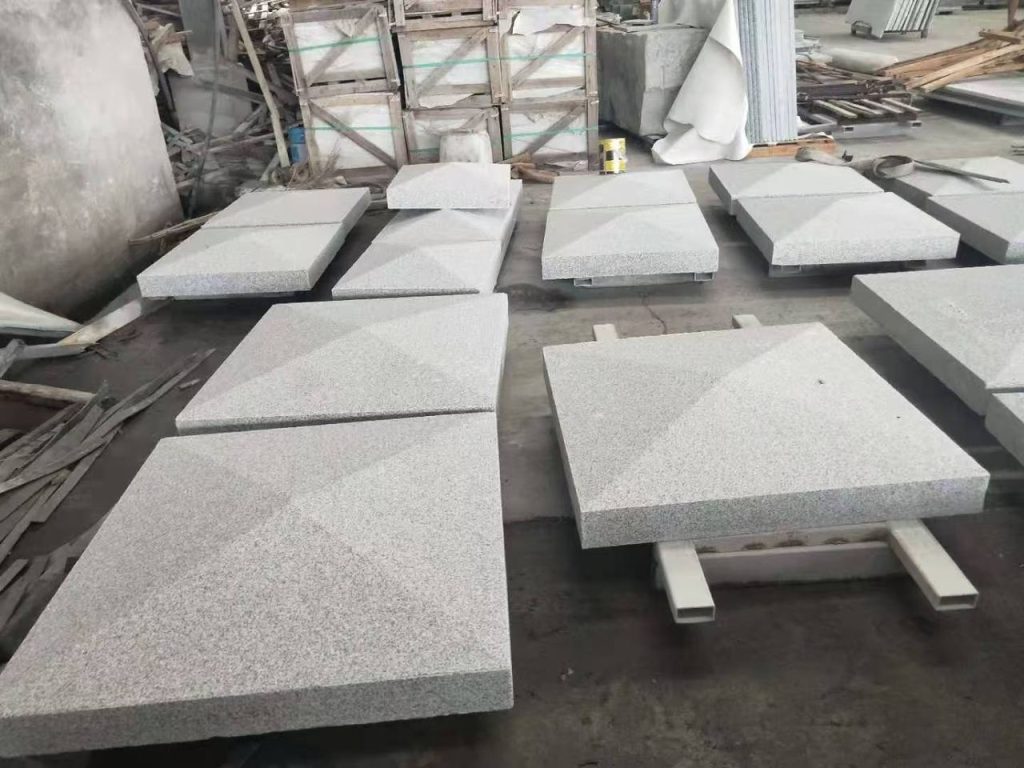
A pool deck is the only place in a project where stone is asked to be decorative, load-bearing, chemical-resistant and safe under a wet bare foot, all at the same time. Everything else in the building gets to pick two of those.
That is why the failures we get sent photographs of are almost never dramatic. They are a coping edge that has gone chalky after three summers. A deck that was perfectly matched on the pallet and visibly two different colours once it rained. A polished run of paving that a guest went over in bare feet at the shallow end. None of these are accidents. They are the predictable result of decisions made at specification stage, and every one of them is decided before the first block is cut.
Why pool decks punish stone
A stone surface beside water is doing six jobs at once, and the sixth one is the one that causes trouble.
- Water, permanently. Not splashes. A deck is wet at the edge most of the day and wet everywhere after rain. Anything that absorbs water is being asked to do so continuously rather than occasionally.
- Chemistry. Chlorine, salt, or both, at varying concentrations, on a surface that is also getting brushed and hosed.
- UV and heat. Dark stone in full sun reaches temperatures that are not comfortable to stand on, and the surface expands and contracts across every day of the year.
- Load. People, loungers, steps, trolleys, and the cleaning equipment that gets dragged across the edge.
- Bare feet. It is the only commercial surface where the safety requirement is being tested by someone with no shoes on.
- It never dries out underneath. This is the one that catches people. A coping sits over the pool wall and the bond line sits above a damp void. Water is present on the underside as well as the top, and moisture has no way to escape.
Indoors you can choose a surface for how it looks and accept a certain amount of maintenance. Outdoors, beside water, the maintenance decisions are made by the material and by the profile, not by the cleaning rota.
Most of the work we cut for this sits in the granite range — coping, kerbs, paving and steps — because that is what the material and the application have in common. The rest of this piece is about the decisions that come before the order.
Salt water, chlorine and freeze-thaw
Three things do the damage, and they are not equally important in every market.
Salt is the one that surprises people, because a salt pool still contains chlorine — the salt is simply the feedstock for it. What the salt does over time is migrate into any pore it can reach, and then crystallise as the water evaporates. A crystalline growth inside a pore pushes outward, and a surface that has been pushed outward from the inside eventually lets go of it. On a dense stone this is a very slow process. On an open, porous stone it is a visible one.
Chlorine attacks less than people expect at the surface and more than people expect at the joints and the sealers. Stone itself is largely indifferent to pool chemistry. What degrades is the sealer, the pointing, and any metal the water touches.
Freeze-thaw only matters if the deck actually freezes, but where it does, it is decisive. Water in a pore becomes ice, ice takes more space than water, and the pore loses. A material that holds a lot of water has a lot of places for that to happen.
The practical translation is a single number: how much water the stone takes in. Dense igneous material — granite, basalt, the dark fine-grained stones — takes on very little, which is why they turn up beside pools for decades rather than seasons. Sedimentary stone takes on more, and behaves accordingly. If you want the background on telling those families apart on a sample bench rather than on a spec sheet, we wrote that up in how to tell granite, basalt and porphyry apart.
Slip resistance is a surface decision
This is the part that gets specified by assumption more often than by measurement. The instinct is that slip resistance is a property of the stone. It is mostly a property of the finish.
Take one block of granite and split it four ways:
| Finish | How it is made | Beside a pool |
|---|---|---|
| Polished | Abrasive heads taken progressively finer until the surface reflects | Dry it is fine. Wet it is the wrong answer. Keep it for interiors |
| Honed | Fine abrasion with the gloss taken off, matt and smooth | Better than polished, still smooth. Depends entirely on the grain |
| Flamed | Surface heated hard and quenched, so the grains split and open | The default for wet areas. Open, grippy, and it does not look busy |
| Bush hammered | Mechanical impact that pits the surface | The most grip you can specify, and the roughest underfoot. Common on public decks |
Four finishes, four different surfaces, one stone. A specification that names the granite and not the finish has not actually specified the deck.
Australian projects usually want that expressed as a classification under AS 4586, and which classification applies depends on things only you know: whether the deck is covered or open, whether it is a private residence or a public pool, whether the wet area is the whole deck or only the strip beside the water. We can produce the surface needed to hit a target, but the target is a decision for the designer and the certifier, and we will say so rather than guess at it for you.
What a rough surface costs you
There is a second-order point here that is easy to miss: a heavy texture is not free. The rougher the surface, the harder it is to clean, the more it holds onto sunscreen and calcium, and the more of it you feel through a towel. On a domestic deck most people end up somewhere in the middle — a flamed surface, or a bush hammered edge with something smoother underfoot. If you want the full list of what we can produce and where each one belongs, that is on the finishes page, and we went through all seven in the seven granite finishes.
Coping profiles and what each one is for
Coping is the piece that does the actual work. It covers the pool wall, it takes the foot traffic at the water line, and it is the edge everybody looks at. The profile is not a style choice — it is what connects the deck to the pool shell, and it decides how the whole perimeter reads.
- Bullnose. A rounded edge, usually a half-round. The classic pool coping. No arris to chip, nothing sharp for a wet foot, and it takes a hand well when somebody is climbing out.
- Ogée. An S-shaped moulding that turns the water back. It reads as more formal, and it works where the coping is meant to be seen as a line.
- Straight or square edge. The simplest and the least forgiving, because it depends entirely on the cutting being accurate and the joint being tight. Where the whole perimeter is straight this is very clean.
- Rock face or split face. A natural broken edge. It suits a landscape project, but it is worth remembering that a rock face is also what you sit on and what a child grabs, so the profile matters as much as the appearance.
- Drop face and rebate. Profiles that turn down over the pool wall, so the coping covers the junction with the shell rather than sitting on top of it. This is where the detail has to come off the section drawing, not off a photograph.
The name is not the section
The single most common problem on a coping order is that the profile was agreed verbally as a name, and the name turns out to mean two different sections to two different people. It is worth looking at the section on the drawing rather than the word on the schedule. Every edge we cut under pool coping is made to the section you send rather than to a standard moulding, and the same applies to the coping and caps we hold for public and municipal work.
Where the deck and the coping have to agree
Coping and paving usually come off the same order, and they should come off the same block selection. Not because it is tidy, but because of what water does to colour.
Every stone gets darker when it is wet, and it does not get darker by the same amount. Two pieces from different block selections can look indistinguishable on a dry pallet and clearly different along the wet edge of a pool, where one is permanently damp and the other is only damp after rain. The place the difference shows is the place with the most attention on it.
The same logic applies to the finish. A flamed coping running into a polished deck is a deliberate contrast in the right project and a mistake in most others, because the two surfaces read as different materials once they are wet.
This is the reason we would rather quote a pool from a single drawing than from a list of pieces. The perimeter, the deck and the steps are one order, and the point of quoting them together is that the material, the colour and the batch can be held consistent across all of it — the deck included, whether it runs as kerbs and paving or as larger pieces.
What the plan has to show us
We cut to a drawing. On a pool project, that means the enquiry is really the plan, and these are the things on it that decide whether the quote is dependable:
- The section through the coping. The profile in cross-section, including how it turns down over the wall. A name is not enough; a section is unambiguous.
- The shape of the perimeter. Straight runs, radiused corners, or a free-form edge. Curves are cut to a template, and how many of them there are changes the work involved.
- Which areas are wet and which are dry. A covered terrace and an open deck beside the water can reasonably take different finishes.
- The stone, chosen from a sample. Colour is not something we can confirm from a screen. It is confirmed on a physical piece, and we would rather you hold one before anything is cut.
- The pool and the climate. Salt or chlorine, and whether the deck freezes. Both change what we would steer you away from.
- Timing and how it ships. Whether the order goes out as finished pieces or as slabs to be cut locally changes the packing, and the packing changes the date.
If you have a schedule rather than a set of drawings, send it anyway. We will tell you what is missing rather than quote around it. That is the same position we take on any order, and it is set out in how a stone order is quoted.
Send the plan
Send the section through the coping, the shape of the perimeter, and a note on whether the pool is salt or chlorine. If a sample has already been agreed on site, photograph it in daylight and tell us what it is.
We will come back with the stone we would use, the finish we would put on it for the wet edge, the profile we read from your section, and the questions that still need an answer before anything is cut. If the specification has a problem in it, we would rather raise it now than ship it.
Send us the drawing and we will tell you what we can hold to.
Every figure on this page comes from our own order sheets. Where something is a trade norm rather than a number we can hold, we say so — send a spec and we will confirm it against a real block before you commit.
More from the yard
Send the drawing. We do the rest.
Reply within one working day, in English or Chinese. Send a spec, a drawing or just a photo of the sample you are matching — we will tell you honestly whether we can hold it.
MOQ 1 × 20FT · FOB XIAMEN · SAMPLES IN 7 DAYS