Big Slabs
Small slabs for paving and modules, large slabs for worktops and cladding — both cut from the same block, so the colour matches.
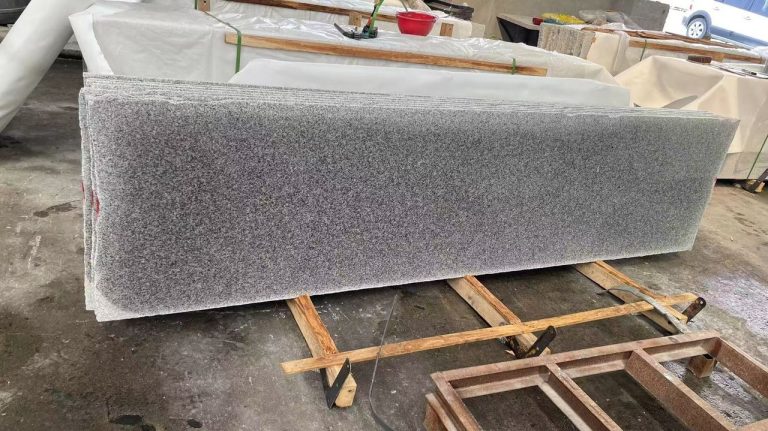
A granite big slab is a block sawn into a sheet: one face of stone, cut flat, then finished. What separates a small slab from a large one is not the stone — it is the block it came out of, the saw that cut it, and how much of it survives the saw. That is why the two are priced and specified differently, and why a buyer asking for "granite slabs" gets two different answers depending on which one they mean.
We cut both, from the same blocks, at our yard in Hui'an. Below is what each one is actually for, the sizes that hold in practice, and the point where a large slab stops being the right answer.
Small granite slabs — module paving, borders and set-piece cutting
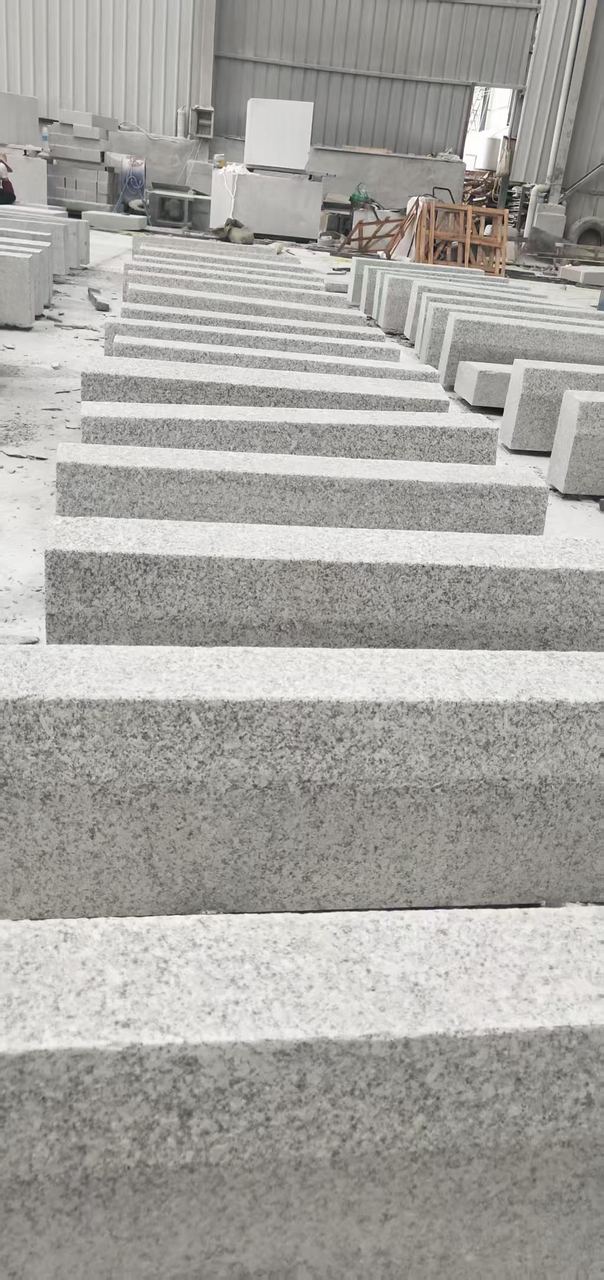
In the UK trade, "small" almost always means modules rather than sheets: 600×300, 600×600, 900×600, with 300×300 for banding. These are cut from the offcuts of a big slab, which is why they cost less per square metre — and why the colour is guaranteed to match the sheets in the same order, because it is the same block.
| Size (mm) | Typical use | What to watch |
|---|---|---|
| 600 × 300 | Paving in running bond, patios, garden paths | The workhorse module. 30 or 40 mm thickness for pedestrian use. |
| 600 × 600 | Single-size paving, thresholds, utility areas | Fewer site cuts than 600×300, but a flatter bedding layer matters more. |
| 900 × 600 | Paving, step treads, wide-format terraces | Needs a firm base — a 900 mm span will rock on a soft bed. |
| 300 × 300 | Borders, banding, infill between cobble sets | Cut from offcuts, so it is the cheapest way to add a second colour. |
The advantage of buying small slabs as modules rather than as sheets is tolerance. A 600×300 paving unit at ±1 mm length is a unit that lays with a consistent joint; a sheet cut down on site is not, because the site saw has no reference edge. If the drawing calls for a joint width, ask for it cut at the yard, not on the scaffold.
Large granite slabs — worktops, cladding panels and book-matched pairs
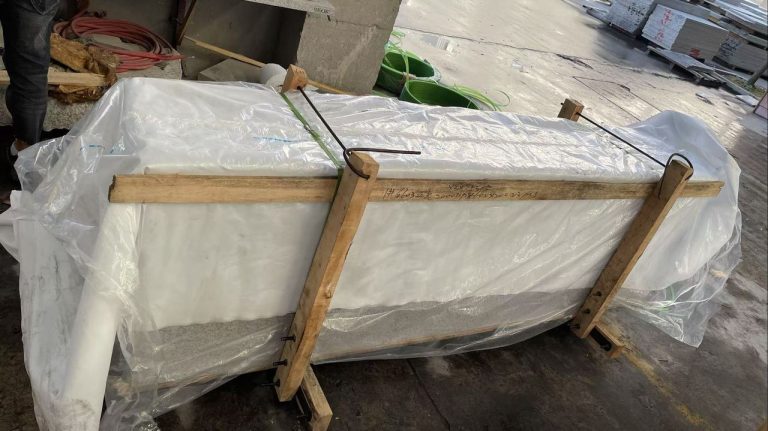
A large slab is the full sheet off the block. It is what you specify when the job has to read as one piece of stone: a kitchen run with no joint in it, a wall panel that lands on a shadow gap, a pair of surfaces matched across a corner.
| Size (mm) | Typical use | Weight at 20 mm |
|---|---|---|
| 2400 × 1200 | Worktops, islands, bar tops, table tops | ≈ 78 kg |
| 2800 × 1600 | Kitchen runs, interior wall cladding | ≈ 121 kg |
| 3000 × 1500 | Long worktops, waterfall ends, reception desks | ≈ 146 kg |
| 3200 × 1600 | Book-matched pairs, feature walls, headboards | ≈ 138 kg |
Those weights are not decoration. Granite runs at 2.70 g/cm³ for white, light grey, red and yellow; 2.85 for dark grey; 2.90–3.00 for black. At 20 mm that works out at roughly 54 kg per square metre for a light granite and 60 kg for a black one — which is the number that decides how many people it takes to carry a slab up a stair, and whether a two-man team can set it at all.
What actually limits the size you can get
- The block, not the saw. A slab can only be as long as the block it came out of. Standard blocks land around 2.6–3.2 m, which is why 3200 mm is the practical ceiling for a single-piece run and why anything longer is a joint, not a slab.
- Yield. A big slab with a flaw at one end still has to be sold as a flawed slab unless the flaw falls outside the cut. This is why "large granite slabs" quotes vary so much between suppliers for what looks like the same stone — one is quoting the slab, the other is quoting the usable area inside it.
- Thickness. 18, 20 and 30 mm are the standard bands. 20 mm is the default for worktops and interior cladding; 30 mm for anything that takes an exposed edge or a heavy load. We hold ±0.5 mm on thickness, ±1 mm on length and width, and flatness inside 0.3% — a figure you can check with a straight edge on arrival rather than taking on trust.
- Veining direction. A book-matched pair needs two slabs cut from the same run of the block, one either side of the saw. Ask for it before the block is opened, not after — once the block is cut the pair is gone.
Small and large from one order
Most of our projects are mixed. A kitchen order takes the large slabs; the paving, thresholds and skirting that finish the same room come from the offcuts of those slabs. Buying both from one lot is the only way to be certain the colour and the grain match across a joint, and it removes a second freight movement.
We ship mixed lines in one 20ft container as standard — a light granite at 20 mm loads around 350–400 m² per container depending on how the A-frames pack. If you are working to a site programme, tell us the phase dates when you send the drawing and we will sequence the container loads against it, rather than shipping everything at once.
What we need to quote small or large slabs
- The sizes and quantities, per line — either a cutting list or a drawing with dimensions.
- The colour family, or a photo of the sample you are matching to.
- Finish: polished, honed, flamed, leather or bush-hammered.
- Thickness and edge detail.
- Destination port, so the freight sits inside the price rather than beside it.
Send that and we come back line by line against your drawing, with the tolerance we can hold on each item — not a catalogue price against a size we do not actually have.
Big Slabs
What holds, and what we will not promise.
- Hardness
- Above 6 on the Mohs scale — takes a flame finish, resists scratching and weathering
- Density
- ≈2.70 white / light grey / red / yellow · 2.85 dark grey · 2.90–3.00 black
- Composition
- Quartz, feldspar and mica, formed under pressure and slow cooling
- Tolerance
- ±0.5 mm thickness, ±1 mm length and width, flatness inside 0.3%
- Typical use
- Exterior paving, courtyards, kerbs and steps, memorials, carving, interior tiles
- Minimum order
- 1 × 20ft container, mixed families allowed
Tolerances shown are our normal production bands. The number we actually work to is written on your confirmation sheet before production starts. Colour must be judged against your approved sample — slabs vary in veining, tone and batch.
Send the drawing. We do the rest.
Reply within one working day, in English or Chinese. Send a spec, a drawing or just a photo of the sample you are matching — we will tell you honestly whether we can hold it.
MOQ 1 × 20FT · FOB XIAMEN · SAMPLES IN 7 DAYS