Kerbs, setts and tactile paving: choosing stone that lasts outdoors
Kerbs, setts, slabs and tactile units do four different jobs. What each one needs from the specification, and what to settle before a hard-landscape order is cut.
8 October 2026 · 10 min read · GranTerra Stone, Hui'an
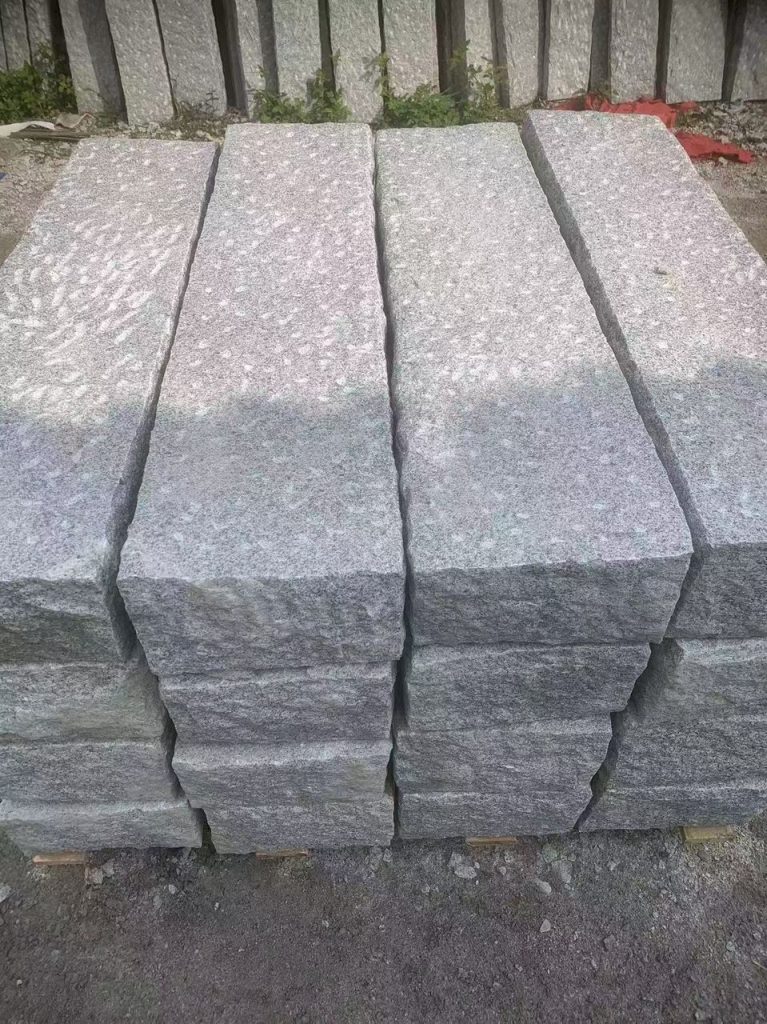
On a schedule of works, “paving” is one line. To the people laying it, it is four different products doing four different jobs, and most of the trouble on a hard-landscape scheme starts when a schedule treats them as interchangeable.
A kerb holds an edge against traffic. A sett carries turning vehicles and can be lifted out and replaced one piece at a time. A slab covers ground quickly and is chosen to look uninterrupted. A tactile unit exists to be felt underfoot, and fails its whole purpose if it sits a metre from where it belongs. Different loads, different ways of failing, different things to settle before anything is cut.
Four jobs wearing the same word
Take the four in turn and it becomes obvious why one word causes so much confusion. The loads are not comparable, so the units should not be specified as if they were.
Kerbs take lateral load. A wheel climbing them, a vehicle nudging them while turning, a snow plough catching them. Their job is to hold the structure behind them in place and to define the edge in a line a driver can read at speed.
Setts take vertical load in small packages. Because each unit is small, the surface can follow a curve, take a gradient and be opened up for a buried service without destroying a large area.
Slabs take load across a wide face. They are about speed of laying, fewer joints and a quiet, continuous surface.
Tactile units take almost no load at all. They carry information, and their correctness is entirely about position and layout.
Frame the order that way and the questions change. The kerb question is about section and how it is bedded. The sett question is about pattern and joint. The slab question is about base and joint width. The tactile question is about the drawing. The landscape and municipal range is organised along roughly those lines, which is why the categories look the way they do.
The kerb is a structural element, not a border
The commonest mistake on an enquiry is treating a kerb as decoration — a neat stone edge added after the road has been designed. It is the opposite. A kerb is the element that confines the pavement layers and stops the edge of the surfacing from unravelling. If it is under-specified, the road fails along its edge, and the whole surface has to be re-done long before the stone has worn out.
That is why kerb units are narrow and deep rather than flat and wide: they are working in the vertical direction. A deeper section buried further into the base does more of this work than a wider stone sitting on the surface.
What breaks kerbs is rarely abrasion. It is impact, and it is impact concentrated at a corner or at the point where a straight run meets a curve. Which leads to the item most often left off a schedule: the curved sections.
Radius kerbs are not the same product as straight kerbs bent on site. On a tight radius, standard straight units either splay open into visible gaps on the outer face or crush against each other on the inner one. Getting a clean curve means either units cut to the required chord along the arc, or purpose-made curved pieces. Both are producible, both change the price, and both need to be known at enquiry stage rather than improvised on the day the setter arrives. Send the radii and the arc lengths and this is straightforward; send “some curved kerbs” and somebody has to guess. Our granite kerb stones are cut against the scheme for exactly this reason.
Setts, cobbles and the small units that do the hard work
Small units are the oldest answer to a hard-wearing surface, and they are still the right answer in three specific situations: where traffic turns, where the ground has to be opened up again, and where the surface has to follow a shape that flat slabs cannot.
The engineering logic is the joint. A surface made of many small units is a surface made of many joints, and joints are flexible. They let the surface move slightly with what is underneath it instead of cracking. They also let water pass, which is why small units behave well on a slope and around drainage.
The trade-off is the same facts read the other way. More joints mean more places for weeds, more maintenance, more noise under a trolley, and a surface that is tiring to walk on if the units are laid proud of one another. A sett surface is a decision to accept maintenance in exchange for durability and repairability, and it should be taken deliberately.
One practical variant is worth knowing about: small units pre-faced onto a mesh backing. The units are set with the correct joint and spacing in the factory, then rolled out on site, which takes most of the labour and most of the inconsistency out of the laying. It is a good answer for a large area that needs the look of cobbles at a speed closer to slabs. The limit is the edges — a mesh panel is a rectangle, so curved boundaries and corners still have to be cut and finished by hand, and that work has to be allowed for. See cobbles on mesh for how the panels arrive, and decorative paving patterns for what happens when the layout, not just the unit, is the design.
Slabs, joints and what holds a surface level
Slabs are the fast answer, and for most public surfaces they are the right one. Fewer joints, a quieter surface underfoot, a cleaner line, and a lower labour cost per square metre. What they demand in exchange is a base that is genuinely consistent, because a slab has no joints to absorb inconsistency in what is under it.
The joint, again, is where the decisions live. Too narrow and there is nowhere for movement and water to go, so the units start spalling against each other. Too wide and the surface collects water and debris and stops reading as a continuous plane. The right answer depends on exposure, gradient and what the surface is bedded onto, and it is a specification decision rather than a site one.
Where a scheme is wet for much of the year, or freezes, the joint becomes the most important detail on the drawing. That discussion belongs with the one in specifying stone for a wet edge, because the mechanics are the same: water has to leave, and the surface has to stay put while it does.
The other option worth pricing on a large scheme is stone supplied cut to the layout rather than as standard units cut on site. Cut-to-size paving arrives ready to lay: no site cutting, no waste pile, no dust, and a much shorter programme. It costs more at the quarry and less on site, and on a tight urban programme the second number usually wins. The cut-to-size range is the place to start if that is the direction you are heading.
Tactile paving is a layout decision
Tactile units are the one part of a paving scheme where the stone is almost incidental. The unit is simply the material that carries a texture; the design work is where the textures go.
The logic is simple once it is stated. Some units warn — this is a crossing, a hazard, a change of level, stop here and check. Others direct — this way, keep going, the route continues. A person using them underfoot or with a cane is reading a message, and the message only works if it is continuous and if it lines up with the thing it is describing.
That is why a tactile layout that is merely “in roughly the right area” is worse than useless: it misdirects. A warning surface set back from the kerb tells someone the road is further away than it is. A direction strip that stops short of the crossing leaves them at the kerb with nothing to follow. Neither is a stone problem and neither can be fixed by choosing a better granite.
What we need is therefore a layout, not a quantity. Where each type of unit starts and stops, how it relates to the kerb line and the crossing, and whether it has to run continuously across a junction. Colour matters here too, but as a contrast decision rather than a decorative one — the surface is meant to be distinguishable from what surrounds it. We make granite tactile paving in the surface patterns each function requires, and the tactile paving category shows what those look like; the placement is the part only the scheme can answer.
What the specification has to fix before we cut
Most of the cost and almost all of the delay on a paving order comes from four things that were not settled early. None of them is difficult, and all of them are cheaper to answer at enquiry than after production has started.
The surface finish, per unit type. A kerb face, a sett and a paving slab in the same scheme rarely want the same finish, and the finish decides both how the stone reads and how it behaves underfoot. Flamed, honed, bush-hammered and sawn faces all age differently and all price differently. The finishes page is the short version; the materials page covers how the stone itself varies, which matters more on a large area than on a small one.
The curves and the corners. Every radius, and the arc length of it. This single item is responsible for more mid-project price changes than anything else on a landscape order.
The joints and the pattern. Whether the units are laid to a pattern, what the joint width is to be, and what is being used to fill it. A pattern is a production instruction, not a site instruction: if the units have to be selected or packed in a particular order to make the layout work, we need the layout.
How it travels and how it lands. Stone is heavy, and weight dictates the crate, the pallet and the lifting plan. A unit size that is perfectly sensible on a drawing can be unmanageable on a pallet or impossible to move across a finished surface without damaging it. The factory and export page shows how our orders are cut, checked and packed; the packing is designed around the site, not around the quarry.
The general principle behind all four is cutting to your drawing rather than to a stock list. On a public scheme there is almost never a standard unit that fits everything, and pretending otherwise is how a scheme ends up being cut twice.
Send the scheme
Send the layout, the radii, the unit types and the finishes, and we will tell you what we would change before the first block is sawn. If the design is still moving, send what you have — a plan with the curves marked is more useful than a finished schedule without them.
If you are working on the wet end of a scheme, the pool edge, coping and paving covers the part of this problem that water makes worse. Our product range shows the units we cut, and send the list is where an order starts. What we would rather do is ask the awkward question at quotation stage than answer it after the stone is on a ship.
Every figure on this page comes from our own order sheets. Where something is a trade norm rather than a number we can hold, we say so — send a spec and we will confirm it against a real block before you commit.
More from the yard

Send the drawing. We do the rest.
Reply within one working day, in English or Chinese. Send a spec, a drawing or just a photo of the sample you are matching — we will tell you honestly whether we can hold it.
MOQ 1 × 20FT · FOB XIAMEN · SAMPLES IN 7 DAYS