Vessel, undermount or pedestal: choosing a stone basin that survives a hotel
Water does not care which basin you chose. Vessel, undermount and pedestal are three different routes for it, and each one fails somewhere different. Here is what to settle on the order before the saw starts.
4 October 2026 · 9 min read · GranTerra Stone, Hui'an
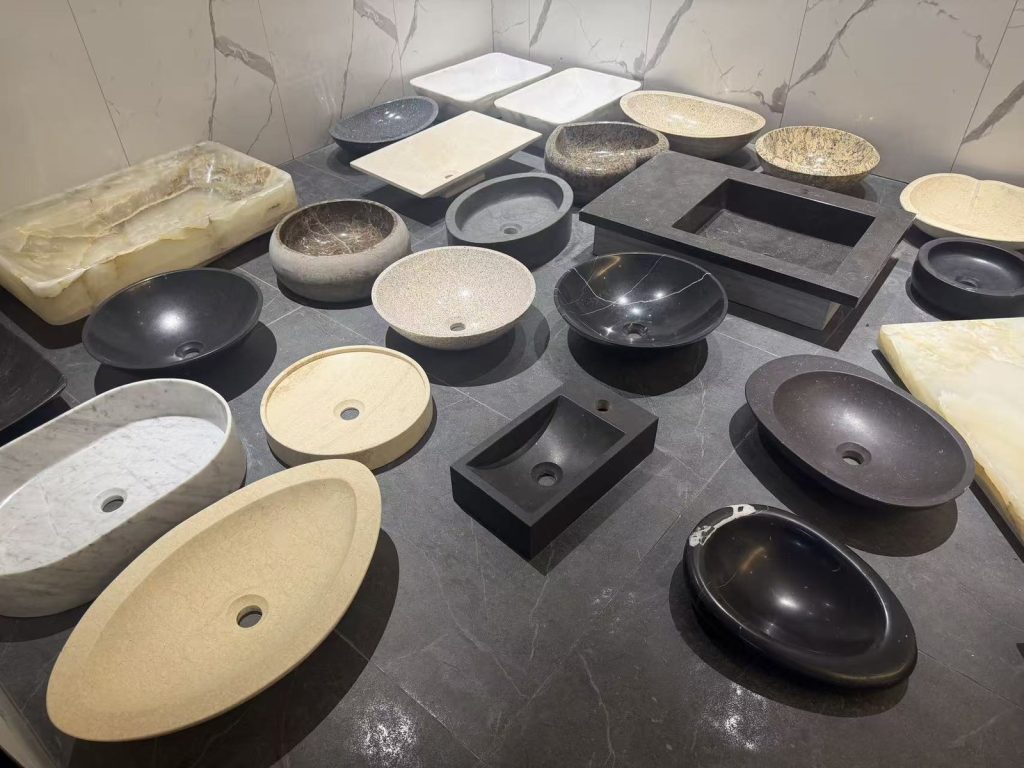
Three hotel bathrooms, three stone basins, and the same complaint eighteen months later: water where water should not be. The fitting decides that long before the basin does.
Vessel, undermount and pedestal are not three styles of one product. They are three different routes for water, and each one fails somewhere different. Below: where the water goes, what each fitting asks of the counter and the floor, and what is worth pinning down on the order before the saw starts.
Three ways to set a basin in stone
Vessel. The bowl sits on top of the deck, with the waste running down through a hole cut in the stone. Nothing is concealed and nothing is protected. The whole object is exposed to a wet hand at two in the morning, and every drop that leaves the rim lands on your counter.
Undermount. The bowl hangs below the stone and the deck overhangs it, so what you see from the doorway is the cut edge of the stone rather than the bowl. Water that misses the bowl lands on the deck and has to be pushed back over that edge — never into it.
Pedestal. The bowl stands on a column that also hides the waste and the supply. The counter is freed completely, which is the whole point of it, and both the load and the plumbing move down into that column.
Where the water actually ends up
Each fitting has a predictable failure point, and it is set by geometry rather than by price, brand, or how good the stone is.
| Fitting | Where the water travels | What goes first | Settle it at drawing stage |
|---|---|---|---|
| Vessel | Over the rim, across the deck, down the back | The deck behind the bowl, then the joint against the cabinet or the wall | Deck depth behind the bowl, and somewhere for the water to leave the deck |
| Undermount | Onto the deck, and into the seam between stone and bowl | The cut edge, which stays damp all day and is the one edge nobody polishes | Whether the stone can hold a fine edge, and what the bathroom is cleaned with |
| Pedestal | Off the bowl, down the column, onto the floor | Where the column meets the floor, and the waste run inside it | The floor structure, and whether the waste can drop straight or has to travel sideways |
None of those three failures is a manufacturing fault. All three are what happens when a fitting meets a room that was not drawn around it — and all three are decided on paper, well before anyone lifts a basin.
What each fitting asks of the counter
A vessel basin puts its whole weight on the deck, in the middle of a span rather than at the edges. A counter stiff enough for a tap is not automatically stiff enough for a stone bowl standing on it, and a deck that flexes will eventually tell you about it at the joint around the waste. A round, oval or boat bowl sits quite differently on the same deck, so the shape is part of the structure question, not just the styling one.
An undermount makes the stone itself the load path, and the cut edge is the part that stays wet all day. That is why we will ask about the cleaning routine before we confirm the edge on something like an undermount Carrara bowl. A fine unpolished edge on a stone that cannot hold one will spall at the rim, and it will do it slowly enough that nobody notices until the trap starts to smell.
A pedestal takes the counter out of the argument and moves the pressure to two other places: the floor and the waste run. On a suspended timber floor, or where the waste has to travel sideways before it drops, the column is where the problem will show. See a pedestal bowl and a matching column sitting separately — worth drawing together before you choose.
The load question nobody asks at sample stage
A stone basin is a dense object. What decides whether it stays where you put it is not the bowl, it is the bracket, the deck or the floor underneath it. Three questions worth answering early:
- What is the counter built from, and is there support directly under the bowl rather than only along the front edge?
- What is behind the finished wall, where the basin and the tap are fixed?
- Is the floor a slab, or a suspended deck?
We cut and finish the basin. The fixing is on your side of the line, and the earlier we know the structure, the more useful our answer is — including when the honest answer is that a heavy bowl wants a different fitting.
The finish has to survive the housekeeping trolley
The finish you approve on a brochure page becomes the finish your housekeeping team lives with, and the two do not always want the same thing.
A honed face hides water marks and does not show scratches or etches the way a polish does, which is why it is the usual answer in a wet room — a honed rectangular bowl or a honed round one both read calm after years of daily use. A polished face is easier to wipe and looks sharper on arrival, but on the softer stones it will etch the first time an acidic cleaner is left to sit, and the etch does not come out — as on a black granite bowl, where a polish is genuinely the right answer because granite resists the acid that marble does not.
Neither finish is wrong. Choosing one from a photograph is. Look at the finish on a physical piece, in the light the room will actually have — the same discipline we ask for in colour and sample approval. The finishes themselves are set out in the seven granite finishes, and the working list sits on the finish page.
Where the soap goes, and where the drip line lands
Two things go missing from almost every drawing we receive. The first is which side the soap and the towel are on: a deck drilled for a tap but not for accessories ends up with a bottle balanced on top of it, or drilled twice. The second is where the drip lands when a guest steps away wet. On a vessel that is the deck in front of the bowl. On a pedestal it is the floor, roughly where a bare foot arrives.
Send the room, not just the basin. A sketch of the elevation with the door swing, the mirror and the towel rail on it tells us more than a photograph of a bowl you liked. If the room also has a stone top, the two are best drawn in the same conversation — see vanity tops and tops cut for a specific basin.
Six lines for the order
Before the saw is set up, these are the six things that change the outcome. None of them is a dimension — they are decisions.
| Clause | Why it moves the cut |
|---|---|
| The fitting, named | Vessel, undermount and pedestal share almost nothing at the machining stage |
| A drawing or template, not a photo | A photograph gives us a look. A template gives us a bowl that fits the hole |
| Waste and supply positions | Set before the saw starts, or not at all; moving them later is a new piece |
| The finish you approved, on a real sample | Honed and polished are the same stone and a different room to live in |
| The destination market and the cleaning regime | Decides what we will and will not put a fine edge on |
| The structure behind and beneath | Tells us whether a heavy bowl is the right call, or a lighter one is |
We cut to your drawing, to your template or to your order. Where a tolerance or a shape cannot be held, you will hear it while the drawing is still editable, not once the crates are nailed shut. Finding that out at quoting stage costs a phone call; finding it out on site costs a re-order. The same principle runs through how a stone order is quoted and which rock you are actually being quoted.
Two of the pieces on this page are worth looking at side by side before you decide anything: a rectangular travertine bowl and its round counterpart are cut from the same family, and they behave differently on the same deck. Accessories are worth ordering with the basin so the deck is drilled once. Send us the room on the quote form, or work from the bathware range if you already know the shape you want.
Questions we get asked
Can a stone basin be drilled for a tap on the bowl instead of on the deck?
On a vessel, yes — and it changes the deck because the tap and the bowl become one object to fix. On an undermount it cannot, because the stone would be drilled through the piece the water is meant to run across. Tell us which you want while the drawing is still open, because the two are not interchangeable afterwards.
Which fitting is best for a rented or serviced apartment bathroom?
Usually a pedestal, for an unexpected reason: nothing is fixed to the counter, so a damaged bowl is a swap rather than a joinery job. The trade-off is that the waste run inside the column has to be planned, not improvised.
Will two basins from the same order match each other?
Two bowls cut from one block will hold together in daylight. Two bowls cut in different weeks from different blocks may not, even under the same colour name. If matching matters, say so on the order and we will cut them as one run rather than as two.
Do you cut to a template we supply?
Yes — that is the normal case for an undermount, and for a vessel where the deck is already made. Send the template with the waste and supply positions marked, and we will confirm what we can hold before anything is cut.
Every figure on this page comes from our own order sheets. Where something is a trade norm rather than a number we can hold, we say so — send a spec and we will confirm it against a real block before you commit.
More from the yard
Send the drawing. We do the rest.
Reply within one working day, in English or Chinese. Send a spec, a drawing or just a photo of the sample you are matching — we will tell you honestly whether we can hold it.
MOQ 1 × 20FT · FOB XIAMEN · SAMPLES IN 7 DAYS