Carved stone objects: why the block sets the limit
A carved object is the one product where the stone is the shape, not a surface on it. Why the block, not the drawing, sets the limit, and the four things the sketch has to fix.
9 October 2026 · 10 min read · GranTerra Stone, Hui'an

Almost everything we sell is a surface. A slab is a face. A worktop is a thickness with a finish on it. A paving unit is a top you walk on. In all of those the order of events is the same: you choose a material, your drawing decides the shape, and we cut to it.
One part of the catalogue does not work that way. A carved object — a sphere, a bollard, a bowl, a planter, a table base — is not a surface on stone. It is the stone. There is nothing fixed on top of it and nothing around it to hide what it is made of, and no drawing can produce a shape the block is not willing to give up.
That one difference is behind most of the questions we get about this line, and behind most of the surprises. Here is what actually decides whether a carved piece works.
The stone is not a surface here
On a countertop the conversation is straightforward: which stone, which finish, which edge. Colour lives on a face you can approve, and the drawing is the difficult part.
On a carved object the priorities reverse. The stone wraps around the form, so the figure — the colour and the veining — travels over it instead of sitting on one flat face you can sign off. The finish goes onto every surface at once, including the underside, because there is no hidden back to leave rough. And the shape is limited by what came out of the quarry rather than by what a machine can hold.
Two things follow from that immediately. A matched pair of spheres can only be matched by block — the only way to make two look alike is to cut them from the same piece, which is why a photograph of last year’s pair is not much help in matching this year’s. And the small end of the line, the bowls, trays and boxes in the carved décor collection, is the same discipline at a smaller scale: a bowl with a drain and a table with an eased edge are both settled before the first cut, not during it.
Two jobs that look the same: directing and stopping
Bollards are the clearest example in this line of a product where the important decision is invisible, so it is worth stating plainly.
There are two kinds. A directing bollard marks an edge — it tells a driver where the paving ends and a person where to walk. A stopping bollard resists a vehicle. From a few metres away they look identical, and on a drawing they are often the same symbol.
The difference is not in the stone. It is in what is under it and inside it: the footing, the reinforcement, and whether the thing is tied into a foundation rather than bedded on one. Stone is the wrong material to improvise protection from, because it is strong in compression and brittle in impact. It will take the load it was designed for and shatter against a load it was not.
So we will tell you which of the two a carved stone bollard does, and we will not dress a directing bollard up as a stopping one by making its face straighter. If your scheme needs a rated protective line, that is an engineered assembly with a different supply chain, and saying so at enquiry costs nothing. Discovering it after installation costs rather more. Our fence posts and bollards sit in the same family as the rest of that line.
The block sets the ceiling, not the drawing
A drawing can ask for anything. A block cannot supply anything, and on carved work that asymmetry is the whole game.
A sphere is the least forgiving shape in stone. It has to come out of a block larger than itself in every direction, and that block has to be sound all the way through — because a fissure that a slab would hide on one face runs straight through the middle of a sphere and will find the polisher, or the installer, eventually. The ceiling on round work is therefore a property of the quarry rather than of our machines. When you ask for bigger, we either find a block or we say no, and we say no more often than people expect.
The same applies to elongated forms. A tall slender piece is not a thin piece of stone; it is a piece of stone with a grain direction, and it wants to be cut with that direction and not across it. Read the block the wrong way and you get a table base that rings true in the workshop and splits in a cold store.
And when the block is not there, there is a second answer: build the form from segments and dress it until the joints are tight. It will be round, and it will be the size that was asked for. It will also have a joint, and on polished stone a joint catches light in a way that nothing hides. That is a reasonable trade on a large planter, where the eye is at a distance and the surface is broken up anyway. It is a bad trade on the object in the middle of a lobby. If a piece will be looked at closely, say so, and we will price the block rather than the assembly. The honed sphere and the sphere sets on stands are both cut from one block per piece; both sit in the spheres and bollards range.
Hollow, solid, and where water gets in
Hollowing is the decision that looks like a manufacturing detail and behaves like a design one.
Solid is the honest answer for small pieces — a bowl, a tray, a sphere. It is also the wrong answer for anything a plant will live in, because a planted container is a wet container. Hollowing saves weight, and weight is what you pay for twice: once in freight and once in handling on site. But a hollow object has a wall, a wall has two surfaces, and any enclosed space outdoors will collect water.
Water in a sealed void does one of two things in a climate that freezes. It expands, and it splits the piece along the weakest plane — usually the joint, or the thinnest part of the wall, and usually in the second winter rather than the first, so it does not present as a defect when it happens. Where it does not freeze it sits, and standing water stains stone from the inside, which is not a mark anyone can polish out.
So every hollow object leaves the workshop with a way for water to get out and air to move through. A planter gets a drain through the base. A covered piece gets a vent. And if a design arrives with a cavity sealed on all sides, we will ask where the water goes; if the honest answer is nowhere, we will propose a change rather than build it. The carved bowl and planter is the two ends of that in one form — same outside, different inside.
The base is where a carved object fails
Carving is not where these objects fail. The base is.
A sphere on a stand, a bollard set into paving, a planter standing on a terrace: each of them meets the ground somewhere, and that meeting point is where the trouble starts. A sphere that is simply placed will roll. A bollard bedded too shallow will lean, and then it will always have leaned. A planter sitting flat on a slab traps water underneath and stains the paving around it, which is a mark on the floor rather than on the object — somebody else’s problem, until it is yours.
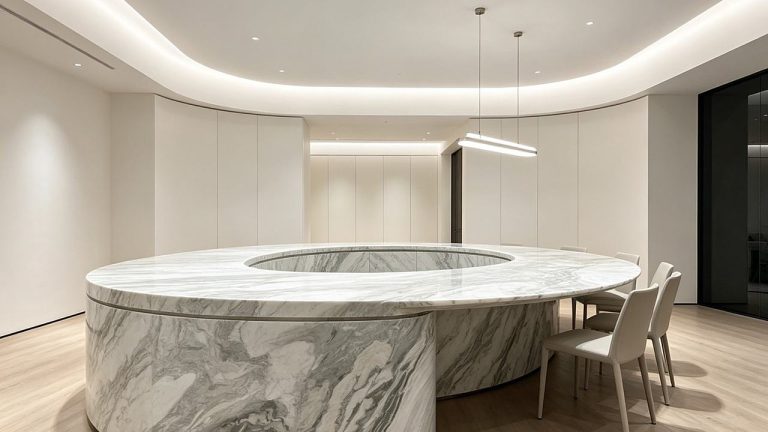
None of that is site work to be sorted out later. The plinth, the socket, the depth it is set to and the drainage under it are part of the object. Tell us what it will stand on and whether it has to be removable — a courtyard piece that can be lifted out for resurfacing is a different object from one that is bedded permanently — and the base gets designed into the carving. The sphere on a stand and the travertine round table are both specified base-first for this reason.
Weight is the freight
This line carries the hardest freight economics in the catalogue, for the simple reason that you are shipping solid mass rather than air. Two objects that look the same in a photograph can differ enormously in what they cost to move, and the difference is almost always hollow against solid, or one block against several pieces.
Which makes the packing a design decision rather than an afterthought. A pallet the forklift can take without a second attempt. Banding that survives a container. Corner protection on any polished face, because a chipped edge cannot be repaired in transit, and a chipped corner on a carved object cannot be repaired at all. And for anything large, a crate that can be opened and closed again on site, so that whoever unwraps it is not inventing a method at the back of a lorry.
We will tell you what a piece weighs before you commit to it, because the number that decides your landed cost is rarely the carving price. We will also give you the lead time honestly: carving is slow work, and the cheapest way to buy it is a run of the same piece from one block, where the set-up is shared across the batch. Our factory page shows how pieces are cut, checked and packed, and how an order is quoted covers where a run starts and where it stops being economical.
What the sketch has to fix
Four things, even if the sketch is a photograph with arrows drawn on it:
- Which faces are seen. The finish on the faces nobody looks at can be coarser; the finish on the top of a table cannot. Say which is which rather than leaving us to guess.
- The base and how it meets the ground. Fixed, removable, buried or bolted — and what surface it stands on.
- Whether water has anywhere to go. A drain, a vent, or a dry placement. Anything holding a plant needs a drain.
- Whether it has to match something. An existing piece, a batch of several, or stone already on site. Matching happens at the block, not at the photograph, so tell us early — it usually changes which material is even possible.
The stone itself is the last question rather than the first. Our materials and colour page covers what each family does in the hand, finishes covers what the surface does, and colour variation explains why two pieces from two blocks will never be a pair.
Send the sketch
The one-line version: send the sketch, the standing surface, and whether it has to match something. A photograph with the changes marked on it is often enough to start. What we cannot work from is a shape with no indication of where it goes or what it stands on.
From that we can tell you what the block can actually produce, what it will weigh, how it will be packed, and what has to be settled before anything is carved. Our product range shows the forms we cut — from the carved sport spheres and bowls and trays through to planters and table bases — and sending the sketch starts the order. We would rather ask the awkward questions at this stage than at delivery, because on a carved piece there is no second chance to change your mind.
Every figure on this page comes from our own order sheets. Where something is a trade norm rather than a number we can hold, we say so — send a spec and we will confirm it against a real block before you commit.
More from the yard

Send the drawing. We do the rest.
Reply within one working day, in English or Chinese. Send a spec, a drawing or just a photo of the sample you are matching — we will tell you honestly whether we can hold it.
MOQ 1 × 20FT · FOB XIAMEN · SAMPLES IN 7 DAYS