Stone spheres, planters and table tops: specifying single carved pieces
How to order carved stone single pieces without disappointment: what to specify on spheres, planters and table tops, and what real stone will and will not do.
12 October 2026 · 8 min read · GranTerra Stone, Hui'an
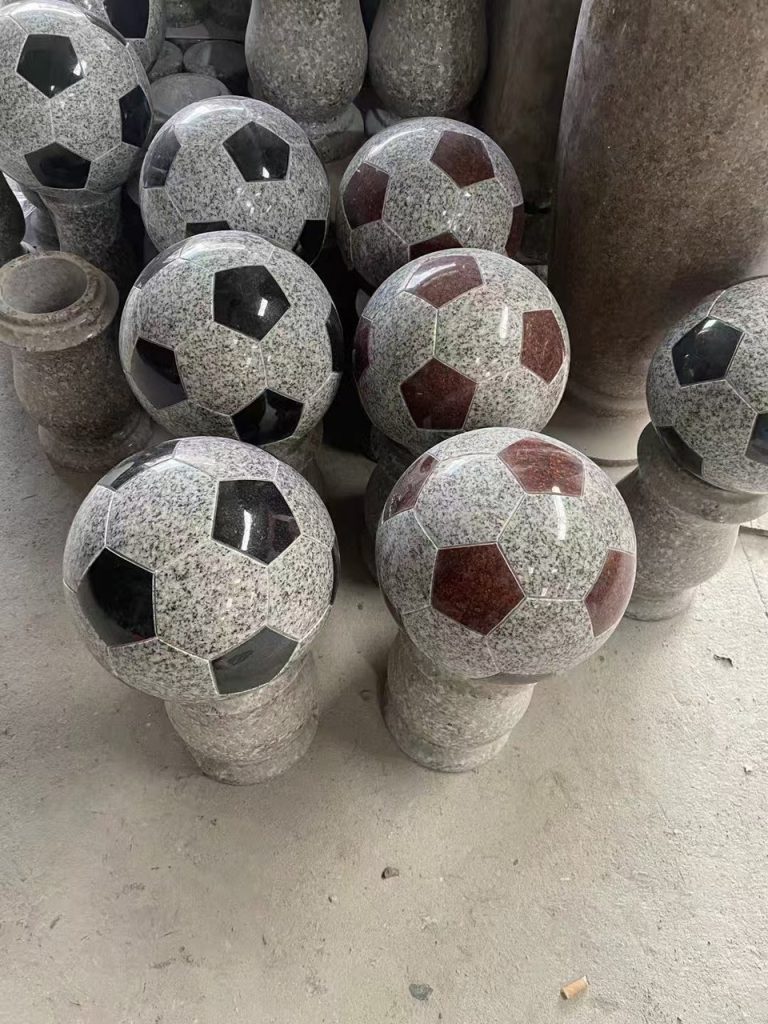
Carved single pieces are the part of a stone order where specifications get vague fastest. Nobody struggles to describe a slab or a kerb; a sphere, a planter or a table top gets a photo, a mood, and the phrase “something like this” — and then two people discover, much later, that they were picturing different pieces. We have quoted these objects for years, for landscape schemes, hotel lobbies, retail floors and private gardens, and the same handful of decisions decides whether the pieces land right.
This article is the buying side of that conversation: how a single carved piece differs from the rest of a stone order, what actually matters in spheres, planters and table tops, and how to specify one so the workshop and the client agree on what is being made. It complements our earlier piece on why the block sets the limit — that one is about what stone allows, this one is about how you order what it allows.
What makes a single carved piece different
Everything else in a stone order is measured and priced as surface area. A single carved piece is priced as a piece: the material is only one input, and the cutting time, the risk of failure and the number of good pieces a block actually yields all carry weight. That has three practical consequences worth knowing before you ask for a quote.
First, colour consistency is judged per piece, not per batch. A set of spheres will show the natural variation that comes from the same block — the same honest reality we covered in colour variation in granite, and the reason we never promise “identical” from real stone. If a scheme needs visual uniformity across a row of pieces, say so early and we will select from a single block where possible.
Second, damage behaves differently. A scratched slab is a surface problem; a chipped sphere is a shape problem. Single pieces travel as individual items in crates, and the packing conversation matters more than people expect — our shipping guide covers how that works.
Third, there is usually no off-the-shelf price for a custom piece. Every quote is a workshop calculation, and a drawing or photo plus the finishing requirement is the fastest way to a real number.
Spheres and bollards: where craft shows first
The sphere is the honest test of a carving workshop. If the piece is not truly round, no finish hides it; the eye catches an off-centre surface instantly, and a slightly flatted side reads as a defect even when the stone is faultless. This is why sphere quotes take longer than you might expect and why the cheapest sphere is rarely the cheapest outcome. The full range sits in our stone objects line, from single showpieces to grouped sets.
Two decisions come up on almost every enquiry. The first is presentation: a sphere on a stand sits cleanly and can be rotated to show off the pattern, which is why we offer pieces like a single sphere on a stand and sets on stands. A sphere without a stand needs to sit in a fixed position or be held by its surround, which works well in planting beds and at entries where it doubles as a bollard.
The second is the surface. A honed, matte surface is the safer choice outdoors: it does not mirror rain and sun the way a polished one does, and it hides the foot traffic around it. A polished sphere — like our honed finished piece and the polished sport spheres — reads as a showpiece and belongs where people look closely and nothing rubs against it: interiors, lobbies, display rooms. Our finish guide explains the difference in practice.
Sport-themed spheres deserve a special mention because they are the pieces clients underrate. A carved sport sphere looks simple from a photo, but each panel has to be positioned on the curve so the form reads correctly from every angle — a subtle, fiddly job that tests the workshop, and a genuinely memorable gift or trophy piece for clubs and corporate buyers.
Planters: the piece is the easy part
A stone planter fails for boring reasons, and none of them are the carving. Drainage is the first: without a way out, water sits, roots drown, and the planter becomes a very heavy pot of dead plants. Ask for drainage holes and confirm where they sit; it is a small line in the quote and it is the difference between a feature and a mess.
The second is exposure. In regions that freeze, water trapped in a crack will expand, and a season or two of freeze-thaw does what no crowd does. For outdoor planters in cold winters we steer clients toward dense granites and thick walls, and we say so plainly rather than let the order repeat a failure. Marble planters like the carved marble bowl are beautiful, but they are happier indoors or in sheltered settings where the weather cannot get into the stone.
The third is weight. A stone planter is a piece of rock, and moving one is a two-person job at best. For roof terraces and balconies, or for clients who rearrange their planting seasonally, we talk through lighter options before the order goes in. Where a project needs something between catalogue pieces — bowls, shapes, sizes — our stone planter range is cut to your order rather than to a fixed catalogue, so the piece fits the space instead of the other way round.
Table tops: an edge profile conversation
A carved table top looks like a slab with softer corners until you sit at it. What makes a table work is the edge: its thickness reads as solid or thin depending on profile, its shape decides whether the top is a comfortable resting place for arms, and its finish decides how the surface ages. The conversation that matters is not the stone — it is the edge profile and how it has been executed.
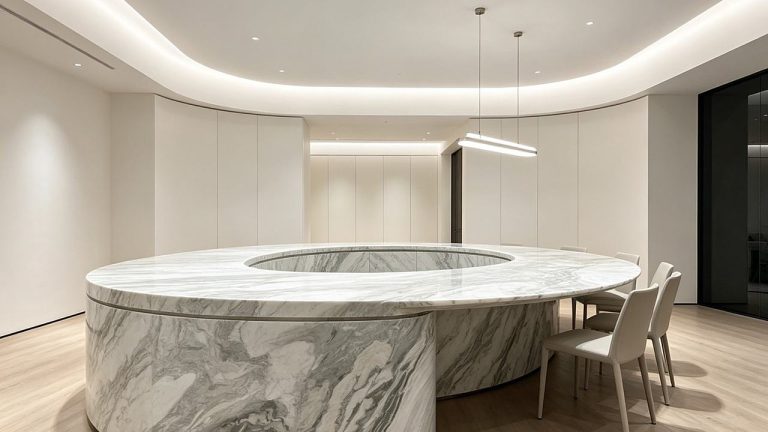
Travertine remains a favourite for statement pieces like the round travertine table, because its natural tone and filled voids give every top a different face, but the same logic applies to granite and marble tops. Matching the top to the seating height of the setting is part of the spec, and so is how the piece is supported; a top that overhangs a heavy frame is a tipping risk, not a design feature.
If the piece is for hospitality, treat it like a worktop decision rather than a decor one: the surface will meet cups, elbows, cleaning crews and time. Our worktop material guide covers that trade-off, and carved decor pieces like these can be combined with plain stone tops for a coordinated scheme.
How to order these without disappointment
The pattern behind every successful custom-piece order we have shipped is the same. The client shows a reference — a photo, a drawing, a piece seen in a hotel — and we show back exactly what we will make, in the same language. That means confirming four things before production starts: the stone and its finish, the shape and any features (drainage, fixing, stands), what “acceptable” means for colour and natural marks on that piece, and how it will be delivered and handled.
For repeat and multi-piece orders, a first article is the cheapest insurance in the business: one approved piece sets the standard the rest are measured against. And where a scheme mixes carved pieces with functional stone — worktops, vanities, coping — it is worth planning the whole order together, so material, finishing and packing stay consistent across every crate. You can see how the pieces come off the floor in our workshop and process pages.
A short checklist for single carved pieces
- Agree the reference, in writing. A drawing or a clearly marked photo beats a mood board at every step.
- Decide stand or no stand for spheres before quoting — it changes the piece, the price and the presentation.
- Specify drainage and exposure for planters, and weight limits for elevated settings.
- Talk edge profile and seating height for table tops, not just stone colour.
- Define “acceptable” per piece — real stone varies, and a shared standard prevents disputes.
- Approve a first article on any repeat order, and pack the order as one project.
If you have a piece in mind — a sphere set for an entrance, planters for a terrace, a table for a hotel lobby — send the reference and the setting it goes in. We will tell you what the stone will do, what it will not, and quote the piece that actually fits.
Every figure on this page comes from our own order sheets. Where something is a trade norm rather than a number we can hold, we say so — send a spec and we will confirm it against a real block before you commit.
More from the yard
Send the drawing. We do the rest.
Reply within one working day, in English or Chinese. Send a spec, a drawing or just a photo of the sample you are matching — we will tell you honestly whether we can hold it.
MOQ 1 × 20FT · FOB XIAMEN · SAMPLES IN 7 DAYS