Granite, quartz or marble: choosing a worktop material that fits
There is no best worktop material, only the right one for the project. How granite, quartz and marble behave with heat, stains and colour, and where each one earns its place.
11 October 2026 · 8 min read · GranTerra Stone, Hui'an
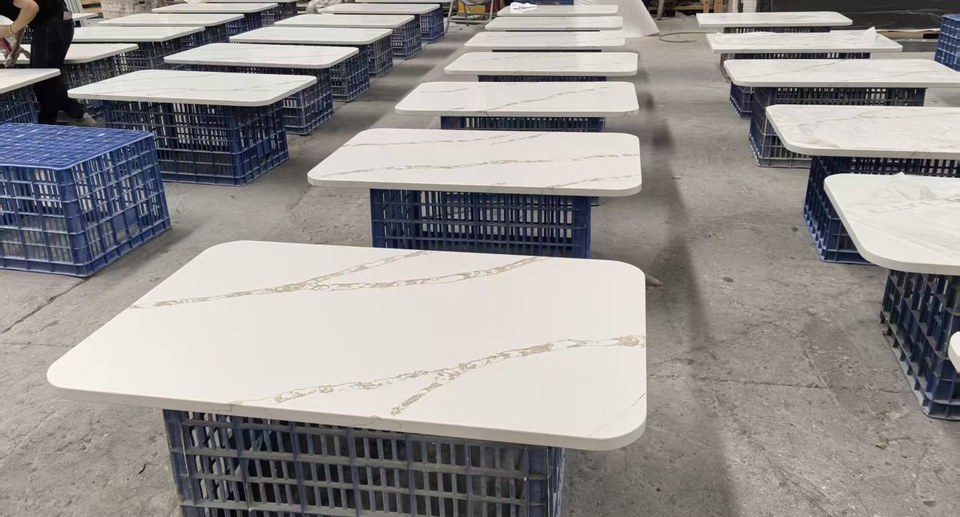
The question lands in our inbox in different clothes but it is always the same one: “which is better, granite or quartz?” Sometimes marble is in the frame too, sometimes a competitor’s sample is sitting on the desk next to ours. After years of quoting worktops for homes, hotels and commercial kitchens, our honest answer is that the question is pointed in the wrong direction. No material is better. Each one wins a different project, and the trick is knowing which side of the trade-offs your project actually lives on.
This article walks through the three materials the way we walk through them with buyers: what each one physically is, how it behaves under real use, how honestly it matches the sample you approved, and where each one simply earns its place. By the end you should be able to point at your own project and say which column it falls into — or confirm that the right answer is a mix.
First, what each material actually is
Granite is an igneous rock: minerals that cooled slowly inside the earth, which is why you can see individual grains of quartz, feldspar and mica in every slab. It is quarried in blocks, sawn, and finished into tops in the workshop. Every slab is a piece of geology, and no two are identical.
Marble started life as limestone and was transformed by heat and pressure into a rock made mostly of calcite. That history gives it the veining people fall in love with, and it also makes it chemically softer than granite: calcite reacts with acids, which shapes where marble can sensibly be used.
Quartz worktops — the ones we fabricate in white with a sink cut-out or as black double-bowl tops — are not quarried as stone at all. They are engineered surfaces: crushed quartz blended with resin and pigment, pressed into slabs and cured. That origin explains almost everything about how quartz behaves, good and bad. It also explains why “quartz” and “quartzite” are not the same product, a confusion worth clearing before any quote is compared.
How each one behaves under real use
Marketing pages love tables of hardness. Buyers do not live in tables; they live with a top for a decade. Here is the behaviour that actually shows up.
Heat
Granite shrugs off a hot pan better than the other two, which is why it keeps winning outdoor kitchens and busy cooking zones. Marble tolerates ordinary kitchen warmth but can suffer from sudden, concentrated heat. Engineered quartz has a resin content, and resin is the weak link: setting a pot straight from the hob onto quartz can leave a mark that no cleaning will fix. Trivets are cheap insurance everywhere, but on quartz they are not optional.
Scratches
Granite resists everyday scratching well; sliding a ceramic plate across it is not an incident. Marble scratches more readily and shows fine wear lines in time — some owners count that as character, others as damage, and you should know which person you are before you order. Quartz resists scratches well too, though it is not scratch-proof and cutting directly on it dulls both the blade and the surface.
Stains and chemicals
This is where the three split most clearly. Quartz is the most forgiving: the resin surface shrugs off coffee, wine and oil, which is why it is beloved in rental and hospitality fit-outs. Granite varies by colour — some shades are denser than others, and a sealing routine is part of ownership. Marble is the most exposed: lemon, vinegar, wine and many everyday cleaners will etch the surface, leaving dull patches. Etching is not a defect and it is not removable; it is chemistry. A marble top is a decision to live with a surface that records its life.
Colour: what you choose versus what arrives
Engineered quartz is the only one of the three that behaves like a catalogue. The shade you approve is, batch to batch, very close to the shade that ships, which makes it the easy choice when a project needs fifty tops that look identical or a replacement top years later. Slight batch variation exists, and we say so when it matters.
Granite is the opposite, and that is not a flaw to apologise for. Variation is the product. We have written before about why one block is never one shade: blocks from the same quarry differ, and slabs from the same block differ from each other. Any honest supplier will tell you that a photo on a screen is not a slab — our own materials and colour pages are built around that principle. If absolute colour control is the top requirement, that requirement is quietly pointing you at quartz, and it is better to admit it now than after the container arrives.
Marble sits in between: more consistent within a block than granite typically is, but with dramatic veining that makes every top unique. Book-matched pairs — where two slabs mirror each other — are possible and are one of marble’s genuine signatures.
Where granite earns its place
Granite is the material for heat, weather and workload. Outdoor kitchens, covered terraces, barbecue counters, high-traffic restaurant pass areas: anywhere a hot pan, a blazing afternoon or an impatient weekend cook will find the surface, granite is the safe recommendation. It also spans the widest price range of the three, from quiet greys to dramatic movement patterns, so budget conversations usually start here. Our tops and panels line covers the range, from kitchen countertops to custom pieces, and the seven surface finishes we apply change both the look and the behaviour — a leathered granite and a polished granite are different surfaces in practice, not just in photographs.
Where quartz earns its place
Quartz wins wherever consistency and low maintenance matter more than heat tolerance. Residential kitchens where the owner wants the surface to look exactly like the sample they pinned; apartment developments where every unit must match; hospitality projects that want a clean, uniform look without sealing routines. The batch production runs we photograph in the workshop exist precisely because repeat consistency is quartz’s core promise. The honest limit is heat: a quartz top next to a commercial range or an outdoor grill is the wrong specification, not a brave one.
Where marble earns its place
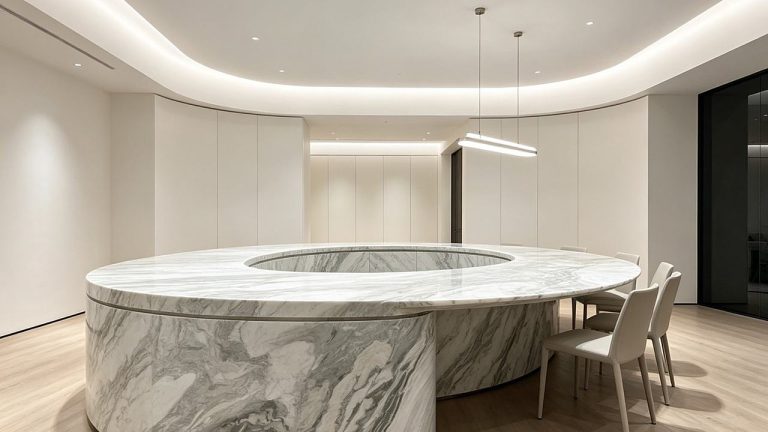
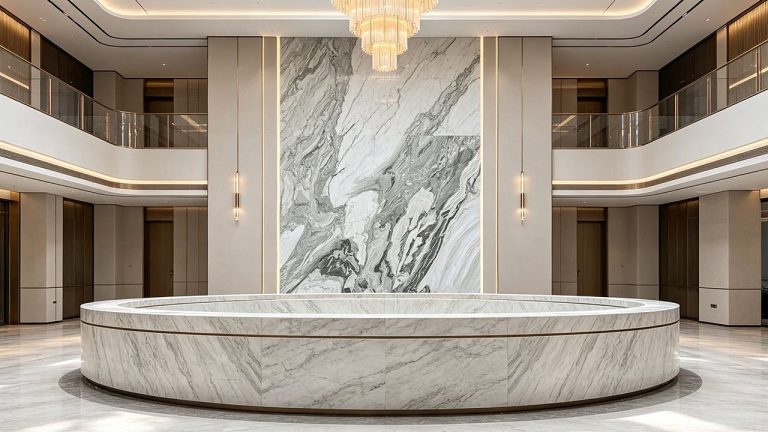
Marble is a statement, and pretending otherwise does it a disservice. It belongs where the surface is part of the design story: a hotel lobby bar, a showcase vanity, a bathroom where vanity tops with basin cut-outs carry the whole room. Bathrooms are friendlier to marble than kitchens because the acid exposure is lower — soap and water are not the enemy that lemon juice is. If the client accepts that a patina will develop and the design is strong enough to carry it, marble delivers what nothing manufactured can imitate. If the client expects the surface to look factory-fresh forever, marble is the wrong answer regardless of how beautiful the sample is.
Commercial projects change the arithmetic
A single residential top forgives a lot. A commercial order does not, because the decision multiplies: the material must perform across dozens or hundreds of units, match across batches, survive staff who do not read care instructions, and be replaceable years later. We have covered the commercial kitchen case in detail — thickness, edges and cut-outs for commercial kitchens — and the short version is that material choice and fabrication planning have to be made together, not in sequence. This is also where quartz’s batch consistency quietly becomes a technical property rather than an aesthetic one.
The fabricator matters as much as the material
Two identical slabs can produce very different tops depending on who cuts them. Edge profiles change how a top catches light and how it chips. Cut-outs for sinks and hobs, done badly, are where failures start. This is why we work the way described in cut to your drawing: the client’s template and the workshop’s process decide the outcome together, and the same discipline applies whether the material is granite, marble or quartz. Before comparing quotes, it is worth asking each supplier the same set of questions about tooling, tolerance and finishing — the answers separate more quotes than the price does. Our finishes page shows what we hold ourselves to on the surface side.
A short way to decide
Compressed to its essentials:
- Heat, weather, workload, budget range — granite. Outdoor and heavy-use projects rarely have a second candidate.
- Uniform look, low maintenance, interior, batch consistency — quartz. Specify it away from direct high heat and it will not ask for attention.
- Statement design, lower acid exposure, patina accepted — marble. Buy it for what it becomes, not what it looks like on day one.
And mixing is not a compromise; it is what experienced specifiers do. Granite outside, quartz in the main kitchen, marble on the showpiece vanity — each material deployed where its strengths are real and its weaknesses invisible.
If you have a drawing, a template or even a rough plan, send it over. We will quote the same project in the materials that make sense for it, tell you plainly where a material is the wrong call, and let the drawing — not the brochure — make the decision. The delivery is part of the design, and so is the material choice that starts it.
Every figure on this page comes from our own order sheets. Where something is a trade norm rather than a number we can hold, we say so — send a spec and we will confirm it against a real block before you commit.
More from the yard
Send the drawing. We do the rest.
Reply within one working day, in English or Chinese. Send a spec, a drawing or just a photo of the sample you are matching — we will tell you honestly whether we can hold it.
MOQ 1 × 20FT · FOB XIAMEN · SAMPLES IN 7 DAYS