A flaw or a feature: judging stone on arrival
27 October 2026 · 16 min read · GranTerra Stone, Hui'an
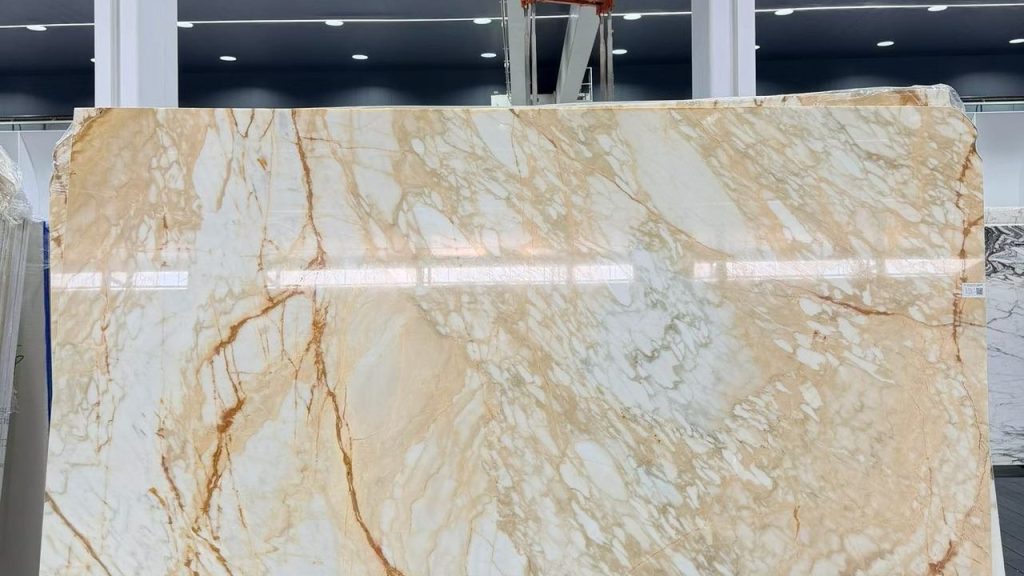
Somebody opens a crate, looks at the top slab, and says: that is a crack. Somebody else looks at the same slab and says: that is the stone. Both of them are describing what they can see. The argument that follows is not really about the stone at all. It is about the fact that nobody wrote down, before the order was placed, where the line between those two sentences was supposed to fall.
Natural stone has no grading system the way a fired tile does. There is no official first quality and second quality, no certificate that says a slab passed. Two slabs from the same block can be sold at very different prices because of how they look, and both are perfectly sound material. That absence of an external referee is the reason disputes happen, and it is the reason the referee has to be built into the order instead.
This is a note about how that judgement is actually made: what is worth arguing about, what the physical tests are, how a photograph either helps or destroys your case, and what we are willing to put in writing before a saw touches the block.
There is no universal pass mark for natural stone
A ceramic tile has a grade printed on the box. It either meets the grade or it does not, and the argument is settled by a document. Granite and marble do not work that way, and any supplier who tells you a shipment is “first quality” is using a word that has no defined meaning outside their own price list.
What exists instead is fitness for purpose, and it is entirely dependent on where the piece is going. The same slab, with the same golden vein running across it, is a defect on a floor where the vein reads as a scar across a field of pale stone, and it is the entire reason somebody bought that slab when it becomes a feature wall. Neither reading is wrong. They are answers to different questions.
This has a hard practical consequence. If the standard is use-dependent, then it has to be fixed at the point where the use is known — which is the drawing, not the delivery. A specification that says “good quality granite” has fixed nothing. A specification that says the face is to be one continuous field with no vein wider than a pencil and no patch of contrasting ground has fixed something a person can actually check against.
We would rather have that conversation at quotation stage, when it costs nothing but a paragraph, than at the gate of a site when the crane is already booked.
The four things people actually argue about
In practice, almost every disagreement sorts into one of four boxes, and they are judged by completely different means. Knowing which box you are in stops the conversation from going in circles.
Colour. Whether the pieces read as one material, and whether they read as the same material as the sample. Judged by comparison against a reference, never by memory.
Surface. Dull patches, polishing inconsistencies, a band where the finish did not take, a watermark that will not dry. Judged by looking at the surface at a low angle in raking light, because a flat-on view hides all of it.
Integrity. Lines, cracks, chips, voids, a patch of soft mineral that will not take a polish. Judged physically, by feel, by light, and by tapping.
Workmanship. Dimensions, squareness, flatness, edge profile, the position of a cut-out. Judged with a tape and a square, and this is the only one of the four where the answer is properly objective.
The mistake people make is applying the standard of one box to another. A colour argument cannot be won by measuring, and a workmanship argument should never be reduced to “it looks wrong”. Keep them apart and each one has an answer.
A colour line is not a crack
This is the single most common misjudgement in the trade, and it goes both ways: material gets rejected that is perfectly sound, and material gets accepted that is not.
A vein is mineral. Something flowed through the stone while it was still forming, and what you are looking at is the record of that flow, now solid. It has no depth, no opening, and no effect on how the piece behaves under load. A crack is a separation. The stone has parted, even if only by a fraction, and the two faces no longer transmit force to each other across that line.
There are three field checks that separate them, and none of them require equipment.
Run a fingernail across it. A vein is flush with the surface or slightly proud. A crack catches. This is a rough test and it is not a standard, but it distinguishes the two categories in most cases, and it takes a second.
Look at the light. Rake a torch across the surface at a low angle. A crack throws a shadow line on one side. A vein does not, because there is no step for the light to fall off.
Light it from behind. On a thin piece, a strong light behind will show a crack as a bright line of transmitted light along its whole length. A vein will not transmit, because the mineral filling it is opaque.
There is a fourth thing, and it matters more than the other three: where the line sits. A hairline in the middle of a paving field, under no particular stress, is a different proposition from the same hairline running out of the corner of a cut-out, or across the middle of a span, or into the anchor point of a wall panel. Position turns a cosmetic question into a structural one.
A crack is a question of where, not whether
Almost every block of stone has cracks in it. The block came out of a mountain; the mountain had a history. What the trade does with that history is cut around the damage, and where that is not possible, stabilise it.
Two kinds of line matter here, and they are not the same.
A healed vein is a fracture that closed again while the stone was still forming, and the minerals in the fluid sealed it. It is, geologically, a scar that knitted. In commercial terms it is part of the material and it will not open.
An open crack is a separation that has not sealed, and it will behave as a separation when the piece is loaded, wetted, or heated. On a floor it is a route for water and a place where a chip starts. On a wall panel it is a reduction in the section that has to carry the panel.
Between those two extremes sits the ordinary work of the factory: resin. Resin filling is standard practice for a great many stones, and it is not a cover-up. It consolidates a surface that would otherwise be too open to polish, and on some materials nothing in the price range would look like the sample without it. What matters is that it is disclosed rather than discovered. Reading a slab before it is cut covers what the resin is doing and where it usually sits. Our position is that a filled area is marked on the packing list against the piece number, so that the person opening the crate knows before they look.
What we will not do is call a filled crack sound because it has been filled. If a line is structural and it is in a place where it matters, the piece comes out of the order.
Chips tell you when it happened
A chip is the most useful piece of evidence in a whole delivery, because its shape records the moment it occurred. Three questions, asked in order, will usually settle who pays.
Where is it? Factory chips sit on an arris that was machined — an edge that was cut, profiled or chamfered in the works. Transport chips sit on a corner or on the face, and they are usually accompanied by a mark from whatever hit it: a strap, a crate batten, a forklift tine.
How does the break look? A fresh break shows the interior of the stone, which on most granites is lighter and more granular than the weathered outside. A break that has been exposed for a while has picked up dirt in the voids. If a “factory defect” arrives looking grey and dusty in the fracture, it did not happen in the factory.
What does the packaging say? A chip underneath a crate batten, with the foam still intact around it, happened before the crate was closed. A chip where the foam has been torn out, with the stone dust still in the tear, happened after.
This matters because it decides the remedy. A factory chip is our responsibility and gets replaced. A transport chip is a claim against a carrier that has a time limit measured in hours, and the only thing that makes that claim possible is having photographed it before the pallet was unwrapped further. An installation chip is nobody’s warranty, and it is the most common of the three.
What a reference sample can and cannot prove
A sample is not a photograph of the order. It is a physical piece of the material, and it does two jobs well and one job badly.
It proves what the material is. Handle it, look at it wet and dry, put it next to the other options. That is its proper use, and no photograph substitutes for it, because a screen cannot show you how a surface behaves under a raking light.
It proves the range the material moves within, if the sample was cut from the actual block or from a bundle you are buying. That is a stronger claim and it depends entirely on where the sample came from. A sample cut from stock tells you what the stone is like. A sample cut from your block tells you what your stone is like.
What it cannot do is certify that every piece in a delivery will look like it. A small sample is one slice through a material that varies in three dimensions. It shows you a point, not a volume. Anyone who tells you the sample is a guarantee of uniformity is either misunderstanding the material or managing your expectations badly.
Its real value is narrower and more useful: it is the only object both parties can point at. When the question is “is this the stone we agreed”, the answer is a comparison, and a comparison needs a reference that is not a memory. The same logic runs at larger scale when a whole panel is approved rather than a small cube, and the mock-up process is worth reading if your project is going that way.
Colour is judged against a batch, not a memory
Nothing causes more disputes than a client comparing a delivery to the last delivery. The comparison feels objective, because both are physical, and it is the wrong comparison.
Stone varies across a quarry, and it varies more between quarries that produce a material under the same trade name. Two bundles cut years apart, or cut from opposite ends of a deposit, can both be honestly described by the same name and still read as different stones when laid next to each other. That is not a failure of the material. It is what a natural product does. Why that happens is a separate question from the one here, which is what it means for a delivery that has just arrived and is about to be signed for.
It means the question to ask is not “does this match what I saw before”. It is “is this internally consistent, and is it consistent with the reference we both hold”. Those are two different tests and they have different remedies. An internally consistent delivery that sits slightly outside an old memory is usable if the use tolerates it. A delivery that is internally inconsistent — pale pieces and dark pieces in the same field — is a problem regardless of what the reference says.
This is the argument for keeping a piece. The offcut from the approved sample, kept dry, labelled, in a drawer rather than on a windowsill. It costs nothing and it ends a certain kind of conversation in about four seconds. If you are still choosing which material to hold that argument about, the stone range is the place to see how far each one moves before you commit to a batch.
Photograph it the way it will be judged
A great many claims fail not because the stone was fine but because the evidence was not. The photograph that loses an argument is usually the one taken quickly, close up, with a flash, of an object with nothing beside it for scale.
Three frames will carry almost any case.
The wide frame. The piece in its context: which crate, which position in the bundle, how much of the delivery is affected. Without this, a close-up of a chip proves that a chip exists and nothing about its importance.
The detail frame, with a scale. A coin, a tape, a pencil — anything of known size, in the same plane as the damage. A close-up with no reference cannot distinguish a mark that matters from one that does not, and the reader will assume it is smaller than it is.
The frame with the paperwork. The piece number or the packing list in shot with the damage. This is the one people skip and it is the one that connects a photograph to a shipment.
Then there is light, which is the part that actively misleads. A flash fired straight at a polished slab flattens exactly the surface relief you are trying to show, and it turns a dull patch into an even field. A raking light from one side does the opposite and exaggerates every mark. Daylight through a window, at an angle, is usually the honest choice.
And watch the reflections. A band of reflected light across a polished face reads, in a photograph, exactly like a crack running the width of the piece. This is not a hypothetical: it is the most common false alarm we are sent, and the giveaway is that the “crack” continues past the edge of the stone and across the wall behind it.
The signature at the gate
Whatever the paperwork says, the delivery is decided by what the person with the clipboard writes on it. There are three options and only one of them is expensive in a way that is hard to recover.
Signed clean. The consignment is accepted as complete and in good order. Everything after this point becomes a conversation about goodwill, because the document says there was nothing to see.
Signed with exceptions. The delivery is accepted, with specific damage noted against specific piece numbers. This is almost always the right answer for a delivery that is mostly fine, because it keeps the project moving and preserves the claim.
Refused. Justified when the material is not the material, or when damage is so extensive that the delivery cannot be used. It is a heavy instrument and it should be a considered one, because refusing a container that turns out to be usable costs everybody a fortnight.
The practical instruction is not to sign clean until somebody has walked the load. The packing and loading side is covered here, and the reason it is worth reading before the container lands is that the packaging tells you where to look first. Foam compressed at one end, a strap that has cut into a corner, a batten that has shifted — each of those is a pointer to a specific piece.
What we put in writing before we cut
Since we cannot point to a grade, we point to a document. On an order of any size, these are the things we are prepared to state, and they are the things worth holding us to.
What the material is. The commercial name and the quarry region. Not a performance claim, a provenance statement, and it is checkable.
The batch. Which block or bundle the order is cut from, and confirmation that the pieces in one delivery are drawn from that batch rather than assembled from stock.
The finish. Which surface, applied to which faces. A finish stated for the face and not for the edges is an incomplete instruction and we will ask. The finishes we work in are listed together with where each one belongs.
The tolerance. What we hold on dimension and squareness, stated as a figure rather than as “accurate”.
What is disclosed. Filled areas, patches, and any piece that has been stabilised, marked against its number.
What is not promised. That the delivery will match a photograph. That it will match a delivery made in a previous year. That every piece will be beautiful. These are not disclaimers, they are the honest boundary of what a natural material can offer, and stating them early is what makes the other five items worth anything.
We will also put in writing, before cutting, that a given piece is a poor fit for a given position, if we think it is. That is a harder sentence to send than a quotation, and it is the one that prevents the argument at the gate.
Bring the argument forward
Every dispute about a stone delivery is a dispute that was available for free at some earlier point. The cheapest version of it happens before the order, when a paragraph in a specification settles what “acceptable” means. The next cheapest happens at the sample, when a reference is agreed and kept. The expensive version happens on a driveway with a crane waiting, and the most expensive version happens after the piece is on the wall.
None of this requires a standard that does not exist. It requires deciding, in advance, which of the four questions you are asking, and what evidence would answer it.
If you are about to place an order and you are not sure how to word that paragraph, that is a good moment to send us the drawing. We will tell you what we would write, and what we would not sign.
Every figure on this page comes from our own order sheets. Where something is a trade norm rather than a number we can hold, we say so — send a spec and we will confirm it against a real block before you commit.
More from the yard


Send the drawing. We do the rest.
Reply within one working day, in English or Chinese. Send a spec, a drawing or just a photo of the sample you are matching — we will tell you honestly whether we can hold it.
MOQ 1 × 20FT · FOB XIAMEN · SAMPLES IN 7 DAYS