Freestanding stone bathtubs: what a fit-out has to settle
A stone bathtub is the heaviest object in a bathroom, and the parts you would adjust on a bath are fixed inside it. What has to be settled on the drawing before a block is opened.
9 October 2026 · 11 min read · GranTerra Stone, Hui'an
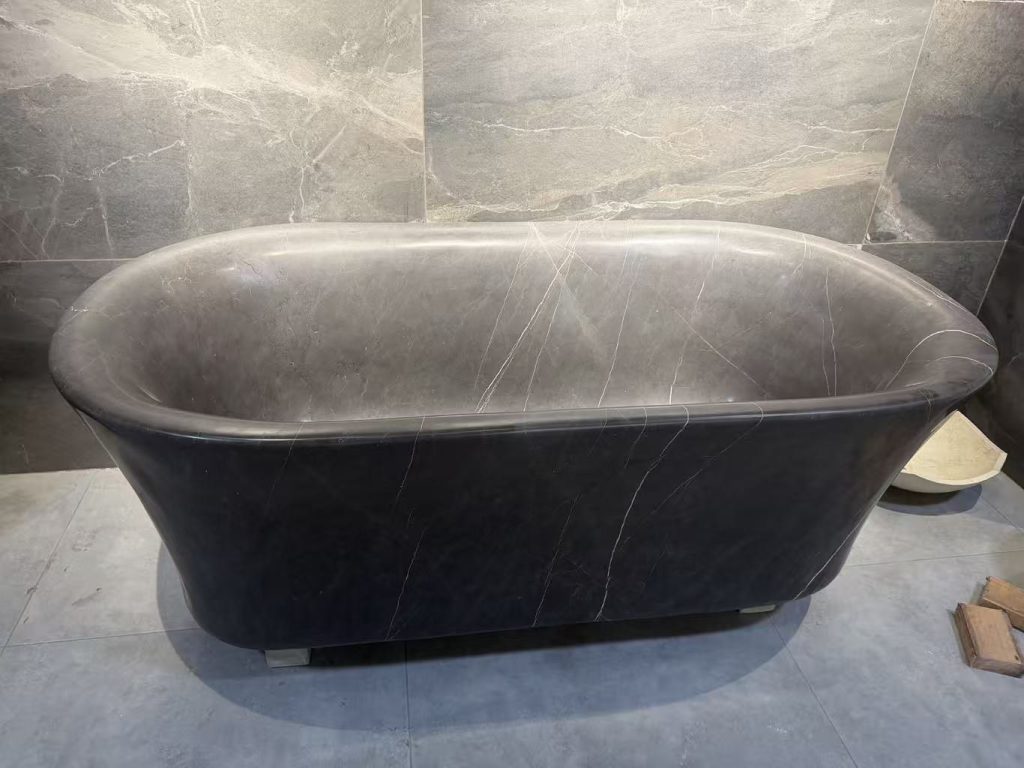
A stone bath is usually specified the way a bath is specified — chosen from a photograph, matched to the rest of the bathroom, and then handed to the plumber. On a stone tub that order of events is the wrong way round. By the time the block is opened, three of the four decisions that actually matter have already been made without anyone deliberately making them.
What follows is what we have learned from cutting these — mostly from the enquiries where somebody had to ask an awkward question late. A carved tub is the heaviest object in a bathroom, it cannot be moved the way a bath is moved, and the parts you would normally adjust on site are fixed inside it. It is worth ten minutes of drawing before anyone picks up a chisel. Our freestanding tubs are all cut to order for exactly this reason.
Why a stone tub fails differently from a stone basin
A basin and a tub are both “stone bathroom products”, and almost nothing else about them is comparable. A basin is a small object with a hole in it. A tub is a large, thin-walled, deeply hollowed object that has to hold a few hundred kilograms of water without deflecting, sit flat on a floor that may or may not be designed for it, and be got into a room through openings that were designed for something else.
The failure modes are completely different. A basin fails visibly and cheaply: it chips, it stains, it is replaced. A tub fails structurally or it fails at installation, and both of those are expensive in a way a chipped basin is not. A tub that cracks is a workshop job on an object that weighs as much as a small car and is now inside a finished building. It is the one stone product on a project where the cost of getting it wrong is not the price of the stone.
That is why the useful conversation about a tub is not about shape. Shape is the easy part and it is the part every supplier can show you in a photograph. The hard part is the four things below, and they are all decided on paper.
The floor, the doorway and the lift come before the design
Start with weight, because it is the constraint that cannot be argued with later. A hollowed stone tub is heavy before it is filled and heavier after. That weight does not spread itself politely. It arrives at the floor through a small footprint — the base, or the feet, or the rim if the tub sits flush — and a point load is a structural question, not a stone question.
Where it lands matters as much as how much it weighs. A ground-floor bathroom on a slab is one conversation. A tub on an upper floor of a converted building, over a timber-framed span, is another, and that conversation belongs to a structural engineer rather than to us. We will happily tell you the weight and the footprint so it can be checked. What we cannot do, and will not pretend to do, is tell you a floor is fine because a tub of that size is usually fine. On an upper floor, that is the sort of assumption that ends in a very expensive crane.
Then comes access, and this is the question that catches more projects than the load does. A tub that fits the bathroom perfectly can still be impossible to get there. Stairs, door openings, the turn at the top of a landing, and above all a lift — a lift that a bath can be walked into may be a lift that a stone tub cannot. Once it is in, it is not coming out again without dismantling something. Two rules follow, and they are both cheap: measure the route, not just the room, and settle it before the block is cut rather than at delivery.
If the route genuinely will not take one piece, that changes what we make rather than cancelling the job, which is the subject of the next section.
Carved from one block, or built from panels
There are two ways to arrive at a stone tub, and they are different objects with different compromises.
Carved from a single block. One piece, no joints, no visible seams anywhere on the inside or the outside. The rim is continuous, the interior reads as one surface, and there is nothing to dress or fill. The trade is weight, material use and size: the tub can only be as large as the block, a lot of good stone ends up as waste, and it is the heaviest version of the object. This is the right answer when the tub is the centre of the room and the route allows it.
Built from panels and dressed. The form is assembled from cut pieces, worked until the joints are tight and matched, then finished as a whole. It is lighter, it allows a larger or more complex shape, and each piece is easier to move into a building. The trade is the joints: they have to be worked properly, and they have to be placed where the eye (and the water) will not find them. Placed well, they disappear. Placed to save time, they telegraph through the finish within a season.
Which one you need is mostly decided by access and size, not by taste. When a client is choosing between the two on a project, we would rather have that conversation with the drawings in front of us than with a photograph: our Carrara tub, the Nero black tub and the white marble tub are all made this way, and how each one is built depends on the room it is going into.
The drain and the overflow are fixed before you see them
This is the part of the process that surprises people most. On a bath, the waste and the overflow are fittings — there is a flexible base, a hole that can be opened a little, a trap that can be persuaded. On a stone tub, the waste and the overflow are cut into the stone at the factory, and once they are there, they are there.
So the drawing has to answer, before we start: where is the waste going to be, and where is the trap going to sit under it. On a freestanding tub the trap is often exposed or concealed inside a plinth, and where it sits is decided by where the drain is in the floor. If the floor drain goes in after the tub is ordered, one of the two is going to be moved, and it will not be the stone.
The overflow is the detail worth thinking about rather than copying. On a carved tub it is not a pipe poking through a wall; it is worked into the form, either as a slot or a gallery, and its position and depth are part of the design rather than an accessory fitted afterwards. It also has to be somewhere the water can actually leave — an overflow below the rim line is decoration. The rim height, the overflow and the waste all have to agree on the same drawing, and they have to agree with the floor.
Inside and outside are two different surfaces
A tub has an inside face and an outside face, and they are asked to do opposite things. The outside is on show and takes the finish the room wants. The inside is where somebody stands, steadies themselves and sits down, and it is almost always wet when they do. Those two briefs pull in different directions, and treating the tub as one finish is how a beautiful object becomes a difficult one to use.
In practice the inside is usually honed or otherwise tuned for grip rather than gloss, and the outside is polished or textured to suit the scheme. The rim is the third surface and the one that gets handled — it is where a hand lands when somebody steps in, so it has to be eased rather than left sharp, without becoming a ledge that holds water. The finishes page covers what the surfaces do; on a tub the point is simply that you rarely want the same one inside and out.
Colour behaves on a tub the way it behaves everywhere else in stone — the block is the block, and no two are identical. A tub is a large single object, so the movement in the stone reads across it as one continuous figure rather than as tiles that can be shuffled. It is worth reading how colour varies in a block before approving a tub from a small sample, because there is no second chance to redistribute the figure.
Heat, weight and the filled tub
Two physical facts about stone matter once the tub is in use, and both are worth telling a client before they are surprised by them.
The first is thermal. Stone is dense and it takes heat from what it touches. A carved tub feels cold to the hand when it is empty, and on the first fill it will draw heat out of the water and cool it a little faster at the start than a lightweight bath does. It also holds its temperature well once it has settled. Most people who choose a stone tub for a hotel or a spa are choosing it precisely for this behaviour — it is part of the experience — but it is a behaviour, not a defect, and it is better stated than discovered. The same thermal mass is why a stone tub suits a warm-climate bathroom and why it is worth thinking about in one that is not.
The second is that the object changes once it is full. The floor is carrying the tub plus the water plus the person in it, and the load is not spread any more widely for having grown. The drain has to be able to empty the tub at a rate that makes sense for a hotel — a tub that takes too long to drain is a housekeeping problem on a schedule. None of this is exotic, but all of it is settled better on the drawing than on the day of installation.
What we need on the tub drawing
By this point the list is short and concrete. To quote and make a stone tub properly, we need:
- The room and the route. Where the tub sits, and how it gets there — openings, stairs, the lift if there is one. Not just the bathroom.
- The floor. What is under the tub, and whether the load has been checked. We will give you the weight and the footprint; the structural call belongs to your engineer.
- The waste and the trap. Where water leaves the floor, and how the trap is to be concealed or left exposed.
- The drain and overflow positions on the tub, agreed with the plumbing rather than assumed.
- The finish inside, outside and on the rim, stated separately.
- The stone, or the intent. A named material, or a photograph and a budget, and we will tell you what will hold the colour across an object this size.
If a bathtub is being specified alongside basins, the same drawing usually carries both, and the basin decisions are their own set — vessel, undermount or pedestal covers those in detail. Where a room has both, it is worth matching the stone at the block rather than at the sample, so the tub, the basins and the tops read as one material. Our stone bathware range runs from tubs through vessel, pedestal and undermount basins to accessories, and a room specified from one range starts from one material list.
Send the room
The one-line version: send the room, not the tub. A plan of the bathroom with the route into it marked, the drain position, and a note of what is under the floor is worth more to a tub order than a photograph with a style attached. From that we can tell you which of the two ways of making it suits the job, what it will weigh, and what has to be settled before the block is opened.
Our product range shows the shapes we cut, and how we cut, check and pack shows how a large object is packed to survive the journey that a bath would not need to survive. Send the drawing to start an order, and we will come back with the awkward questions first — because on a stone tub they are much cheaper to answer now than at the front door.
Every figure on this page comes from our own order sheets. Where something is a trade norm rather than a number we can hold, we say so — send a spec and we will confirm it against a real block before you commit.
More from the yard
Send the drawing. We do the rest.
Reply within one working day, in English or Chinese. Send a spec, a drawing or just a photo of the sample you are matching — we will tell you honestly whether we can hold it.
MOQ 1 × 20FT · FOB XIAMEN · SAMPLES IN 7 DAYS