The number on the crate: how stone finds its place
25 October 2026 · 14 min read · GranTerra Stone, Hui'an
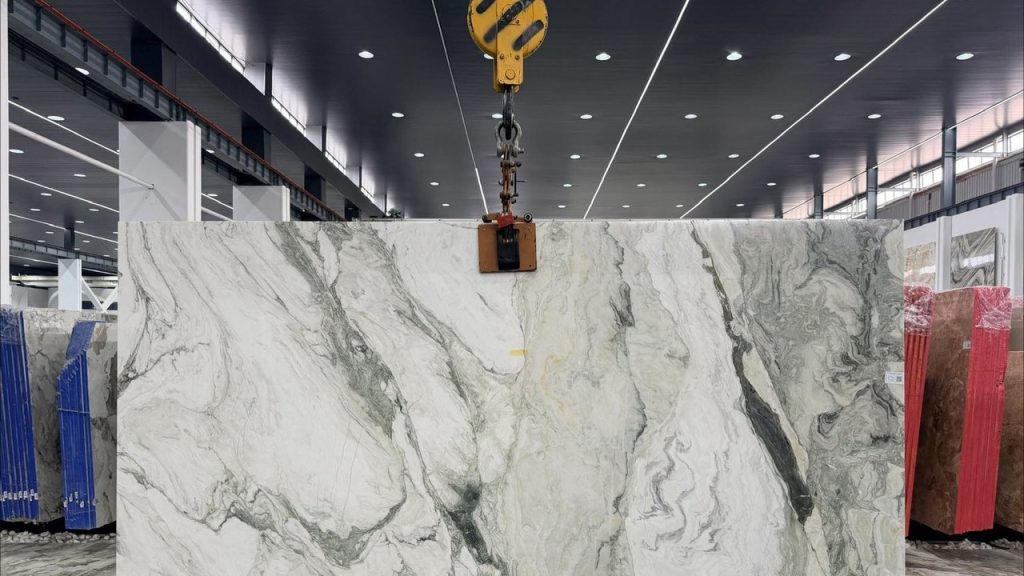
Somewhere between the saw and the wall, a piece of stone stops being a piece of stone and becomes a position. A bay. A course. The third unit in from the corner. That transformation happens on paper, long before anything is cut, and it is the most fragile handover in the entire chain — because paper is the only thing holding the two ends together.
What follows is about that handover. Not the drawing, not the crate, not the trade that beds the stone, but the thin line of numbering running between them, and what actually happens when it snaps.
A crate is a position, not a pile
When a container is opened on site, the first thing a foreman sees is volume. Crates, wrapped bundles, pallets. It looks like stock and it behaves like stock right up until it is needed, at which point it turns out to be an assembly with one correct order.
Every bundle already has a job, and the job is not “the ground floor”. It is a specific rectangle on a specific elevation, cut from a specific block, at a specific place in that block’s pattern. That knowledge lives in two documents: the cutting list that came out of the shop drawing, and the packing list that went into the container. If both survive the voyage and both reach the person holding the pry bar, the stone behaves like a kit. If either one is lost, misread or skipped, the same stone becomes raw material again — and raw material on a finished site is a liability, not an asset.
Most of the failures we hear about months after a job is closed are not cutting failures. They are handover failures. The pieces were right. The information was not.
How a piece gets its number
A number is not invented at the saw. It is derived. The shop drawing is divided into zones, the zones into courses, the courses into pieces, and each piece inherits a position that has to survive all the way down to the last cut. Only then does the drawing office decide which piece comes from which part of a block, because a vein has to run the right way across a joint, and a corner has to land where the pattern can afford it.
Two conventions are common. A running number — one, two, three — is quick to label and easy to read aloud across a noisy site. It is also brittle: insert a piece during a revision and every number after it shifts. A coordinate-style reference, zone plus course plus sequence, takes longer to write but survives a redesign, because a new piece receives a new coordinate instead of displacing its neighbours.
We default to the second, and the reason is practical rather than tidy. Site work is organised by zone. A crew is given the east elevation, not “the first eighty pieces”. If the reference begins with the zone, a bundle can be delivered straight to the crew that needs it without anyone opening a spreadsheet in the site hut. If it begins with a running index, every bundle has to be sorted on the ground before it can be used — and sorting on the ground is exactly where the wrong piece gets picked up.
One rule outranks either convention: pieces cut from the same block carry the same block reference. Colour and movement are continuous within a block and stop dead at the next one. Two pieces from one block read as a pair even when they are installed far apart. Two pieces from different blocks read as two different stones even when they are touching. The block reference is not decoration; it is the only thing that tells a fitter whether the joint in front of him is meant to disappear. This is the same reading skill that goes into judging a slab before it is cut, applied backwards, from the wall to the yard.
Where the numbering breaks
It breaks in four places, and none of them is dramatic. Each is a small convenience that seems reasonable at the time it is taken.
Packing by size. A container is loaded to use its volume well. Long pieces travel together, heavy pieces go low, and the result is a crate that is efficient to ship and meaningless to install. Three different elevations can end up in one bundle because their pieces happen to share a length. The packer did nothing wrong. The site now has to unpack and re-sort, and re-sorting is the step nobody has time for on the morning the crane arrives. Packing decisions made for the ship become installation decisions made under pressure.
Paper labels in a wet container. A label printed on office paper and taped to a wrapped bundle has a working life measured in weeks. Sea freight is humid, condensation forms on the inside of the container skin, and a label that was crisp in the yard is a grey smudge on arrival. Marking that survives the voyage is either cut into the bundle wrapping itself, duplicated onto the piece in a place that will not be seen, or written into the packing list by crate position — third from the left, second layer. Position survives when the ink does not.
Receiving by count. Goods-in is usually measured against a delivery note: how many pieces, how many crates, damaged or not. Nobody counts to a position. A crate that arrives complete but mixed gets signed for as correct, and the error surfaces only when the crew reaches the far end of the elevation and finds itself holding a piece with nowhere to go.
The fitter’s shortcut. This one gets blamed and deserves it least. A fitter under time pressure, holding a piece that looks right and fits the gap in front of him, will set it. The tolerance in stone is small enough that a wrong piece often does fit — it was cut to the same nominal size. It is only the vein that is wrong, and the vein is only obvious once the wall is finished and the light rake across it.
Dry-lay before anything is fixed
The only reliable check is to lay the order out before it is bedded. Dry-lay means placing pieces in the positions they were cut for, on the ground or against the wall, with nothing fixed: no adhesive, no shims, no cutting.
It is unfashionable because it looks like a delay. In practice it is the cheapest hour in the project. A dry-lay of one elevation exposes four things at once — a bundle delivered to the wrong zone, a piece cut from the neighbouring block, a joint that closes on the drawing and opens on the floor, and a closure piece that is missing because the drawing changed after the list was issued.
Dry-lay is worth doing zone by zone rather than for the whole order. A full dry-lay needs a space the size of the finished job, which almost no site has. A zone dry-lay needs a few square metres and one crew, and it tests the part of the order that is about to be installed, which is the part where an error still costs nothing to correct. It is the same logic as approving a mock-up, moved from aesthetics to logistics: look at it before it is permanent.
Photograph the dry-lay. The photograph is the record that the order matched the drawing before anyone committed to it, and it is the only document that settles the argument six weeks later about whether a joint was specified that way or built that way.
The first line decides the last piece
Setting out is usually described as marking a line. It is really a decision about where the error is allowed to go. No building is square, no slab is flat and no wall is straight, so the stone has to absorb a discrepancy somewhere. The setter’s job is to choose that place, and then to put the first course there.
The consequence is simple and almost always ignored: the first line determines the last piece. If the first course is placed against a wall that is out of square, the error is carried to the far end of the room, where it arrives in the most visible position and in the largest amount. If the first course is set from the most visible feature — a threshold, a change of material, the centre line of a doorway — the error is pushed towards the walls, where a skirting, a shadow gap or a trim piece absorbs it without anyone noticing.
The same logic runs vertically. An elevation laid from the top down puts the discrepancy at the floor, where the floor finish covers it. An elevation laid from the bottom up puts it at the ceiling, where a shadow gap is the only thing that can hide it and where a shadow gap is often not detailed.
What we ask for at quotation stage is therefore not “the setting-out drawing” but two marks on the drawing we already have: which piece is first, and where the order is expected to close. Those two annotations cost nothing and they prevent the most expensive conversation on site, which is the one about who is going to re-cut the final course. Stairs have the same problem in one dimension — the first riser fixes where the top landing has to arrive.
Error that accumulates
Individual pieces are accurate. The order is not, because joint widths add up. This is the point where a job that looks correct piece by piece drifts visibly across a floor.
The control is mechanical rather than skilled: a spacer of consistent width on every joint, rather than eye and thumb. A fitter setting joints by eye will be within a millimetre on any two adjacent pieces and half a course out by the end of a run, because the eye averages and the error is one-directional. Consistency beats precision, and it is the only thing that can be written into a method statement.
Accumulation has to be designed for, not corrected at the end. There are two honest ways. One is to place a joint that is meant to be wider at a known location — a movement joint, a change of pattern, a change of material — so the error has somewhere designed to be absorbed. The other is to cut closure pieces in the factory, to the measured width, and ship them as a separately marked bundle, so the final course arrives as a fitted piece rather than a site cut.
The wrong way is to leave the last piece to the site and trim it there. A site cut is made with a hand tool, on a surface that may already be dusty, by someone kneeling on the piece. It will be visible, and it will be the piece nearest the door, because that is where a run ends.
What a re-cut actually costs
A missing or wrong piece is rarely expensive as stone. The stone is a small part of the bill. The cost sits in the chain that has to restart.
- The block may be closed out. If the batch is finished, a replacement comes from a different block, and a different block is a different colour at the joint. The replacement is then visible even when it is dimensionally correct.
- One piece is not a batch. The saw has to be set up, the piece handled, and it joins the queue behind whatever is already in the mill. A single unit is the least efficient thing a workshop can be asked to make.
- Shipping one piece is the worst ratio in the trade. A bundle occupying a fraction of a container pays for a whole booking, and it sails with the next consolidation rather than when the site needs it.
- Air freight exists, and is priced to remind everyone why it is rare.
- The site stands still. Labour, plant and access equipment are already mobilised. A stopped crew is a cost that never appears on a stone invoice but always appears on the project.
Set against that, the effort of correct numbering — one list, one packing convention, one photograph at dry-lay — is trivial. This is the part of the process where being boring pays for itself several times over. The related risk, that a replacement will not match the original batch, is not a risk at all once the number and the block reference are right.
What we need before we number
Numbering is downstream of information. A position can only be derived from a drawing, and six things decide whether the derivation will hold.
- A dimensioned elevation or paving layout in a format we can read and mark up. A rendered image is not a drawing; it shows intent, not dimensions.
- The zone plan. How the project is divided for installation, and in what order those zones will be built. This is what makes a bundle useful on arrival rather than a puzzle.
- Vein direction, where it matters. A feature wall, a matched pair, a floor where the pattern is meant to run through a doorway. Say which surfaces must read as continuous and which may be broken.
- Where a cut is acceptable. Every order has at least one place where a joint can be adjusted without being seen. That place should be chosen on the drawing, not discovered on site at the end of a run.
- Whether you already have a numbering system. If the contractor or the installer works to its own convention, we follow it rather than introduce a second one. Two systems on one job is worse than either system alone.
- Who signs for the delivery. One name, and ideally the same person who will stand at the dry-lay. A number is only useful to whoever is holding the list.
What the number does not cover
It is worth being direct about the limits, because a numbering system that is oversold quietly becomes an excuse.
A number does not make two blocks match. Colour and movement vary between blocks and no amount of labelling closes that gap. The only control is to reserve enough material from one block for the area that must read as continuous, and to accept a break where the architecture allows one.
A number does not replace a dry-lay. It tells a fitter where a piece belongs. It does not prove that the piece is the right one. Only laying it out does that.
A number does not fix the substrate. Stone follows the wall it is fixed to, and a wall that is out of plumb produces a joint that opens regardless of how well the order was marked.
And a number does not survive a site cut. Once a piece is trimmed on site its position stops being a position and becomes a piece that fits a gap. There is nothing wrong with that as a method, but it is a different method, and it should be chosen deliberately rather than arrived at because the closure bundle was never made.
What we can hold is narrower and more useful: every piece leaving the workshop traces to a zone, a course and a block, and that trace is written on the bundle, in the packing list, and on the piece itself somewhere that will not be seen. After that the wall belongs to the installer. We would rather say so plainly than pretend the number does work it cannot do.
If a drawing is about to be issued for cutting, the useful thing to send is not a better image but a marked-up plan: where the run starts, where it closes, and which surfaces must read as one piece of stone. Those three answers are what a cutting list is built from, and everything on site follows from them.
Every figure on this page comes from our own order sheets. Where something is a trade norm rather than a number we can hold, we say so — send a spec and we will confirm it against a real block before you commit.
More from the yard


Send the drawing. We do the rest.
Reply within one working day, in English or Chinese. Send a spec, a drawing or just a photo of the sample you are matching — we will tell you honestly whether we can hold it.
MOQ 1 × 20FT · FOB XIAMEN · SAMPLES IN 7 DAYS