Stone care after handover: efflorescence, rust and sealing
What actually happens to stone after the last slab is laid: salt carried by water, iron from fittings rather than the stone, a sealer sold as waterproofing, and cleaners that quietly do the damage.
21 October 2026 · 13 min read · GranTerra Stone, Hui'an
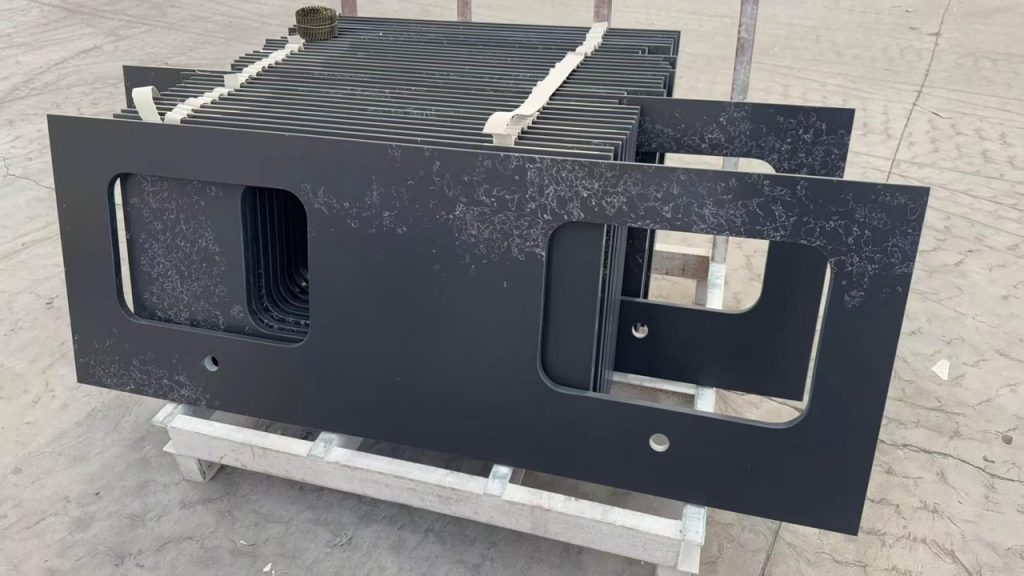
Handover day is the cleanest the stone will ever be. Every surface has just been washed down, the joints are still the colour the installer mixed, and the whole job reads the way it looked on the sample board. Then the building opens, and eighteen months later somebody sends a photograph of a wall with a white bloom across the bottom course, or a counter with a brown ring around a tap, and asks whether the stone was faulty.
Almost every time, it was not. Stone is a material that reacts to water, salts and cleaning chemicals slowly and visibly, and most of what gets reported as a defect is a predictable consequence of something that happened after the last slab was laid. Knowing the mechanism matters commercially, because it decides whether a hotel spends its maintenance budget on a cure or on a repeat.
What the stone is doing when nobody is watching
Granite is dense, but it is not sealed by nature. Between the mineral grains there is a network of microscopic pores and hairline capillaries, and those capillaries are connected to the surface. Water does not need a crack to enter; it will move into the pore structure by capillary action, slowly, from any surface that stays wet long enough.
Once water is inside, three things can happen, and they are worth separating because they get blamed on each other. The water can freeze, and the expansion prises grains apart. It can carry dissolved salts inward, then leave them behind as it evaporates, and those salts crystallise under the surface. Or it can carry salts outward and deposit them on the face, which is what a white bloom actually is. All three need the same thing to start: moisture held against the stone for a long time, with no way to dry.
That is why the failures cluster in the same places across very different projects — the base of a wall, the bottom of a cladding panel, the back of a coping, the shaded north elevation that never gets sun, the area behind a planter, and any horizontal surface where water stands. Not the busiest floor, and rarely the middle of a big field of paving. The stone is usually fine where it can dry.
Efflorescence is water carrying salt, not stone failing
The white powdery bloom that appears on paving, wall bases and around joints is salt that was dissolved in water, moved to the surface, and left there when the water evaporated. The salt can come from the stone itself, from the mortar or bedding sand, from the ground behind a retaining wall, or from the water used for cleaning. The stone is the road, not the source, in most cases.
This is why cleaning it off with a stiff brush and water often makes it come back within weeks. Brushing removes the visible deposit and adds fresh water, which dissolves more salt and draws it to the same place. The bloom returns and the customer concludes the treatment did not work.
The useful question is not what removes the bloom but where the water is coming from. A wall base that blooms every wet season is being fed from behind, and no surface treatment will stop that. A floor that blooms only along one edge is telling you the fall runs the wrong way. A joint that blooms in a band is usually a joint that is holding water rather than shedding it. Dry the source and the bloom stops being a recurring cost; treat only the face and it becomes an annual line item.
For the deposit itself, dry brushing or a light wash with a mild detergent is enough on most granite, and it should be followed by drying the area rather than flooding it. What should not be used is anything acidic, and that includes the proprietary efflorescence removers sold for masonry, most of which are acid-based and safe on clay brick and damaging on a polished or honed stone surface.
Rust has more than one source, and the cure differs
A brown stain on granite sends people looking for iron in the stone, and sometimes that is right. Granite contains iron-bearing minerals, and where a grain of those sits close to the surface and is exposed to moisture, it can oxidise and bleed. This is a property of the material, it tends to appear in specific zones of a block rather than evenly, and it is one of the things a supplier should be able to talk about before the order rather than after.
But on installed work, the more common sources are outside the stone. Steel fixing, stainless anchors of the wrong grade, wire wool used to clean a floor, a steel trowel left against a wall, a metal scupper, a planter bracket, or fertiliser and grit from a nearby site all deposit iron on the surface, and that iron stains when it gets wet. A rust ring around a tap or a drain is almost always the fitting, not the slab.
The distinction decides the treatment. Iron from a foreign source sitting on the surface can often be lifted with a reducing agent and patience. Iron inside the stone is a material condition, it may return, and the honest answer is usually to accept it or replace the piece rather than to promise a permanent cure. Either way, the first step is to stop the water reaching it, because a dry stone does not stain.
Dark stone going pale is usually not fading
Black and dark grey granite develops a chalky, milky film in wet areas, and owners read it as the colour wearing off. Granite does not fade in any meaningful sense over a building’s life. What has happened is a deposit: calcium from hard water, soap residue, or a mineral film from constant wetting, sitting on the surface and scattering light.
It is most obvious on a honed or polished face because the contrast is highest there, and it is most common exactly where the specification asked for a dark stone in a wet, hard-water environment, which is a design decision made for how it looks empty rather than how it looks in use. A flamed or bush-hammered dark stone hides the same film far better because the surface is already uneven.
Removal is mechanical and mild: a non-acidic descaler formulated for stone, dwell time, and a rinse, worked in small areas. What makes it come straight back is a maintenance crew using a general bathroom cleaner weekly, because most of those are either acidic or leave a surfactant film of their own. The fix is a change of product in the cleaning cupboard, not a change of stone.
What sealing does, and what it is sold as doing
Sealing is the most oversold item in the whole stone conversation. A penetrating sealer lines the pore structure near the surface with a water-repellent chemistry, which slows the rate at which water and oily liquids soak in. It buys time, and that is the whole of the benefit. A joint that holds water, a substrate that stays damp, or a vertical face wetted from behind will defeat any sealer ever made, because the moisture never had to cross the treated surface to begin with.
Granite is a poor candidate for heavy sealing, because its absorption is already low. On a dense grey or black granite floor or an exterior cladding panel, the practical benefit is small and the maintenance obligation is real, since a sealer has to be reapplied on a cycle and a badly applied one leaves patchy sheen that is harder to remove than the stain it was meant to prevent. Where sealing genuinely earns its place is on absorbent materials, on light-coloured stone in food and beverage areas, and on honed surfaces near cooking where oil is the actual risk rather than water.
Film-forming sealers and coatings are a different product with a different trap. They sit on top, they look convincing for a season, and then they wear unevenly, trap moisture underneath, and lift in patches that cannot be blended. On exterior work and on any floor with traffic, a film is usually a decision that gets paid for twice.
If a sealer is being specified, the useful thing to ask is what it is meant to prevent, on which surface, and how it will be maintained afterwards. A sealer with no maintenance plan is a one-off cost that quietly expires.
Cleaners do more damage than weather
In most buildings the cleaning regime matters more than the climate. Three families of product cause the majority of the harm.
Acidic cleaners — descalers, tile and grout removers, rust removers, and the citrus-based products sold as natural — attack the polished or honed surface of any calcium-bearing stone and dull it permanently. On granite the effect is slower than on marble, but it is cumulative, and it shows first as a loss of reflection in the traffic lanes and around sinks.
Strong alkaline degreasers strip sealer and lift the surface of a hone, and they are the usual culprit when a kitchen floor goes patchy within a year. Bleach attacks the binder in cementitious joints and the pigments in some coloured grouts, which is how a floor ends up with bright joints and dirty-looking stone, so the whole installation gets blamed.
The safe default is dull: neutral pH, diluted as the label says, dwell time short, rinsed and dried rather than left wet. On a hotel or restaurant site, the practical move is to put the stone on a short list of approved products and keep everything else out of the building’s cleaning store, because the crew changes and the training does not always follow.
Where freeze and salt do their worst
Cold climates punish stone in a pattern that is easy to predict and hard to fix later. Water enters a pore, freezes, expands and prises the surface. Repeated cycles open the stone up, and after that the damage accelerates because more water gets in each time. The stone that fails first is rarely the busiest paving; it is the piece that stays wet longest, which usually means a shaded edge, a step riser, a wall base, or a horizontal surface holding water because the fall is marginal.
De-icing salt makes it worse in two ways. It keeps water liquid at lower temperatures, so the stone is wet through more cycles than it would otherwise be, and it deposits chloride salt that crystallises inside the surface and pushes it off. On steps and entrance paving the damage often shows as scaling on the nosing first, because that is where water sits and where mechanical wear concentrates.
The lever is drainage and detail, not product. Falls that actually run, joints that drain rather than hold, copings with an overhang and a drip, and a step detail that sheds water off the nosing all reduce the number of wet hours the stone sees. Where salt has to be used, the less aggressive options and a rinse once the thaw comes are worth more than any coating applied in autumn.
What the daily regime should actually say
A maintenance instruction that fits on one page gets followed; a manual does not. For stone floors, walls and counters in a hospitality setting, four things carry most of the value. Sweep or dry-mop frequently so grit is removed before it is ground in. Use a neutral cleaner at the dilution on the label, and rinse. Dry the surface rather than let it stand wet, especially around sinks, drains and entrances. Deal with spills promptly, because the difference between a stain and a permanent mark is usually measured in hours.
Four prohibitions belong on the same page. No acidic product on any stone surface. No bleach on joints. No abrasive pads or wire wool, which leave iron and scratch the face. No pressure washing of a wall or a joint line at close range, which drives water exactly where the design was trying to keep it out.
Two things are worth adding for the first year specifically. Expect some efflorescence on new work in wet conditions and treat it as normal rather than as a claim, because new construction carries a lot of moisture that has to leave somewhere. And photograph the finished installation properly, surface by surface, before handover, because a dated photographic record is what turns an argument about a defect into a conversation about a stain.
The handover file that earns its keep
The most useful thing a client can hold five years later is not a warranty, it is a record. Which stone, from which supplier, on which order, with what finish, what sealer if any was applied and when, and what the approved cleaning products are. Where a floor or a wall may need pieces added later, keeping a small quantity of the same production set aside is far cheaper than trying to match it afterwards, and it is worth agreeing that at the time of order rather than during a repair.
That record also settles the most common dispute in the whole category, which is whether something is a fault in the material or a consequence of how it has been kept. The answer is usually visible in the pattern: a defect tends to be even and repeatable across the whole consignment, while a maintenance problem follows water, traffic and chemistry. A dated photograph of a dry, freshly cleaned surface is often all that is needed to tell the two apart.
The finishes guide covers which surfaces hold up where, the piece on colour variation explains why a later order will not match a photograph, and the pool edge article and wet area article deal with the design decisions that decide how much water the stone ever sees. Existing work, including wall bases and copings, is photographed across the installation gallery.
If a project is already showing a stain, a bloom or a dulled surface, send photographs of the affected area, a note on what has been used to clean it, and the date it first appeared. We will tell you which of the mechanisms above it most likely is, and whether the answer is a cleaning change, a detail change or a piece to be replaced. Where a scheme is still being drawn, the stone index and the works pages show what is available and how it is finished, and the enquiry form is the place to send a plan.
Every figure on this page comes from our own order sheets. Where something is a trade norm rather than a number we can hold, we say so — send a spec and we will confirm it against a real block before you commit.
More from the yard
Send the drawing. We do the rest.
Reply within one working day, in English or Chinese. Send a spec, a drawing or just a photo of the sample you are matching — we will tell you honestly whether we can hold it.
MOQ 1 × 20FT · FOB XIAMEN · SAMPLES IN 7 DAYS