Stone paving patterns: fan, crazy paving and mosaic
A paving pattern is a laying problem before it is a stone problem: how fan and radial work is set out, how crazy paving and small-unit mosaic behave, and how colour, joints and fall decide what the pattern reads as.
16 October 2026 · 11 min read · GranTerra Stone, Hui'an
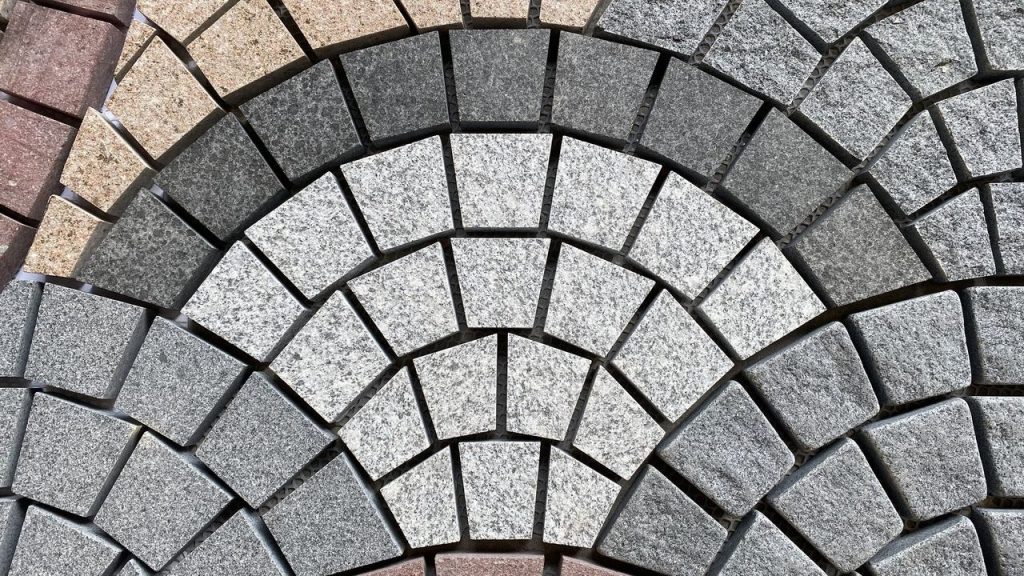
A paving pattern is chosen from a photograph and judged on site, and the gap between the two is almost never the stone. It is the geometry. Two pavements can use the same granite, the same finish and the same joint, and one looks like the picture while the other looks like an accident, because one was set out from a datum that suited the pattern and the other was started at a convenient corner and allowed to drift into the edges.
This article treats pattern as a laying problem rather than a decorative one: the radial fan, the random or crazy field, and the small-unit mosaic, what each one demands of the drawing before anything is cut, how colour and joints decide what the eye reads, and how a pattern behaves once a fall, a drain and a kerb join the drawing.
What a pattern asks of the drawing
A pattern is geometry, not a finish, so it is fixed by three decisions that all happen before cutting: the module (the unit that repeats), the setting-out datum (where the repeat is measured from), and the way the pattern meets its boundaries. Get the datum wrong and the pattern itself is perfect while the pavement looks wrong, because every error in a pattern shows up at the perimeter, where the pattern has to stop and the cuts are no longer repeats.
The datum is usually a wall, a step, a doorway centreline or the middle of a run, and each choice produces a different strip of cut pieces at the far edge. A pattern set out from the middle splits its remainder between two edges and reads balanced. One set out from a corner pushes the whole remainder into one strip. Neither is wrong, but only one of them is usually what the client pictured, and the choice has to be made on the drawing rather than improvised by the first layer who reaches the edge.
The second consequence is quantity. A pattern consumes more stone than a plain field of paving, because odd shapes leave offcuts that cannot go back into the repeat. That waste belongs in the quote, and a price built on a plain-field rate is the reason pattern projects surprise people late.
Half-round fans and radial work
A fan or radial pattern is a set of courses curving around a centre, so each piece is a truncated wedge and the joints converge towards that centre. It is the most forgiving pattern from a distance and the least forgiving in the hand, because the pieces change as the radius changes: near the centre the same course has to be cut narrower, and the tighter the radius, the more pieces and the more joints the pattern carries.
Radial work is set out from its centreline, not from its outer edge, and it wants symmetry. A fan that is slightly out of balance is read instantly, because the eye can compare one half of the pattern against the other and find the difference. The centre is also where the pattern is most vulnerable: if the centre lands on a drain, a column base or a step, it has to be designed as part of the pattern instead of being avoided, since a fan with a hole punched through its middle is the most visible defect a paving job can have.
Where fans are wanted across a large area, the pieces can be precut to the drawing instead of hand-shaped on site. Cutting the modules at the factory makes the repeat identical from one bay to the next and takes the judgement out of the laying — the pattern arrives as a series of numbered pieces rather than a radius and a hope. Our decorative paving patterns and cut-to-size paving are produced that way, from a plan rather than a standard sheet.
Crazy paving and the random field
Random paving, often sold as crazy paving, is a field of irregular polygons cut to interlock, and its whole value is that no two pieces are the same. That is also what makes it hard to price and hard to reproduce: a truly random field cannot be copied from a photograph, because there is nothing to repeat. When a client wants a specific look, the honest route is to treat the layout as a design in its own right and dry-lay it, photograph it, and number the pieces before they are bedded, so the field can be rebuilt exactly.
The consequence of irregularity is joints that vary in width. Narrow joints read as a surface; wide joints make each piece read as an object, which can be the point, but wide joints have to be built for. A joint that wide has to sit on a bedding that will not shrink away from it and a joint material that will not crack or wash out, and it adds surface for water to sit on. That is a durability question as much as an appearance one, and it belongs with the outdoor-material discussion in kerbs, setts and tactile paving.
The edge of the pieces is a decision that has to be taken before cutting, not after: a chiselled or tumbled arris reads as hand-made, a sawn arris reads as contemporary. Both are legitimate, and choosing late is how a random field ends up looking like a factory reject rather than a design.
Small units: setts, cobbles and mesh-backed sheets
Small units are what make a pattern possible at all. A sett is large enough to be a unit and small enough to turn a curve, and it is the workhorse of every fan, arc and ring. Below that, cobbles and mosaic move from paving into surface texture, where the individual piece stops reading as a shape and the field starts reading as a colour and a grain instead.
Sheet-mounted cobbles — small units bonded to a mesh or a backing so they can be laid in panels — buy speed and consistency. The trade-off is that the sheet is on a grid, so a single sheet design repeated across a large area shows its module as a visible break in the pattern. Alternating or rotating sheets hides the repeat; laying them all in the same orientation does not. The backing is only a handling aid, and a mesh-laid surface still needs the same bedding and the same attention to the base as loose stone, because a sheet can crack along its own line on a base that moves. Our mesh-backed cobbles and granite setts are supplied for exactly these two ways of working.
Where pattern should stop is part of the drawing. A pattern that simply runs into a kerb, a channel drain or a door threshold leaves the awkward cuts at the most visible line in the job. Good pattern work resolves at those lines deliberately, with a band, a border or a change of direction that looks intended rather than leftover.
Colour, joints and the mix that reads as one surface
How a pattern reads is decided as much by the joint as by the stone. At a tight joint the pavement reads as one plane and the pattern comes from the shape and the shading of the pieces; at a wide joint every piece reads separately and the pattern becomes graphics. Neither is better, but joint width and pattern have to be chosen together, and a joint colour matched to one of the stones in the mix will do more for a pattern than any amount of checking the pieces on a sample board.
Accent colours are the other place patterns go wrong. An accent only works if it is accepted that the stone varies from block to block and from pallet to pallet, so a deliberate contrast can become an accidental one if the accent stone is drawn from more than one batch. That behaviour is set out in colour variation in granite, and the difference between the stone families being mixed is covered in granite, basalt or porphyry. Finish matters just as much, because the same colour reads differently honed, flamed or bush-hammered, and the way the finishes behave in a pattern is the subject of the seven granite finishes.
The practical rule is to fix the palette by family and by batch before the pattern is drawn, not after, so the drawing is designed around the stone that will actually arrive.
Pattern on a fall, a drain and an edge
Outdoor paving is built to a fall, and the fall is not negotiable on appearance grounds: water has to leave. That means the pattern follows the fall rather than the fall being bent to suit the pattern. Some patterns cooperate — a radial field drawn around the outlet turns a drain into the centre of the design instead of a hole in it — and some do not, in which case the honest answer is to end the pattern at a line and continue with a plain field on the other side of it.
Where the fall changes, or where a pattern crosses a change of substrate, the pattern should be interrupted rather than carried across. A pattern that runs unbroken across a movement joint, or across the line where two slabs meet, will crack along that line and take the pattern with it. The discipline is the same one used on any outdoor scheme: set the pattern in bays that respect the joints, so movement shows at a joint rather than through the middle of a fan.
Two more things belong with the pattern on the drawing. The first is grip: a pattern carries many more joints and edges than a plain field, which helps underfoot when wet but also holds water at every one of them, so a pattern in a pool surround or a shower area has to be chosen with the wet-edge details in pool coping and paving rather than on looks alone. The second is the boundary, because a pattern meets kerbs, channels and steps, and those fixed elements are cut to their own specification; our kerb stones are made to the same plan so the pattern and the edge arrive agreeing.
What to send when you want a pattern
A photograph tells us the look; it does not tell us the geometry, and a pattern cannot be cut from a picture. What makes a pattern quotable and makeable is a small set of decisions written down:
- The pattern and its module. Fan, random field or small-unit repeat — and if it is a repeat, what the repeat unit is.
- The setting-out datum. Where the pattern is measured from, and which edges it has to finish cleanly against.
- The plan with boundaries. Kerbs, channels, drains, thresholds and any level change, so the pattern can be resolved at them rather than run into them.
- The fall and the outlets. Where water goes, so the pattern can be drawn to suit it.
- The joint intent. Tight or wide, and the joint colour, because both change how the pattern reads.
- The palette. Which stones, from how many batches, and the finish of each.
- Precut modules or loose units. Whether you want the pattern delivered as numbered pieces or set out on site from loose stone.
Send the plan and a reference photograph together and the pattern can be quoted as a drawing rather than a rate per area; the way that turns into a price is described in cut to your drawing. Precut pattern pieces are numbered and crated in the laying sequence, which is a large part of why planned pattern work arrives without damage — the crating that makes that possible is set out in our note on how a stone order is packed and shipped, and the factory shows where the modules are cut and marked.
If it would help to see these patterns in finished work rather than as diagrams, the installation gallery is photographs of real pavements and the materials pages show the colours and finishes a pattern can be built from. Send the plan through the quote page and we will come back with the module, the setting-out and the cut list.
Every figure on this page comes from our own order sheets. Where something is a trade norm rather than a number we can hold, we say so — send a spec and we will confirm it against a real block before you commit.
More from the yard

Send the drawing. We do the rest.
Reply within one working day, in English or Chinese. Send a spec, a drawing or just a photo of the sample you are matching — we will tell you honestly whether we can hold it.
MOQ 1 × 20FT · FOB XIAMEN · SAMPLES IN 7 DAYS