Where the weeks go in a stone order
Stone lead times are a queue, not a fixed number. What fills the calendar, what we control, what the sea controls, and how to plan back from an opening date.
28 October 2026 · 15 min read · GranTerra Stone, Hui'an
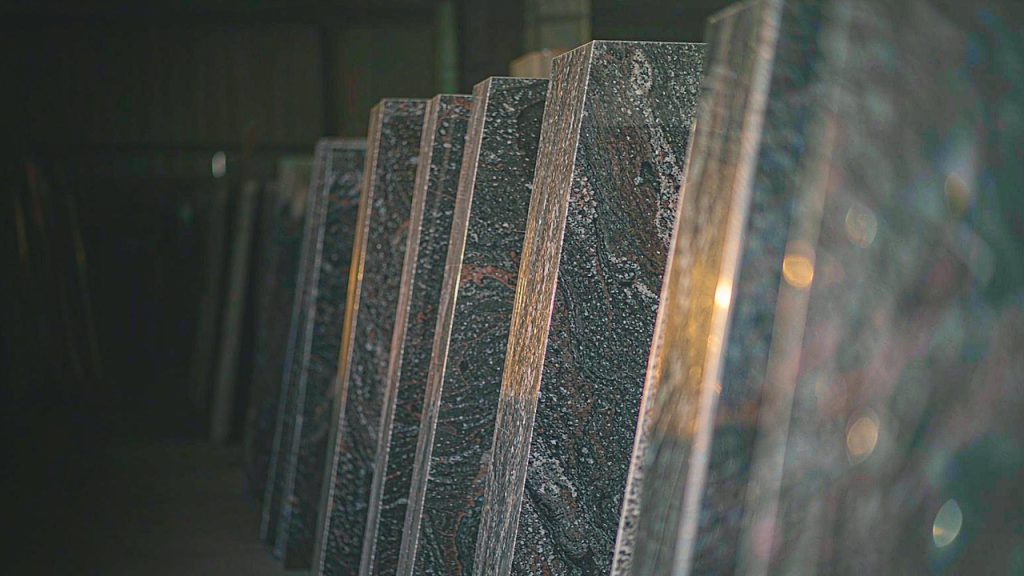
Every stone enquiry begins with the same second question. The first is the price. The second is: how long? And the honest answer is not a number of weeks. It is a date, and a date only means something once you know what it is counting from.
We get asked for “lead time” as though it were a property of the material, like density. It is not. It is the length of a queue that your order joins, and that queue is made of drawings, blocks, saw hours, hands, crates and vessels. Change one of those and the number moves.
This is a note about where the calendar actually goes. Not to defend a long date, but so that when you are holding a programme with an opening night on it, you can see which parts of the sequence are ours to control, which are yours, and which belong to nobody.
There is a queue, not a shelf
The single most common misunderstanding about buying stone from a factory is the assumption that somewhere there is a warehouse full of the thing you want, waiting for a purchase order. For commodity tiles that is roughly true. For cut stone it is not.
What sits in a stone yard is other people’s work in progress: blocks bought against specific projects, slabs sawn from those blocks, and finished pieces waiting for a container booking. Some of it looks available. Almost none of it is, because the block it came from has already been allocated and the client has already approved the face.
So your order does not come off a shelf. It takes a place in a line that was drawn before you arrived, and the position of that place depends on when your information is complete rather than when your email was sent. That distinction is the source of most of the frustration in this trade, on both sides of it.
It also explains why two suppliers can quote wildly different dates for what looks like the same order. One of them is telling you when the saw is free. The other is telling you when a block they have not yet bought might be sawn.
The clock starts on an approved drawing
Nothing in a stone works can begin from a description. A saw cannot cut an intention. Before a single piece is marked, somebody has to translate the design into a set of dimensions, edge details, cut-outs, radii and a fixing logic — and somebody has to sign that translation off.
That signed drawing is the starting gun. We will happily spend a week arguing about it before the order is placed, at no cost, because a week of quoting conversation is cheaper than the three that follow a bad one. Once a deposit is against a drawing and the drawing is marked approved, the work is scheduled. Until then it is a conversation.
The trap is the revision. A drawing that changes after approval does not simply move the affected pieces to the back of the line: it can pull the whole order out of its slot, because the block may have been sawn and the pieces may have been finished. Stone does not go back. A change of mind about an edge profile on approved work is not an edit. It is new material.
If your project has a design stage that is genuinely still moving, the useful move is to say so early and split the order. Get the pieces whose details are settled into production, and keep the unsettled ones out of the queue until they are. A phased order is slower to administer and much faster to deliver.
Choosing and holding the block
For plain work, the block is chosen by us and the only thing that matters is that it is sound and consistent. For anything where the face is the point — a matched wall, a counter, a run of carved pieces — the block has to be chosen against the design, and that choice takes time because it is a decision, not a lookup.
In practice this means photographs and video of candidate blocks, sometimes a visit to the yard, and a conversation about which of the available faces reads the way the drawing intends. Veining direction, the position of a patch of contrasting ground, how the stone behaves when it is book-matched: these are judged by eye, and eyes disagree, which is why a photograph is a starting point rather than a decision. What a picture can and cannot tell you — a cut face read against a sawn one, and what a saw mark says about the block behind it — is set out in reading a granite slab.
A chosen block is held only against commitment. We cannot reserve a block for six weeks on the strength of a friendly email, because blocks are the scarce item in the whole chain and someone else is waiting for that one. Once it is held, it is held — and if it is rejected at the saw for an internal fault nobody could see from outside, the honest news is that the clock restarts on a new block. That is rare. It is also the reason we open blocks early rather than at the last minute.
The saw is the slowest thing in the building
Sawing is where most of the calendar disappears, and it is the part customers never see. A block has to be squared, set on the machine, and cut; a large block goes through in stages rather than in one pass. The saw does not care how urgently you need it. It removes material at the rate it removes material.
There is a second, quieter delay after the cut. Stone comes off the saw wet, and wet stone cannot be finished or inspected properly — water held under the surface reads as a patch that is not there, and a polishing head on damp material gives an uneven result. Slabs are therefore stacked and left to settle before the next operation, and that settling is not a delay anyone can hurry without paying for it later in the finished face.
The scheduling logic is also counter-intuitive. Cuts are grouped by block, not by order, because setting up a machine for one small batch wastes hours that could have been spent cutting the same material for three clients. A modest order can therefore travel faster as a passenger on a large block than it would alone. It can also, if the block it needs is not yet on the machine, wait for a slot that was never going to be free this week.
This is the stage where a buyer can help without knowing anything about saws. Ask whether the material you have specified is available as a block in the yard today, or whether it has to be brought in. That single question separates a date that is real from a date that is a hope.
There is also a physical reason why heavy sections take longer than the calendar suggests. A deep cut is not one pass: the machine works through the block in stages, and each stage is a setup that has to be checked. On a block that is going to yield long pieces, the first cuts are also the ones that reveal what the inside actually looks like, which is why the opening of a block is scheduled early and watched rather than left to run.
Finishing runs on different hands
Once the pieces exist, the work stops being mechanical. Polishing, honing, bush-hammering, sandblasting, hand-dressed edges, curved sections, carved objects: each of these runs at its own pace, and some of them run at the pace of one person with a tool in their hands.
This is where small orders lose their advantage. A crate of large paving pieces is quick, because the machine accepts a flat face and the work is uniform. A mixed order of counters with cut-outs, sills with a shaped edge, a curved panel and a carved object is slow, not because any single operation is hard, but because the pieces keep changing setup and asking for a different set of hands.
Edge work deserves its own warning, because it is almost always underestimated in the programme. A simple aris is nearly free in time. A profiled edge on a long piece has to be run, checked against a template, and polished back to match the face. Multiply that by the number of pieces, and an edge decision made late can add days to a delivery that otherwise looked comfortable.
If you have a fixed date and a mixed order, tell us at quotation stage rather than after approval. It is far easier to sequence finishing around a deadline than to compress it afterwards, and compressing it is how inconsistent faces happen.
Dry-lay, numbering and crating
Before anything is packed, the order should be laid out and looked at as a whole. This is the last moment where a mistake is cheap. A missing piece found here costs a day; the same piece found on site costs a shipment, a delay and an argument.
Dry-laying also settles the sequencing question. Pieces are numbered so that the installer can work in the order the drawing intends, and so that the crate that arrives first carries the pieces needed first. That numbering earns its keep: a fitter who can follow it works in the order the drawing intended, and a fitter who cannot is guessing, usually at the far end of a corridor that is already tiled. How the numbers travel from the yard to the site, and why the same marks appear on the drawing and on the crate, is the subject of the number on the crate.
Packing itself is skilled labour. Stone is heavy, brittle at the edges, and unforgiving of a crate that was built for a lighter material. Faces are protected, edges are separated, timber is positioned where the load actually bears, and the crate is closed only after somebody has photographed what went in. All of that happens in working days, and it is the part of the programme most often assumed to be instant.
When the order is ready, the rest of the journey is picked up in how a stone order ships — the crating, the loading, and what is worth checking when it lands.
What the sea decides on its own
We can control a saw. We cannot control a vessel. Sailing schedules are published and then amended, space is confirmed and then rolled, and a transhipment port can hold a container for a week without explaining itself to anybody.
None of that is unique to stone, and none of it is improved by being argued with. What can be improved is what you know while it is happening. We book the space, we get the bill of lading, and we pass on the sailing and the estimated arrival as we receive them, including when the news is that the date has moved.
Destination clearance is the other variable, and it belongs to your side of the water. A container that arrives on time and sits for a fortnight waiting for paperwork has not, from the point of view of your programme, arrived at all. The documents we issue at loading are the ones your broker needs; the earlier they are in your broker’s hands, the less of that fortnight you spend.
There is one more thing the sea settles for us: stone does not fly. Air freight exists and is occasionally used for a handful of replacement pieces on a stalled site, at a price that makes everybody unhappy. It is not a way to fix a date that was planned without transport in it.
The five ways a date actually slips
In our experience the reasons are short and repeatable, and four of the five are avoidable.
A drawing that keeps moving. Revisions after approval are the largest single cause of late delivery, and the least sympathetically received, because the delay is real but the cause is upstream of the saw.
A quantity that changes after cutting. Adding pieces is usually possible. Changing the size of pieces that already exist is not: the material has been committed and the offcut is not a piece of anything.
A block that fails at the saw. Hidden faults, an unexpected fissure, a colour that does not carry through the depth. This one is nobody’s fault and still costs weeks, which is why we open blocks early.
Money arriving late against an agreed schedule. Production slots are held against deposits. When a deposit lands a fortnight late the slot has usually gone to somebody else, and the queue position goes with it.
The calendar, not the factory. The works close for the New Year holiday, and the weeks on either side of it run slower than the weeks in the middle of the year, because everyone in the region is trying to finish before the same date. Orders that need to sail in that window should be placed as though the window were already closed.
Planning backwards from the opening date
The useful way to use any lead time is to work backwards, and to do it before the enquiry rather than after the purchase order. Start at the day the doors open and subtract.
Take the installation off the end first, including the days the fitter will need for setting out, cutting on site and making good. Then the delivery to site, which is never the same day as arrival at port: clearing, transport, and somewhere to put the crates that is not in the way of other trades.
Then the sea, with a margin for the fact that schedules move. Then packing, then finishing, then sawing, then block selection, then drawing approval. What is left is the date by which your information has to be complete — and it is usually earlier than the date people plan for.
Two practical consequences follow. The first is that the question worth asking at enquiry is not “what is your lead time” but “if the drawing is approved in the week of the fourteenth, when does this arrive”. The second is that a project with a hard opening date should carry spare pieces of the things most likely to be damaged or miscut. Those pieces cannot be ordered after the fact in time to be useful; they have to be in the original crate.
For anything curved, carved or templated, add a separate allowance. Those pieces run on their own clock, described in curved stone work, and they do not compress well. The same applies to anything drawn to a template taken on site: the template has to exist before the stone can, and a template that arrives late is a start date that moves.
Large projects are worth phasing for the same reason. A building that is finishing floors on two levels at once rarely needs every crate on the same vessel. Splitting the order into a first delivery that lets the trades start and a second that follows behind is slower on paper and faster on site, because it stops the whole programme from waiting on the last piece to leave the polisher.
Where a project does split, keep the numbering scheme whole. Crates that arrive in a different order from the drawing are only a problem if the marks stop making sense between shipments.
What we will put in writing, and what we will not
We will give you a completion date counted from two events: an approved drawing and a received deposit. We will tell you which block we intend to use and whether it is in the yard. We will tell you when the order is sawn, when it is finished, when it is packed, and when it is booked to sail. If a revision lands and it costs you a week, we will say so on the day we see it rather than in the week it bites.
What we will not do is promise an arrival date at your port as though we controlled it. We can quote a sailing and an estimate, and we can keep you informed when either changes. We cannot make a vessel leave, and a supplier who guarantees a landing date is either guessing or intending to explain later.
If you are still at the stage of deciding what the order contains, the place to start is the range itself: what we cut, and how each line is worked, is on the products page.
That may read as a cautious way to sell stone. It is the only honest one we have found. A date you can plan against is worth more than a date that flatters the quotation, and the projects that run smoothly are almost always the ones where the sequence was understood before the first block was opened.
Every figure on this page comes from our own order sheets. Where something is a trade norm rather than a number we can hold, we say so — send a spec and we will confirm it against a real block before you commit.
More from the yard


Send the drawing. We do the rest.
Reply within one working day, in English or Chinese. Send a spec, a drawing or just a photo of the sample you are matching — we will tell you honestly whether we can hold it.
MOQ 1 × 20FT · FOB XIAMEN · SAMPLES IN 7 DAYS