How a stone order ships: packing, loading and what arrives
Packing is where a stone order either arrives or does not. What a crate is actually doing, why weight limits a container before volume does, and the minutes after unloading that decide a claim.
10 October 2026 · 11 min read · GranTerra Stone, Hui'an
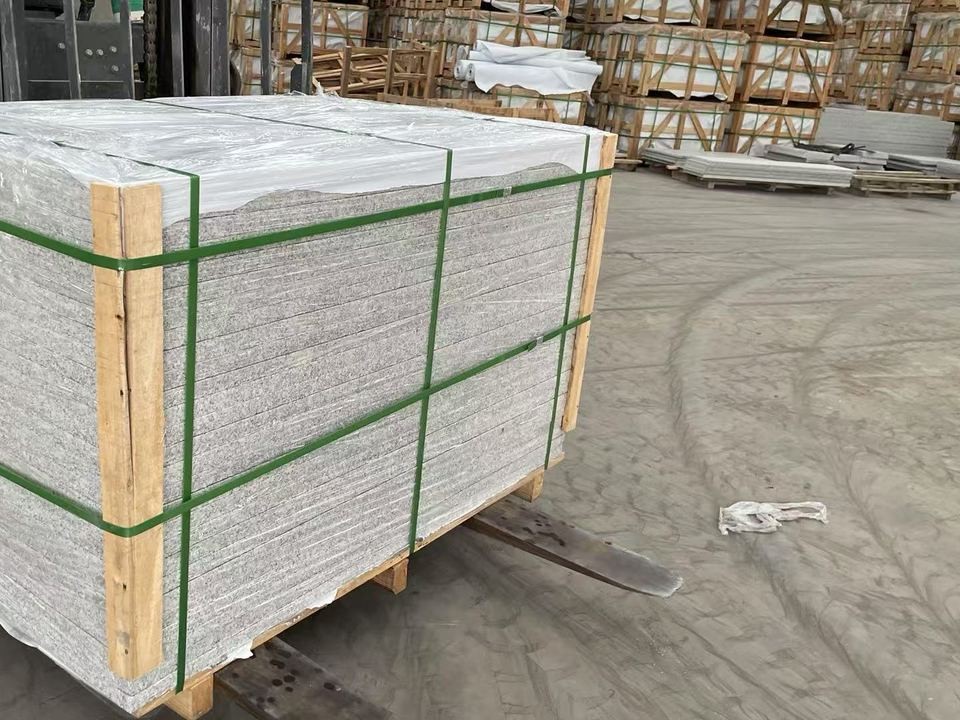
Almost every question we are asked about a stone order is asked before it is made. Which stone, which finish, whose drawing, how many. The packing usually gets settled in a line at the bottom of the quotation, and that is the wrong place for it, because packing is where an order either arrives or does not.
This is not a page about our cartons. It is a page about the handful of decisions that decide whether what you bought reaches your site in the condition it left in — including the one most buyers leave until the last moment, which is where the container is actually going.
Here is how a stone order leaves the yard, and what to look at when it lands.
What actually gets damaged, and when
Stone is not fragile. It takes weather, feet, traffic and a couple of decades of use without complaint. What it does not take is being hit, and almost all of the hitting happens between the workshop and your gate.
The failure is rarely the stone giving way under a load it was made for. It is an edge taking a knock from a forklift tine, a corner losing a chip as a band is cut, or — the expensive one — a whole pallet shifting and the pieces grinding against each other for the length of a sea passage. A polished face that has rubbed against another polished face for three weeks arrives matt and scratched, and no stone resists that.
So the job the packing does is not to carry weight. The stone carries its own weight perfectly well. The job is to stop movement, and to keep two faces that must not touch from ever meeting. Everything else in this article follows from those two aims.
What a crate is for
A crate does three jobs, and naming them explains why some orders go into timber and some do not.
The first is to immobilise. Pieces are packed face to face with a separator between them, packed tightly enough that nothing has room to travel, then held with banding that runs both ways rather than one. A band that goes only around the long side lets the load walk; the cross band is what stops it.
The second is to protect the two things that cannot be put right afterwards: edges and polished faces. Corner and edge protection costs very little and a chipped edge costs a great deal, because a chip cannot be polished out, only dressed — and dressing the edge of a finished piece means it no longer matches the piece beside it.
The third is to survive being handled by people who did not pack it. That is the honest reason a crate exists. Between the yard and your site the load passes a terminal, a crane and a truck driver, none of whom know what is inside. A crate has to be obvious to a forklift, liftable without a second attempt, and still square after something else has been stacked on top of it.
It is also why timber packaging has its own rulebook. Many destinations will refuse wood that has not been treated, so the crate has to be treated and marked before it travels, and your broker will want that marking legible — on the way out and again on arrival. It is the sort of detail that costs nothing when it is on the packing list, and a great deal when it is discovered at the port.
Weight fills a container before volume does
This is the most useful thing to understand about moving stone, and the one that surprises buyers who have shipped lighter goods.
A container is limited by weight and by volume, and a stone load reaches its weight limit while there is still floor space and headroom left over. So the load is not planned in cubic metres. It is planned in kilograms, and the last pallet is not the one that fits — it is the one that keeps the total under the limit.
Two consequences follow. An order that grows by a single extra pallet can push the whole container over, and at that point it is a question about a second container rather than a slightly fuller one; far better raised when the quotation is written than when the container is being loaded. And dense stone and light stone do not cost the same to move. Two orders of the same value, packed the same way, can land at very different prices, because what you are paying to move is mass. Our quotation page sets out where that number comes from.
It is also the reason hollowed work is worth the carving, and why two forms that look alike in a photograph can be far apart in freight. That argument belongs to the carved range rather than here, but the arithmetic is the same one.
Pallet, crate or carton — and when none of them
The right container is the lightest one that does the job, because every kilogram of packing is a kilogram of stone you are not shipping.
Small units that can be laid flat and stacked — setts, cobbles on mesh, kerbs, decorative paving — travel banded on pallets, sometimes with a timber frame or a film wrap over them. They do not need a lid. Fabricated pieces do. A vanity top with a cut-out or a batch of worktops carries a finished edge on every piece and a machined hole in most of them, so each one is separated and the run is cased. Thin material, which is the most breakable thing in the catalogue, goes into cartons, where the pieces support each other and the carton takes the knocks instead.
Large slabs are the exception. They cannot be crated economically, so they travel in an A-frame rack — a purpose-built stand that carries them on edge, which is how they are stored, and which is the only orientation in which a big slab has any stiffness at all.
And then there is the case where the answer is none of the above. Anything too large or too heavy to be handled twice should be planned so that it is loaded once and unloaded once. On a big free-standing piece the crate is a rounding error next to the handling, and the handling is the risk.
A mixed load has to be balanced, not just filled
Most real orders are mixed: paving for the ground floor, basins for the bathrooms, a crate of tops on the same bill. Loading one is a sequencing problem before it is a packing problem.
Heavy material goes on the container floor, spread evenly, because a point load on the floor is how you damage both the floor and whatever is stacked above it. Nothing heavy is stacked on a crate holding polished or hollow pieces. And anything the installer needs first is loaded last, so that it comes out first at the far end — which is worth thinking about, because a container that has to be completely unpacked to reach the first item costs your site a day.
If a delivery goes to more than one address, or to more than one floor of one building, the lots have to be separated and marked at packing rather than sorted on site. Said at order stage, it is a line on the packing list. Said after loading, it is somebody else’s job at your cost.
The papers that travel with the stone
Three documents go with any stone shipment, and buyers who import regularly will know all three: the invoice, the packing list and the bill of lading. The third is the one people skim and the one they need on arrival.
The packing list is what tells your side how the container is organised — how many packages, which lot is in which, what is inside each one, and what each one weighs. Without it, unloading is guesswork. With it, your foreman can plan the order the pieces come out in and have the right equipment standing by.
Before the doors close, ask for photographs of the packed pallets and of the loaded container. A photograph of a blocked, banded, sealed container is not documentation for its own sake; it is the only record of the condition of the goods at the moment they were sealed, and it is what turns a claim into a claim rather than a conversation.
How far we carry the order depends on the term you buy on, and that is settled at quotation rather than here. What does not change is that the paperwork has to match the load, piece for piece, because the packing list is also the list your customs will read.
The ten minutes that decide a claim
Almost everything that goes wrong with a stone delivery is decided in the first ten minutes after the container is opened, and it is decided by whoever is holding the phone.
Check the seal against the paperwork before it is cut, and photograph it. Look at the crate before opening it: a crushed corner, a shifted band, or a crate that has clearly been restacked tells you where to look first. Then unpack in order, and photograph damage where it is — on the pallet, still packed, with the crate in shot.
The reason is not bureaucracy. A claim has to be raised against the carrier while the goods are still in the condition they arrived in, and once the pallet has been broken down and the stone distributed around a building there is nothing left to put in front of anybody. A cracked piece photographed on the pallet is a claim. The same piece photographed on a finished floor is a story.
Notification windows are short for the same reason. Most freight terms require damage to be noted at delivery or within a very short period afterwards, and the window does not reopen after the fact. If a container lands late on a Friday, the photographs still have to be taken before anything is unpacked.
Tell us where it is going before we pack
None of the above is decided by a packing department. It is decided by four questions, and they are best answered when you send the enquiry rather than when you send the order.
What is at the far end. A warehouse with a dock and a forklift is a different pack from a hotel with a goods lift and a narrow service street. If the container cannot reach the site, somebody has to break the load, and the packing has to be designed for that person.
How heavy a single package may be. A crate is only handled if a machine can lift it. On large pieces the weight of one package matters more than the weight of the order, because that is the number that decides whether it arrives by forklift or by hand.
Whether it has to arrive in lots. Separate units, separate phases, separate floors — marked at packing, or guessed at site.
What your customs will look at. Wood packaging rules, marking, and anything your import regulations require to be shown on the crate. This is your line to know rather than ours, but it is worth telling us, because a crate that fails inspection at the port is a crate that gets opened at the port.
Underneath all of it sits the material. What a stone family does in the hand is on the materials and colour page; what a surface does when it meets a band and a fork tine belongs with finishes; and why two batches have to be stacked and shipped as two batches, rather than blended into a single lot that will never match, is the subject of colour variation.
Send the address with the drawing
The short version: packing follows the destination, and the destination is known before the order, not after. A quotation that knows what is at the far end can be packed for it. One that does not will be packed the default way, and the default way assumes a forklift and a dock.
The factory page is where the cutting, checking and boxing happens; the product range is where the differences in packing are visible — cartons for thin tiles, banded pallets for kerbs, and timber for coping, treads and fabricated tops. Send us the site address along with the drawings: it is a much smaller question than it looks, and it changes more than you would expect. Our paving guide and tub guide both end in the same place — the delivery is part of the design, not the paperwork after it.
Every figure on this page comes from our own order sheets. Where something is a trade norm rather than a number we can hold, we say so — send a spec and we will confirm it against a real block before you commit.
More from the yard



Send the drawing. We do the rest.
Reply within one working day, in English or Chinese. Send a spec, a drawing or just a photo of the sample you are matching — we will tell you honestly whether we can hold it.
MOQ 1 × 20FT · FOB XIAMEN · SAMPLES IN 7 DAYS