What a construction site does to new stone
Cement slurry, acid washing, scaffold rust and trapped moisture do more damage than weather. What new stone meets before handover, and who pays for it.
31 October 2026 · 13 min read · GranTerra Stone, Hui'an
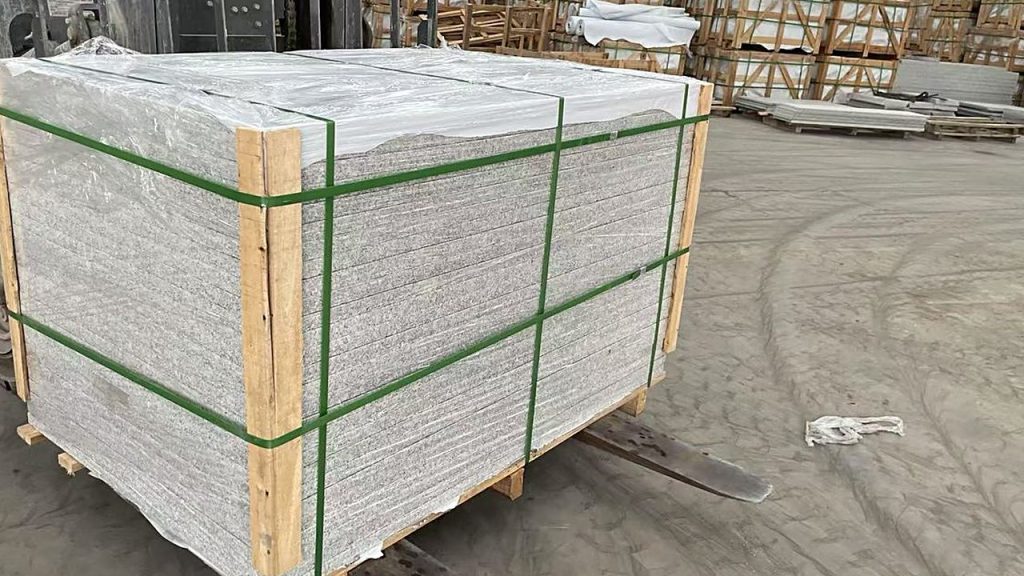
A stone floor is at its best on the day it leaves the workshop. Polished, uniform, wrapped, banded, numbered. Everything that happens to it after that is a negotiation with a building site that has other priorities, and the stone is usually the most expensive thing on the floor with the least protection.
The gap between delivery and handover is where most of the permanent damage in a stone installation is done — and it is almost never done by weather. It is done by the trades working above and around it, by the cleaning method chosen in the last week, and by protection that looked thorough and behaved like a greenhouse.
The stone is finished before the building is
By the time a crate is opened, the stone has already been through everything the works can throw at it: block selection, sawing, finishing, dry-lay, numbering, inspection, packing. That is the part of the process we control, and it is the part that produces a consistent surface.
What follows is the part nobody controls the same way. A hotel fit-out runs for months after the first floor is laid. Ceilings go up, walls get painted, joinery arrives, services are commissioned, scaffolding comes down, and a hundred people who did not specify the stone walk across it every day. Stone is a finished product sitting inside an unfinished building, and the two states are incompatible for as long as they overlap.
The damage that results is rarely dramatic. It is a dull patch where the polish was eaten, a rust bloom under a scaffold foot, a set of pale etch marks near a sink, a border of chipped arrises where trollies were turned. Each is small. Together they are the difference between a floor that looks new at handover and one that looks five years old on opening night.
The first week: unpacking, stacking and condensation
Three decisions in the first week set up most of what follows.
When to unpack. Wrapping is protection, and taking it off early hands the stone to the site. Taking it off late means the crate is in somebody’s way and gets moved by whoever needs the space, without the care that was used to place it. The useful rule is to unpack when the area is ready to receive the stone and not before, and to keep the packing materials on site until the last piece is fixed.
How to stack. Stone should stand or lie in a way that cannot fall, on bearers rather than on the ground, and face to face rather than face to back. Two polished faces resting against each other will grind grit between them and mark both; two faces separated by a clean spacer will not. A stack leaning against a wall is a stack waiting to slide.
Condensation. This one catches people who have done everything else right. A container or a cold store arrives at a hot, humid site and the stone is below the dew point. Open it immediately and the surface beads with water, which is then drawn into the face and the joints before anyone has laid a piece. The stone needs to come up to site temperature in its packing. It is the same physics that fogs a cold glass, and it costs a day of patience to avoid.
What the other trades leave behind
Ask what ruins stone on a site and the answer is not rain. It is the work going on above it.
Grinding and cutting. A disc cutting steel throws a fine spray of hot metal particles that land, cool and sit on the surface. Nothing happens until water arrives, and then each particle becomes a rust spot. This is the single most common cause of the small brown freckles that appear across a new floor in the month after handover, and the trade responsible has usually left the site by then.
Painting and spraying. Overspray lands as a mist and dries. On a textured face it sits in the low points and is very difficult to lift without taking the finish with it. On a polished face it is easier to see and easier to remove, which is the wrong way round for the person who has to do it.
Plaster, adhesive and filler. Dropped, walked in, and left. Most of these are alkaline, and a film of them left on a polished surface for a week will dull it as effectively as a mild acid would.
There is a scheduling decision underneath all of this, and it is worth naming. Laying the stone early buys room at the end of the programme, when every trade is fighting for the same days. Laying it late shortens the exposure, but it puts the stonework in the middle of the final push, when the pressure to move fast is highest and the protection is most likely to be lifted so that somebody else can work. Neither choice is wrong. What is wrong is laying early without a protection plan, which amounts to deciding in advance that the finish is expendable.
Scaffolding and temporary works. Standards stood on finished paving, feet on unprotected stone, and a structure that is dismantled by people dropping things. The load of a scaffold leg is concentrated on a small area and the stone underneath is not designed for a point load of that kind, which is a separate problem from staining.
Cement slurry and grout residue: the alkali problem
The residue that comes with laying stone is not dirt. It is a thin film of cementitious material bonded to the surface, and its chemistry is alkaline.
While it is wet it wipes off. Once it has cured it does not, and the methods used to get it off are the ones that cause the damage: a stronger chemical, a harsher pad, more pressure, longer dwell. A polished surface that has been through that cycle comes out clean and slightly duller than the piece next to it, and the difference is permanent because the polish has been removed rather than covered.
The practical answer is timing and method. Clean the joints as the work proceeds rather than at the end of the week. Keep the mixing area away from finished stone. Use the least aggressive product that will do the job, work in small areas, and rinse and dry rather than leaving a puddle to find its way into the joints.
Acid washing is the single most destructive habit on site
At the end of a fit-out, there is a tradition of washing the whole floor with an acidic product to make it look uniform before handover. On ceramic and porcelain it usually works. On stone it is the most expensive thing that happens to the project.
On marble and limestone the effect is immediate and obvious: the acid attacks the calcite and leaves dull, whitish marks where it stood. On granite it is slower and therefore more dangerous, because it looks like nothing is happening. The sheen goes where feet travel and around the sinks, the darker minerals start to show through, and by the time anyone notices, the whole floor has been treated.
There is no product that puts a polish back. The finish is a decision made at the works and not something that can be restored on site, which is why choosing it deliberately matters more outdoors and in heavy traffic. The only remedy is mechanical: the floor is ground and re-polished, in a finished building, with dust extraction and a result that depends entirely on who does it. That is a week of work and a bill nobody budgeted for, on a floor that was correct before the wash.
The instruction that prevents it is one line in the cleaning specification: no acidic product on any stone surface, at any stage, for any reason. It is worth repeating to the cleaning contractor directly, because the person holding the mop at midnight has not read the specification.
Metal leaves marks that stone cannot forget
Steel and stone do not get on. A scaffold tube that drips after rain, a wire brush used to clean a joint, a steel trowel left face down, a skip that scrapes a paving edge: each deposits iron, and iron plus water plus time equals a rust stain.
On a polished surface the stain sits on top and can often be lifted. On a honed, flamed or bush-hammered face it goes into the pore structure, and removal takes the mark down but rarely takes it out. The pale ghost that remains is the reason a specification should forbid steel wool and wire brushes on stone altogether, and require any temporary metalwork to sit on timber or rubber rather than directly on the finish.
Removing rust once it is there is a compromise by definition, since the effective products are acidic and the surface is the thing being protected. A chelating gel applied locally, briefly, and rinsed thoroughly will lift most of it. Anything stronger trades a rust stain for an etch mark.
Protection that traps water is worse than none
The instinct at the end of a shift is to cover the floor with plastic. Plastic is the wrong material, and it is used on almost every site.
A polythene sheet over a new stone floor traps moisture underneath it. New buildings are wet: screeds cure, plaster dries, and the air inside a sealed site is humid. Trapped under a non-breathable sheet, that moisture condenses on the stone, sits in the joints and produces exactly the symptoms nobody wants at handover — efflorescence, damp patches, a sealer that never performs. The covering looks like care and behaves like a poultice.
What works is a covering that breathes and can be lifted: corrugated board, a breathable membrane, or fibreboard laid loose rather than taped down. The other trap is tape. Ordinary tape applied to a stone face and left for weeks in the sun leaves an adhesive residue that cures, and on a porous face that residue becomes a mark that outlasts the project. If something must be taped, tape it to the protection and not to the stone.
The one exception is the wet area, where the layers below the stone are the ones that matter and protection has to be compatible with them — a subject the waterproofing guide covers, since a floor covering does not protect a membrane from a bad detail.
Who is responsible, and when the cover comes off
Almost every dispute about site damage is a dispute about a handover that never happened. The stone supplier says the material left the works in good order. The main contractor says the floor was fine until the crates were opened. Both are usually telling the truth, and there is no document that settles it.
Two moments close that gap, and both need to be agreed before the order, not after the argument.
The first is the inspection on arrival, done before the crates come apart and the place fills up with people. That is the point where material defects and transit damage are identified and separated from everything that happens next — the arrival inspection has its own method, and a signature at that gate is worth more than any later photograph.
The second is the handover of protection: who covers the stone, with what, from which date, and who is responsible for it until it comes off. That sentence belongs in the programme. So does the date the protection comes off, which should be after wet trades, after painting, after scaffolding, and before the final clean. Protection removed too early is decoration for the last two weeks of the job.
The final clean is a specification, not a favour
The last clean before handover decides what the client sees on day one, and it is usually done by a specialist cleaning contractor brought in for the opening, working to a deadline, with products chosen for speed.
Those products are the problem. A pre-opening clean is typically a strong alkaline degreaser to lift construction film, followed by something acidic to remove the residue, applied with a rotary machine. Each of those steps is defensible on a ceramic tile and destructive on stone. The alkaline step strips sealer. The acidic step etches. The rotary machine, run dry, burnishes the grout and leaves swirl marks in the finish.
The fix is a page, not an argument: neutral products at the label dilution, no acid, no abrasive pads, no pressure washing of joints, and a named person to call before anyone improvises. Pressure washing deserves its own line, because it is the one method that reliably puts water where the design spent money keeping it out, and blows the bedding sand out of the joints while it does it.
One habit separates a clean floor from a damaged one, and it costs ten minutes: try the product on a spare piece or in a corner that will be covered, and look at the result once it is dry. Most of the damage described above is visible within an hour of the first pass, while it can still be undone. That instruction belongs to the person holding the mop, not to the person who wrote the specification.
For a commercial kitchen or a wet area, add the surfaces that are being cleaned daily by staff who were never told anything, and the same page covers both phases — the regime after handover is set out in the care guide, and it works far better if the people who will follow it have seen it once during the fit-out.
What to write into the contract
None of this is exotic. All of it is cheap to write down and expensive to discover.
Five lines cover most of it. Protection: what covers the stone, from when, and who maintains it. Cleaning: no acid at any stage, neutral products, no abrasive pads, no pressure washing of joints. Sequence: protection stays on until wet trades, painting and scaffolding are finished. Acceptance: an inspection on arrival, and a second one when protection comes off, both photographed. Remedy: who pays for a piece that has to be re-cut, and how long a replacement takes to arrive.
That last line is the one everybody skips, and it is the line that decides whether an opening date holds. A damaged piece from a closed batch is not a warranty claim, it is a new order, and the weeks it takes to arrive are the weeks the opening slips. It is the reason a spare belongs in the first order rather than in a later conversation — the argument for it is set out in the piece about spares.
Everything above assumes the material arrived in a condition worth protecting, which is why the packing matters as much as the polishing: the crate is the first protection the stone gets, and the way it is packed and numbered on our floor is what makes the site’s job possible. If you are specifying a fit-out and want the sequence talked through before the order is placed, send the programme with the drawings — that is a conversation worth having early rather than on the day the acid arrives.
Every figure on this page comes from our own order sheets. Where something is a trade norm rather than a number we can hold, we say so — send a spec and we will confirm it against a real block before you commit.
More from the yard


Send the drawing. We do the rest.
Reply within one working day, in English or Chinese. Send a spec, a drawing or just a photo of the sample you are matching — we will tell you honestly whether we can hold it.
MOQ 1 × 20FT · FOB XIAMEN · SAMPLES IN 7 DAYS