Why the spare piece has to be in the first order
Stone cannot be reordered, only re-bought. Why the spare has to be cut in the same run, how many to hold, and where the crate should live for the next decade.
29 October 2026 · 14 min read · GranTerra Stone, Hui'an
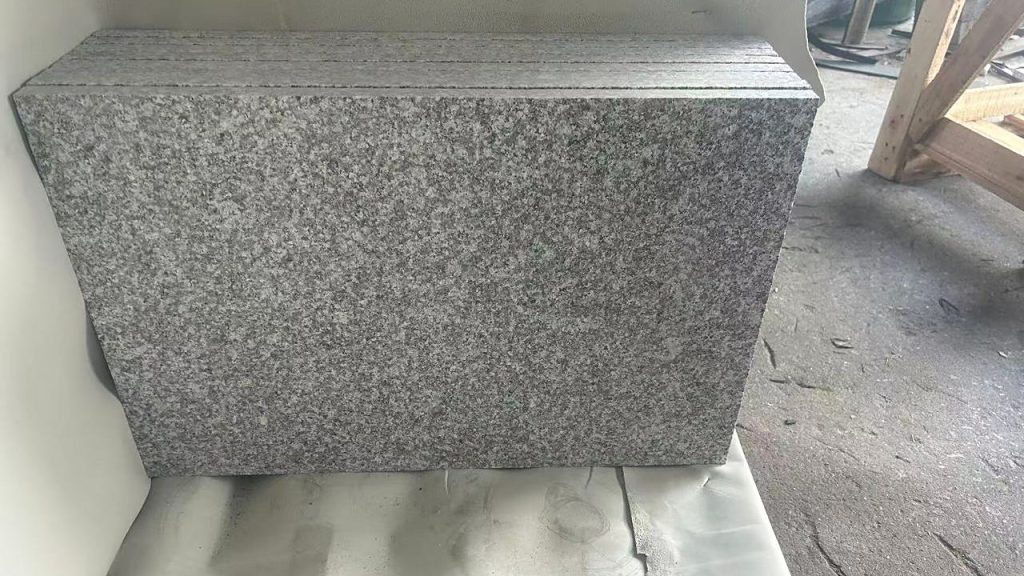
A hotel opens with a granite step at the foot of a short flight into the lobby. Eighteen months later a housekeeping trolley catches the corner of it and takes a piece out the size of a thumb. The stone itself is fine. Nothing has failed. What has happened is ordinary wear in a building with wheels in it, and the only question that matters on the morning it happens is whether a matching piece exists somewhere in the building.
Usually it does not. Not because anyone was careless, but because the order was placed from a net list: the exact number of pieces the drawing called for, no more. That is a perfectly logical way to buy a commodity and a poor way to buy stone, because the thing you are buying cannot be bought again.
This is a note about the piece that is ordered and never installed, and why it has to be ordered at the same time as the pieces that are.
Stone is bought in runs, not in units
A ceramic tile has a product code. You can walk away for two years, come back, and order one more from the same code. Colour will be close. Nobody will see the join.
Stone does not work that way. What you buy is a share of a particular block: a single mass of material with one face, one mineral structure, one way of taking the light. Buy the same granite by name in three years and you will receive a different block, and the difference will be visible wherever the two meet, even though both are correct and both are the material you asked for.
That is the whole argument in one sentence. The unit of purchase is the run, not the piece, and the run is decided once — at the beginning. If there is a fair chance that a piece will one day need replacing, the only moment at which a replacement is possible is while the block is still on the saw. The reasons two runs differ are set out in colour variation in granite; the consequence here is simpler. Later is a different stone.
Where the material goes before it ever reaches site
An order cut exactly to the net list is an order with no room for its own mistakes, and there are always some. The material is consumed before installation begins, by a series of small, predictable losses.
Cutting. Every cut removes material, and the piece you want is never the last thing left in the block. Book-matched faces waste more, because the pair has to come from the same region of the block and the sequence cannot be shuffled.
The dry-lay. When the whole run is spread out across the floor before packing, a piece that reads wrong — a patch of ground where the field should be even, an edge that has chipped in handling — is pulled and re-cut. That is the correct decision, and it happens after the material has already been committed.
Transit. A crate protects against the ordinary knocks of a sea passage, not against a fork-lift that arrives too fast. Claims are settled afterwards, but the piece that was damaged is replaced from the same run or not at all, and by the time the damage is visible the block is usually long gone.
Handling. Stone edges are brittle in a way the face is not. A corner takes a knock between the bench and the crate, or between the crate and the floor of the building, and the piece is scrap for a visible location.
Site. The last metre is the most dangerous. A saw on site, a dry cutter in the hands of someone who has not read the drawing, a chipped arris where a door frame was fitted after the floor. Each of these consumes from the same run.
None of that is a reason to pad an order out of caution. It is a reason to decide, deliberately, which pieces are worth holding one extra of, because the alternative is not a saving — it is a claim, or a wait, or a patch.
A spare has to be a finished piece
The instinct, when the subject comes up, is to keep the offcuts. It sounds thrifty and it almost never works.
An offcut is material, not a piece. It has a rough edge from the saw, a face that may not have been finished, and a size determined by whatever was left over rather than by what might be needed. When a repair is required, what is required is a piece that can go straight in: the right face, the right finish, the edge already worked to the same profile as the piece it is replacing, and, where the joint is tight, a face direction that continues the run rather than fighting it.
In theory an offcut can be re-worked. In practice that work happens on site, by hand, by whoever is available, on a face that is already installed. A polished face cannot be reproduced perfectly against a finished floor, and a profiled edge made with a hand tool reads as a repair the moment the light crosses it. The patch will be functional and visible, which is exactly what nobody wants in a lobby.
So a spare is not a leftover. It is a piece that is ordered, cut, finished and marked in the same operation as the piece it might one day replace — which is why it has to be decided before the saw starts and not after the crates arrive.
The pieces that cannot be matched later
Some pieces can be replaced with a visible seam and an apology. Others cannot be replaced at all, and those are the ones that decide the spare list.
Book-matched pairs. Two pieces cut as mirror images are one design decision. Replace either one and you no longer have a pair; you have one half of a picture and a stranger.
Curves. A curved piece exists because a template existed. Replacing it means making a new template, and a new template — however carefully taken — is not the one the original was cut to. The arc will be close and it will not be the same, and the joint at each end will show it.
Carved objects. A sphere, a planter, a bowl: when the block is gone, the piece cannot be repeated. This is the case where a spare is not a luxury but the only copy that will ever exist. Curved and carved work runs on its own logic for the same reason.
Anything with a cut-out. A counter with a sink opening, a vanity with a tap hole, a panel with a socket: the piece is designed around an interruption, and the stone either side of it has to flow. A replacement cut later will have its own flow.
Runs that read as one surface. Steps, copings, kerbs, a wall of panels: the eye reads the run, not the piece. One mismatched unit in a run of twelve is more conspicuous than a whole new surface would be.
How many to hold, and what changes the number
There is a temptation to answer this with a percentage, and a percentage is the wrong unit. Area is not what gets damaged; pieces are. A small bathroom floor of identical pieces needs less provision than a lobby with forty distinct pieces, even though the floor may be larger.
So the count starts with the number of distinct pieces, not the number of square metres. One of each type is the base. Then it moves with exposure:
Where wheels go. Entrances, service corridors, behind a bar, anywhere a trolley, a cage or a bin is pushed. These are the pieces that will be hit first, and they are the pieces to hold twice.
Where the public leans, sits and puts things down. Bar tops, reception counters, the edge of a pool, the bottom step. A restaurant will damage its counter long before it damages its wall.
Where the stone is thin, wide or unsupported at an edge. A long piece with an overhang is more likely to be broken in handling than a short one, and it is also the piece that is hardest to replace discreetly.
Where the piece is curved, mitred or carved. Hold a pair, not a single. A mitre is made against its partner, and one half of a mitre alone is not a spare — it is half of a spare.
The other half of the decision is what not to hold. Panels that run to the ceiling behind fixed joinery, stone in a plant room, the backs of an island nobody sees: these can be covered by a piece from a later area, or accepted as a visible repair. Ordering a spare of everything doubles a material cost for no benefit, and it is the quickest way to have the whole idea dismissed in a budget meeting.
The spare crate: where it lives, who owns it
A spare that is not stored properly is not a spare. It is a piece of stone in a building, slowly becoming unusable.
It should travel as its own crate, marked as spares, and it should arrive with its own line on the packing list — not buried in the crate with the pieces that are about to be installed, because those crates get emptied and broken up on the day. The pieces inside should be face to face with protection between them, never stacked on edge, and kept flat on dunnage rather than on a damp floor.
Then somebody has to own it. In practice this is the gap where spares disappear: the contractor finishes, the crate is left in a service corridor, and during the snagging period other trades help themselves to it as cutting stock because it is the nearest flat thing to hand. By handover it is three pieces short and nobody knows which three.
The fix is administrative and takes ten minutes. Photograph the spares before the crate closes. Record the piece numbers, the finish and the drawing reference on the crate and in the handover file. Hand the crate to the operator with the keys, and put it somewhere dry, out of the way of the plant, and known to the facilities team. Ten years later the person who needs it will not be the person who ordered it, and the only thing that will make the difference is whether it was written down.
What being short costs a building
The arithmetic people run in their heads is the price of the spare against the price of the piece. That is not the comparison.
It is the price of the spare against the cost of the closure. A chipped step at a hotel entrance is not a stone problem; it is an access problem, a liability problem and, if the only way to fix it is to wait for a block, a problem that lasts for weeks. A damaged bar top closes the bar. A cracked pool coping closes the pool. In each case the stone is a rounding error in the loss.
When a building is short, there are three options and none of them is good. Fit something that does not match and accept that the repair will be the first thing an architect sees. Cover the damage with a strip, a nosing or a mat, which changes a detail somebody drew deliberately, and usually looks like what it is. Or wait for a new run, during which the area is protected, coned and explained to guests.
The spare piece is cheap at order time and expensive at every later moment, and the difference is not really money. It is that at order time the material exists.
There is also a question of who carries the problem, and it is usually not the person who made the decision. The contractor who saved the cost of a spare crate has finished and moved on. The operator inherits a chip in the entrance and no matching stone, and ends up choosing between a visible patch and a closed door. On a project with a defects period, the same arithmetic runs the other way: the repair comes out of somebody’s retention, and it costs more than the spare would have.
That is worth saying plainly to whoever signs the order, because it is the only part of this subject that survives a value-engineering meeting. A spare is not an extra; it is the difference between owning a surface and owning a surface you can maintain.
What we do at the saw so a spare is possible
If the spares are on the order, they are cut in the same run, from the same block, in the same setup, and finished in the same pass. That is the only way a spare is genuinely a match rather than a near miss.
We mark them on the back, not the face, with the word spare and the piece number they belong to. They go into the last crate rather than the first, so that the installers are not offered them as stock on the morning they are short of a piece, and so that the crate that stays closed is the one that contains them. They are listed separately on the packing list, so the site can check them in and hand them over rather than discovering them years later.
The cost difference is modest when the request arrives with the order. It is material plus a little labour, because the saw is already set and the block is already open. The same request six months after delivery is a new block, a new run, a new shipment, and a face that will sit next to the old one and be judged against it — which is why the second version is not really a spare at all. The wait is not a few days either: it is a production queue, and where the weeks go in a stone order explains why a single piece can take as long as a crate. The crate itself, and the check worth doing on arrival, is dealt with in how a stone order ships.
Write it on the enquiry, not after
The instruction is one line, and it is worth more than a paragraph of explanation later: one spare of each piece type in the public areas, marked and packed separately.
Say where the high-risk pieces are, because that is local knowledge we do not have. A bar front that gets kicked, a step that takes a trolley, a counter where plates land: the people who run the building know, and the drawing does not.
For a phased project, put the spares with the phase they belong to. A spare for a floor that is not yet cut has no block behind it and cannot be made to match later, so it has to travel with its own phase rather than waiting for a final consolidated order.
Then check the packing list when it arrives, before the crates are broken up and the site is full of people with tools. Photograph the spare pieces before they go into storage, in the same way you would photograph anything that might become an argument — the habit is described in judging stone on arrival. A spare crate that is checked in is an asset. One that is discovered three years later is a story about the time nobody could find a matching piece.
The lines we produce, and the finishes each one is available in, are listed under our product range.
Every figure on this page comes from our own order sheets. Where something is a trade norm rather than a number we can hold, we say so — send a spec and we will confirm it against a real block before you commit.
More from the yard

Send the drawing. We do the rest.
Reply within one working day, in English or Chinese. Send a spec, a drawing or just a photo of the sample you are matching — we will tell you honestly whether we can hold it.
MOQ 1 × 20FT · FOB XIAMEN · SAMPLES IN 7 DAYS