What a stone repair can and cannot put back
A chip can be made sound or made invisible, and those are different jobs. What resin, grinding and a poultice can achieve, and when a piece has to be replaced.
1 November 2026 · 16 min read · GranTerra Stone, Hui'an
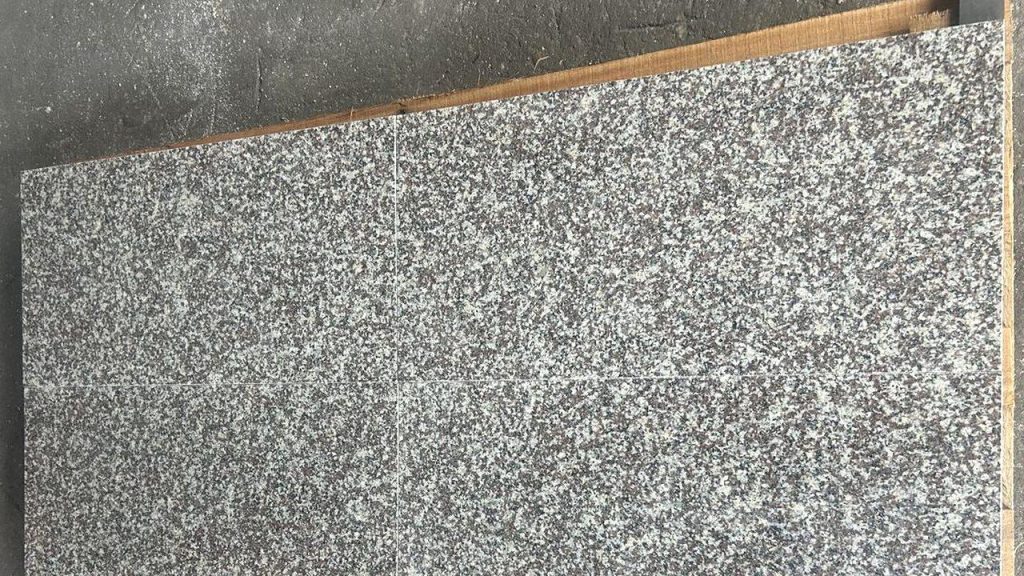
A hotel manager sends a photograph of a step. The nosing has lost a piece the size of a thumbnail, and the message that comes with the photograph is always the same: can you fix it?
The honest answer depends on which of two questions is being asked. One is whether the stone can be made sound again — no sharp void waiting for a shoe, no pocket holding water, nothing that will grow into something worse. The other is whether the stone can be made to look as though nothing happened. Those are two different jobs, done with different materials, by different people, in different amounts of time, with very different odds. Most disappointment in stone repair comes from a supplier answering one of them while the customer hears the other, and nobody notices until the invoice and the daylight arrive together.
So it is worth separating the two before anybody opens a tin.
Two standards for a repair: sound and invisible
Sound is a performance standard. The void is closed, the edge is no longer sharp, water cannot sit in it, and the piece will not fail further under normal use. It can be tested, argued about with a straight face, and signed off. It is also achievable in almost every case where the piece is still in one piece.
Invisible is a perception standard, and it is much harder to satisfy because it is not really about the repair at all. It is about the relationship between that patch and everything around it under a particular light, seen from a particular distance, by a particular person. A join that disappears at two metres in the afternoon disappears a little less at one metre under a downlight, and stops disappearing altogether when the light is raking across the surface from a low angle, which is exactly the light a polished floor lives in for most of the day.
Both standards are legitimate. A chip on a service corridor tread only ever needs to be sound. A chip on the top step of a hotel entrance, where every arriving guest pauses and looks down, needs something much closer to invisible, and may not be reachable at all. Deciding which standard applies, in writing, before any work starts, is the single most useful thing anyone can do in this process. It also protects the person doing the repair, because a standard agreed in advance cannot be renegotiated by a guest’s opinion later.
Four things that get called damage
Repair is not one skill. What arrives described as “damage” is usually one of four distinct problems, and the ceiling on each is different.
A chip or a spall. Material has left. There is a hole, a missing arris, or a corner that is now rounded. This is a filling problem, and the constraint is not the filling but the match.
A crack. Material has separated but nothing has left. Here the question is not cosmetic at all — it is whether the piece is still behaving as one piece, which decides whether a repair is even the right word.
A loss of finish. Nothing is missing and nothing is broken. The surface has gone dull, or cloudy, or has a ring etched into it by something acidic that sat there overnight. This is a surface problem, and the remedy is mechanical rather than chemical.
A stain or a failed joint. The stone is intact and the damage is in what is on it or beside it: a discolouration drawn into the face, or a joint that has given up and is letting water past. These are the two problems most often confused with each other, because a failed joint usually produces the stain.
Getting the category right matters because the categories fail in different ways. A filled chip that is slightly too dark is a cosmetic disappointment. A crack that was treated as cosmetic and then opened is a callout, a closure and an argument.
Filling a chip is easy; hiding it is not
The material for a chip is a pigmented resin, mixed on site to the colour of the stone around it. The technique is well established and the result can be genuinely good. It can be brought flush with the face, it can be worked to the same sheen, and on many granites it will not be found by anyone who was not told where to look.
What it cannot do is reproduce the structure of the stone. Granite is a fabric of interlocking crystals of different colours, sizes and hardnesses. A fill is a single homogeneous material pretending to be that fabric. Up close, and especially in raking light, the difference is not colour but evenness: the fill is too uniform, too smooth, too quiet. On a dark, heavily figured granite, this reads as nothing. On a pale, even stone — a limestone, a light marble, a fine-grained granite with a flat ground — a patch that is slightly too even is more conspicuous than the chip was.
There is a second, less obvious limit. A chip on a face is a filling problem. A chip that has taken the arris — the worked edge itself — is a geometry problem, because the repair now has to recreate a line, and the eye follows lines far more attentively than it follows colour. Two faces have to meet at the same angle they used to, with the same small radius, and the fill has to hold that line while being polished back. This is where most visible repairs actually fail: not the colour, the line. A restored arris that is a fraction off, or that has been rounded slightly in the polishing, changes the way light runs along the edge of the whole piece, and that change is what a person notices without being able to say why.
None of this argues against filling. It argues for knowing, before the resin is mixed, whether the piece in question is one where a fill can hide. A dark figured granite step: yes, often. A pale even limestone counter edge at eye height under a window: probably not, and a replacement piece may be the cheaper route once the second attempt is counted.
Cracks: cosmetic, moving, or finished
A crack asks a different question, and it is answered by observation rather than by product choice. The first thing to establish is whether the crack is live. A live crack responds to the piece: press near it and the gap changes, or the two sides move very slightly against each other. A dead crack does not move, has no debris in it, and stops somewhere short of an edge.
The second thing is where it goes. A crack that runs to an edge, or through the thickness, has divided the piece. From that moment the piece is two pieces held in place by whatever is under it, and any repair is really a repair of the joint between them. A hairline that sits inside a figure in the stone, never reaches a boundary, and shows no movement is a different animal entirely — often it is not a crack at all but a mineral boundary that has been there since the block was cut, which is why judging the difference belongs to the inspection on arrival rather than to a later conversation.
Where a crack is dead, clean and closable, injection works: the two faces are drawn together, a low-viscosity resin is introduced, and the result can be strong enough to be treated as one piece again. Where the crack is dirty, or has already moved, or the piece has been walked on since, injection becomes cosmetic — it hides the line without restoring the continuity, and it will behave accordingly.
The one case where repair should not be attempted is a crack in something that carries load or impact: a stair tread in a public building, a worktop span over a cabinet run, a threshold. These fail suddenly rather than gradually, and a filled crack gives no warning before it does. If the piece cannot be taken out and replaced, the honest option is to reduce what is asked of it — support underneath, a change of use, a mat over the area — rather than to trust a repair in a place where failure means somebody falls.
Polish has to be ground back
A dull patch on polished stone is not a coating problem, and no product sold in a bottle will reverse it. Polish is a property of the surface at a scale too fine to see: a very high proportion of the crystals have been cut flat and brought to the same plane, so light reflects coherently instead of scattering. Once that plane is disturbed — by abrasion, by an acid that has eaten into the calcite between the grains, by a film of cement that sat on it for a week — the only way back is to remove material until a new plane is established.
That means abrasion, in stages, with a machine, and it means a decision about scope. A single worktop can be taken out and refinished on a bench, which is the clean option. A floor cannot. There, the choice is between a local patch and a full pass over the area, and a local patch is almost always the wrong economy on a polished surface, because a hand-worked patch will sit at a very slightly different flatness from the machine-polished field around it. The difference is not something you can point at. It is a shimmer that moves as you walk, and it marks the repair more clearly than a stain would have.
Grinding a floor in a finished building is its own project: dust extraction, water management, protection for everything within reach of the slurry, and a working building that has to keep working around it. The result depends far more on the operator than on the abrasive. It is worth seeing previous work in the same material before agreeing to it, and worth checking which finish was originally specified — a honed floor brought back to a high polish is a different floor, not a restored one.
What a poultice can lift, and what it cannot reach
Stains are the one category where a non-mechanical remedy genuinely works, within limits that are easy to state. A poultice is a paste that sits on the surface, draws moisture out of the stone as it dries, and carries with it whatever was dissolved in that moisture. It is effective on contamination that lives in the pore structure and can move: oil driven into a worktop, rust blooming out of a fixing, cement residue, tannin from a spill, the grey shadow left by a rubber foot.
It does nothing for damage that is not a stain. An acid etch is a change of shape at a microscopic scale, not a discolouration, and no amount of drawing will lift it — that is a polishing job. It also cannot reach a contaminant that has gone deeper than the material can wick back out, which is common in a very porous stone that was left wet for a long time. And it will not work through a sealer: if somebody has applied an impregnator over a stain, the sealer has to come off before the poultice can do anything at all, which turns a small job into a larger one. That sequence — stain first, then sealer, then wonder why it never faded — is common enough that it is worth asking about before agreeing to a price, and it is one of the reasons the care regime after handover is worth writing down rather than passing on verbally.
Joints and sealant are maintenance, not repair
A joint that has opened is not evidence of a bad installation. Movement joints, perimeter joints and sealant lines around a sink or a wall are designed to accommodate movement, and sealant is a material that has a service life. Replacing it is maintenance, in the same category as repainting a wall.
The distinction matters commercially, because the two are constantly conflated in a defects conversation. A re-seal in year three is not a failure of the original work; it is the material doing what the material does. What would be a failure is a joint that was never wide enough to take the movement, or a sealant chosen for a place it was never intended to be — a rigid product in a moving joint, or an interior grade used outside. That is a specification error, and it announces itself early.
The same logic applies to mortar in paving and walling. Repointing is routine. What is not routine is a joint that keeps opening in the same place, which points at what is happening beneath rather than at the pointing.
Matching was decided at the order
The hardest part of any replacement is not cutting the piece. It is that the stone it has to match came from a block that has been used up, and no amount of care at the bench will bring that block back. Colour, figure, the size and distribution of the crystals, the exact reaction of the surface to polishing — all of it belongs to a particular block at a particular moment. A new piece from a new block will be the same stone in the way that two people from the same town are from the same town.
This is the whole argument for holding a spare at the time of order, and it is worth repeating here in its practical form: a spare is not insurance against a rare event, it is the only version of the material that will ever match, and it stops being available the moment the run is finished, as set out in the case for a spare in the first order. Where no spare exists, the realistic options are to take a piece from somewhere nobody looks — which is why the numbering on the crate matters, because it tells you which piece can be sacrificed — to buy into a later run and accept a visible difference, or to design the repair so that the difference reads as intentional. Ranked by how little they offend: out of the main light path, below eye level, in a corner, behind something fixed. A patch in the middle of a lit floor is the worst position available and the one most repairs end up in.
When a match has to be ordered, send a photograph taken in the light where the repair will live, with something in the frame for scale, and say plainly what the surface is: polished, honed, flamed, brushed. Two photographs of the same stone under workshop light and under warm interior light will suggest two different stones, and the wrong one will be cut.
The days closed are the real cost
Ask what a repair costs and the answer will be about resin and labour. The number that actually matters is the one nobody quotes: how many days the area cannot be used, and what happens to the business while it cannot.
A lobby step is out of service for as long as the repair takes to cure and the protection stays on. A kitchen counter is out for a service, or for a day if the work has to be done in daylight. A bathroom floor is out until the grout or the resin has gone off and the room can be handed back. In an operating hotel this is a scheduling problem dressed up as a stone problem, and the scheduling usually decides the method: a repair that can be done and cured inside one night shift is worth a great deal more than a better repair that needs three days.
So the practical questions are about access rather than chemistry. Can the piece be lifted out and taken away, or does everything happen in place? Who moves the furniture, and who puts it back? Who protects the adjacent surfaces, and who is responsible when a machine marks the wall? Who cleans the dust, and who signs the area back into service? And what protects the finished repair from the next trade through the door — because a repair that is complete and then walked over by a tiler with a barrow is not complete — the same problem described from the other end in protecting new stone on site.
What to send, and what we will say first
A repair enquiry that can be answered in one reply contains six things: a photograph with something for scale and a sense of the light; which of the four categories it looks like; where the piece sits and what it does — tread, worktop, wall, floor, threshold; whether it can be removed or has to be worked in place; whether a spare exists; and how long the area can be out of use.
With those, the answer is usually immediate, and it is sometimes no. We will name the standard that is reachable before anyone starts, and we will say so in those terms rather than promising a result and hoping. Where a chip has taken an arris on a pale stone at eye level, the honest answer is often that a replacement piece will look better than a repair, and that the repair should be treated as a way of keeping the area safe until the replacement can be cut. Where a crack is live in something that carries load, the honest answer is that it is not a repair at all.
That is not a reluctance to do the work. It is the recognition that a repair which fails in six months costs more than the replacement would have, in money and in credibility, and that the person who has to explain it to a general manager is not the person who mixed the resin. The range we cut, and the finishes each line is worked to, sits on the products page. The most useful thing a stone supplier can offer here is not a product but a boundary: this will be sound, this will be close, this will not be invisible. Decide which one the building needs, and the method follows.
Every figure on this page comes from our own order sheets. Where something is a trade norm rather than a number we can hold, we say so — send a spec and we will confirm it against a real block before you commit.
More from the yard


Send the drawing. We do the rest.
Reply within one working day, in English or Chinese. Send a spec, a drawing or just a photo of the sample you are matching — we will tell you honestly whether we can hold it.
MOQ 1 × 20FT · FOB XIAMEN · SAMPLES IN 7 DAYS