Stone and fire: what heat actually does to granite
Granite takes a hot pan and a fire pit; resin-bound quartz will not. What heat does inside the stone, why a quench cracks it, and where a surround fails.
30 October 2026 · 14 min read · GranTerra Stone, Hui'an
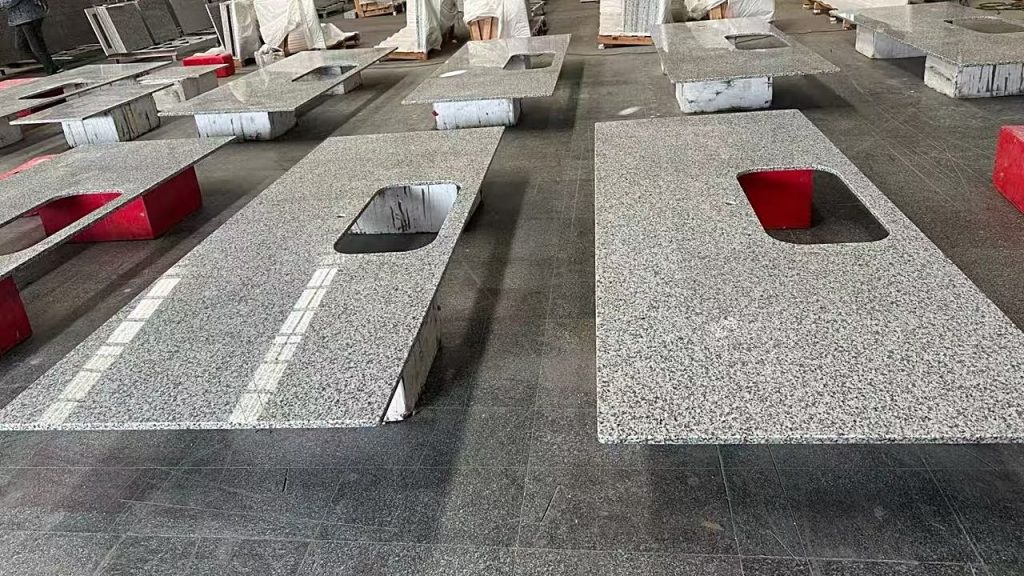
An outdoor kitchen is drawn as furniture and specified as equipment, and the gap between those two readings is where most of the trouble begins. The drawing shows a counter, a grill, a fire bowl in the corner of a terrace. It rarely shows where the heat goes, how close it comes to the stone, and what sits behind the stone when it arrives.
This is not a warning about stone melting. Granite does not melt on a terrace, and the material is far more tolerant of fire than most of what is fixed around it. The failures are quieter and more expensive: a joint that opens in the second season, a surround that spalls on one edge, a polished top that goes dull in a patch nobody can explain, and a fire pit whose stone skin has quietly cooked the structure it was meant to protect.
Fire is a specification, not a styling choice
Three things decide whether a stone element near a fire will last, and none of them is the colour of the stone.
The first is the heat source itself. A gas burner, a charcoal bed, a wood fire and an electric plancha behave differently. Charcoal and wood give a concentrated, uneven heat with radiant peaks and a great deal of ash; gas gives a steadier output with more water vapour in the exhaust; electric gives the least radiant load and the most conducted heat into whatever the element is mounted on. A surround detailed for one is not automatically right for another.
The second is how the heat travels. Radiation lands on the faces it can see. Conduction goes through whatever the hot part is touching. A stone counter that looks safe because it is a comfortable distance from the flames can still be sitting on a steel frame that is carrying heat straight into the cabinet below it.
The third is what is behind the stone. Solid masonry, a hollow blockwork core, a steel sub-frame and a timber carcass respond to heat in four different ways, and only one of them is forgiving. When we are sent a fire pit or an outdoor kitchen elevation, these are the three questions we ask before anything is priced.
What heat actually does inside the stone
Granite is an interlocking mosaic of mineral crystals — quartz, feldspars, micas, and a long tail of others depending on where it came from. Each of those minerals expands at its own rate when it warms. Heat a piece of granite and the grains push against each other, gently at first and then less gently, because the outside of the piece is always hotter than the inside.
That internal argument is why granite behaves well in fire-adjacent work and why it is not indestructible. There is no calcite in it to react with acids, its crystals are locked rather than cemented, and its density means a surface takes a long time to heat. A hot pan set down on a granite top spreads its energy into a large mass of stone rather than concentrating it in a small area. This is the practical reason granite keeps appearing in outdoor kitchens while engineered surfaces quietly disappear from them.
But stone is not insulation. It is a slow conductor, not a barrier, and the heat that lands on a counter keeps travelling. Under a grill surround, that means the mortar bed, the substrate, the fixing brackets and the timber frame all receive a share. If the detail assumed the stone would stop the heat, the first thing to fail will be something you cannot see.
Thermal shock, not temperature, is what cracks a surface
Ask what damages stone near a fire and most people answer with a number. The number is rarely the problem. Rate of change is.
A stone that heats slowly and cools slowly will take a great deal of heat without complaint. The same stone quenched — cooled fast on one face while the rest of it is still hot — develops a sharp gradient through its thickness. The surface contracts, the body underneath does not, and the difference has to go somewhere. It goes into the surface: fine crazing across a polished face, a dull patch that will not polish back, a chip along an arris, or a hairline that opens over the following winter.
The classic case is a fire pit at the end of an evening. The stone is hot, the party is over, and someone puts the fire out with a bucket of water. That single gesture does more damage than a whole season of burning, and it is repeated in hotels and restaurants more often than anyone admits, because the person doing it is on a closing shift and wants to go home.
The same physics explains a set of smaller incidents that get blamed on the material: a hot pan moved onto a wet draining board, a hot top wiped down with a wet cloth, a charcoal grill tipped out onto paving, a hot platter set on a cold stone bench in winter. None of these is about the stone being weak. All of them are about a gradient arriving faster than the stone can absorb it.
How each material fails near a flame
Near a heat source, the three surfaces sold as worktop material fail in three unrelated ways.
Granite is the default for a reason. It takes working heat without discolouring, it does not soften, and it does not care about ash. What it does not like is a quench, a sustained local hotspot under a burner that is too close, and the alkaline residue that wood ash leaves when it is wetted. A polished face near a fire will also lose its shine faster than the same face indoors, simply because it is being cleaned more aggressively and more often.
Marble and limestone are the wrong answer for the cooking side of an outdoor kitchen and a beautiful answer for the seating side of it. Calcite is soft, it reacts with anything acidic, and it is more prone to surface spalling under a fast temperature change than granite is. A marble table on a covered terrace is a considered choice. A marble surround around a charcoal grill is a maintenance contract.
Engineered quartz is the one that fails most visibly, because its binder is resin. Resin is a plastic; heat softens it, scorches it and eventually cracks it, and the damage is not repairable in the way a stone can be re-polished. Every manufacturer of these surfaces says the same thing in different words: use a trivet, do not place a hot pan down, do not install next to a range without protection. Scratch resistance and heat resistance are separate properties, and the marketing tends to blur them. For a full comparison of how the three behave under real use, the material guide covers the ground in more depth.
Where the heat really reaches the stone in an outdoor kitchen
In a typical terrace kitchen, four places matter and only one of them is obvious.
Directly above and beside the burner is the obvious one. Radiant heat lands on the back panel and on the returns at each end of the grill. A back panel in the same stone as the counter looks correct and takes the hardest treatment in the whole assembly: heat from the front, grease from the cooking, and cleaner from whoever wipes it down. It is also the piece most often left out of the drawing.
The counter surface beside the grill is the second. It is not usually hot enough to damage granite, but it collects everything that comes off the grill — fat, smoke, fine ash — and that film, baked on repeatedly, is what dulls a polish and darkens a light stone. A dark, textured surface hides it; a pale polished one records it. The same film is why a restaurant pass area wears through a top faster than a domestic kitchen ever will, a point the commercial worktop guide makes in more detail.
Underneath the counter is the third, and the one nobody photographs. Heat conducted through the stone meets whatever the top is bedded on. If that is a timber carcass with a foil liner, the liner will fail first. If it is a steel frame, the frame will expand and the stone above it will be asked to accommodate the movement.
The floor around it is the fourth. Embers, hot ash and dropped tongs land on paving, and the paving is usually the same stone as the pool deck or the terrace. This is where a flamed or bush-hammered finish earns its place: a textured surface takes a hot ember without showing it, and stays walkable when the surface is wet.
A fire pit is a masonry structure wearing stone
The single most common mistake we see in fire pit drawings is treating the stone as the firebox. It is not. A fire pit has three parts, and only one of them touches the fire.
The burner or lining holds the fuel and takes the direct flame. That is a stainless pan, a refractory lining, or a proprietary insert, and it is specified by whoever supplies the fire, not by the stone works.
The structure carries the lining and gives the pit its form. This is where the air gap and the expansion allowance live, and where a pit either survives or cracks. A lining set hard against the back of the stone has nowhere to expand to, and it will push until something gives — usually a mortar joint on the outside, two seasons later, in the one place a guest can see it.
The skin is what we cut. Coping, cladding, a seat, a plinth. It is a set of accurately made pieces fitted around a structure somebody else has designed, and its job is to look right, drain properly and take the occasional knock.
Two details decide whether the skin lasts. The first is the coping profile: flat enough to sit on, but shaped so water runs off rather than sitting on the edge. The second is drainage at the base. A fire pit that holds water in its footing will show damp patches, efflorescence and eventually a rust bloom from any steel inside it, and none of that is the stone’s fault.
Water and heat together: the crack that arrives in one afternoon
Outdoors, heat rarely arrives alone. The combination that does the damage is a hot stone surface meeting water, and there are three routes by which it happens.
Weather. A summer storm on a fire pit that has been burning for three hours is a quench applied by the sky. There is nothing to design against except the detail: a coping that sheds water rather than holding it, and a lining that keeps the rain off the hot core.
Poolside. A fire feature on a pool deck gets splashed continuously by people who are wet, and then has a fire lit in it. This is the highest-frequency thermal cycling of any domestic stone element, and it is worth choosing the finish for it rather than the photograph.
Cleaning. The most common cause, and the most avoidable. A hot surround wiped down at the end of service, a charcoal grill rinsed while it is still warm, a fire bowl hosed out before the ash has cooled. Every one of these is a quench, and every one of them is written into a closing procedure somewhere. If the stone is going into a commercial setting, this belongs in the handover file rather than in a conversation. The care guide deals with the wider cleaning regime, and the wet-area guide covers what happens below the surface when water is involved.
Finish, colour and what fire leaves behind
Fire does not change the colour of granite. It changes what sits on the granite, and that is a different problem with a different solution.
Wood ash is alkaline. Wet it and it becomes more so, which is why a fire pit surround left with a paste of ash and rainwater goes patchy and why a sealer in that position gives up sooner than the same sealer indoors. The remedy is dry first, wet second: sweep or vacuum the ash while it is dry, then clean with a neutral product, then dry the surface rather than leaving it to stand wet.
Soot and smoke leave a film that is easy to see on a pale stone and easy to miss on a dark one until it is compared with an untouched area. A flamed or bush-hammered face hides the film and takes a stiffer brush without showing scratches. A polished face shows everything, including the marks left by the cloth that was trying to remove it.
There is also the simple matter of what a fire does to a finish over years. A polished surround near a grill is a surface being heated, cooled, greased and scrubbed in a cycle no interior worktop ever sees. It will lose its mirror in the areas closest to the heat, and it will do so unevenly. If that is unacceptable, the choice is made at specification stage, not at year three. The finish guide sets out which surfaces suit which exposure.
What we will not claim, and what we will put in writing
Stone is a good material around fire and a poor substitute for a fire-safe construction, and the difference matters when a project has to be signed off.
We will not describe granite as fire-rated, fireproof, or a fire barrier. It is a non-combustible natural material, which is not the same claim, and a building control submission needs the lining and the structure to carry that argument, not the facing. We do not supply burners, and we do not certify anybody else’s.
What we will put in writing is narrower and more useful. The material, the finish and the face we are cutting from. The thickness and the tolerance we work to. The edge profile by name, so that the coping on site matches the one that was approved. Where the joints and movement gaps fall, and which of them are ours to cut and which belong to the installer. The packing, so that a piece with a shaped edge arrives with something protecting it.
We will also write down the two things clients most often discover later: that the stone transmits heat to whatever is beneath it, and that it will not survive a quench. Neither is a defect. Both are properties, and a property stated before the order is a specification; the same property discovered afterwards is an argument.
What to send with the enquiry
For anything within reach of a flame, the order of decisions matters more than the drawing’s detail. Choose the burner or the fire first, then the structure around it, then the stone. Doing it in the other order means cutting a surround to fit an appliance nobody had chosen yet.
Send us the plan with the heat sources marked and named — gas, charcoal, wood, electric — and the distance from each one to the nearest stone face. Send the appliance’s own installation instructions if it has a required cavity, clearance or ventilation, because those override anything a stone drawing assumes. Tell us whether the coping is a seat or an edge — the difference is a design decision set out in the outdoor furniture guide — and whether the terrace is exposed or covered, and whether the site is coastal, since salt changes how fast everything around a fire degrades.
Then tell us how it will be cleaned and by whom. It sounds like an odd question to ask at quotation stage. It is the question that decides whether the surround still looks right in five years, and it is much cheaper to answer now than to explain later.
Every piece in that assembly is cut to your drawing, in the material and finish you have chosen, from a block we can show you before it is opened. The rest of the range and how each line is worked sits on the products page.
Every figure on this page comes from our own order sheets. Where something is a trade norm rather than a number we can hold, we say so — send a spec and we will confirm it against a real block before you commit.
More from the yard
Send the drawing. We do the rest.
Reply within one working day, in English or Chinese. Send a spec, a drawing or just a photo of the sample you are matching — we will tell you honestly whether we can hold it.
MOQ 1 × 20FT · FOB XIAMEN · SAMPLES IN 7 DAYS