Stone outdoor furniture: benches, tables and the weather
A stone bench or table outdoors is a small structure, not furniture with the roof taken off: a set that has to match, weight decided on purpose, water with somewhere to go, and finishes chosen for how they age.
20 October 2026 · 14 min read · GranTerra Stone, Hui'an
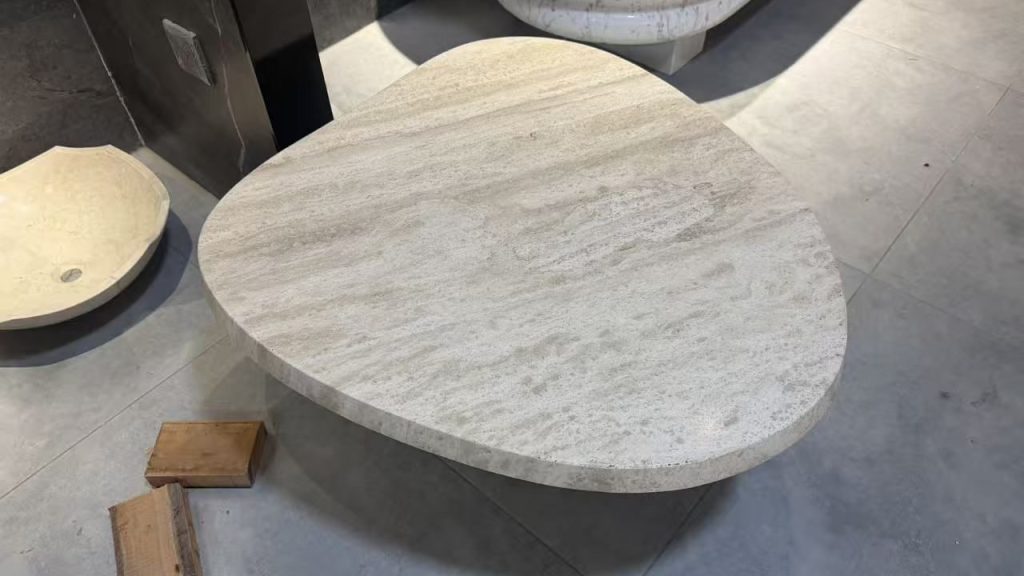
A stone table indoors is furniture. The same table on a terrace is a small structure that has to hold its own in wind, stand up to a hundred covers a week and still look deliberate when it is empty at seven in the morning. Most of the disappointment in outdoor stone furniture comes from treating the second thing as the first: a piece designed for a lobby, moved outside, and asked to behave.
What follows is about that move. Not the carving — our note on single carved pieces covers how those are quoted and made — but what a terrace asks of a bench or a table once it is out there: consistency across a set, weight that has to be decided rather than discovered, water that has to be given somewhere to go, and finishes that survive being cleaned by somebody who does not care about the stone.
Indoors, with the roof taken off
Outdoor furniture is exposed to four things that indoor furniture is not: rain on a horizontal surface, sun that heats the stone and moves it, frost where the ground freezes, and salt where the sea is close. Each of those acts on the same piece in a different way, and the sum of them is why a design that is elegant in a showroom can be a liability on a hotel terrace.
The first consequence is that every horizontal surface becomes a water-catching surface. A seat that is slightly dished, a table top with a raised edge, a joint that runs across the fall — each of those holds a puddle that dries into a stain and, in a cold climate, freezes into a cracked edge. The second is that colour moves. Stone that reads pale and warm under interior lighting can turn grey and cold under an overcast sky, and a piece specified from a photograph taken indoors is being specified from a different material.
The third is use. A hotel terrace takes more contact in a season than a private garden takes in a decade: trays dropped on the edge, chairs pushed against the table, cleaning chemicals, a pressure washer in the spring. None of that is abuse, and all of it argues for edges with something to give, surfaces that do not show every mark, and pieces that can be re-finished rather than replaced.
The set is the design, not the piece
Almost nobody buys one outdoor table. They buy a terrace: a row of tables, benches along a wall, side tables between loungers, a long counter at the pool bar. And a set made of pieces from different stone is not a set, whatever the drawings say. It reads as three separate purchases that happen to be near each other, and no amount of styling fixes it.
That has to be handled at the order, because it cannot be fixed later. Pieces that are meant to be read together should come from one block where the quantity allows it, or from blocks of the same material selected against each other before cutting. The natural variation described in colour variation in granite is honest and unavoidable; what is avoidable is a bench that is visibly a different grey from the table beside it. Asking for a set to be selected as a set costs less than replacing half of it after installation.
There is a second kind of consistency that matters just as much and is easier to forget: the same profile repeated. Twenty table tops cut to the same drawing are a rhythm; twenty tops cut to nineteen drawings are a collection of individual objects, and the eye reads that as untidy even when nobody can say why. If the terrace is a repetition of one piece, the useful thing to send is one drawing plus a quantity, not twenty variations of the same instruction.
Weight has to be a decision
Stone furniture has one property that wood and metal furniture do not, and it is not aesthetic: it is heavy, and that weight is either the point or the problem. There are two opposite specifications hiding inside the phrase “outdoor table”, and they should never be left to the workshop to guess.
The first is a piece that must not move. On an exposed terrace, a light table with an umbrella in it is a sail; on a public promenade, a bench that two people can carry is a bench that leaves. A stone base of real mass solves both, and it also solves the problem of a table that creeps across the paving every time a chair is pushed under it. The second is a piece that has to be moved: by housekeeping for cleaning, by the operator for a winter layout, by two people rather than a forklift. A solid block that cannot be shifted is a maintenance problem for the next twenty years, and a bench that has to be dragged is a bench that gouges the paving it stands on.
Both are legitimate, and the difference shows up in places that have nothing to do with the drawing: how the piece is packed, how it is lifted onto a terrace with no vehicle access, what the slab under it has to carry, and whether a spare can be stored. A stone top with a steel or timber base can be a way to get the look of weight without the handling of it, at the cost of a joint that has to be designed rather than assumed. The question to answer before anything is quoted is simple: is this piece expected to be lifted by two people, or is it expected to stay where it is put?
Benches and seats: what makes stone sit-able
A bench is not a table at a lower height. It has to be comfortable enough that people choose it, and stone is unforgiving about the details that make that true.
The edge is the first one. A stone slab with a square arris is an obstacle; the same slab with a small radius or a soft chamfer is a seat. This is not decoration — it is the difference between a bench the staff use and a bench that stays empty. The second is the surface: a polished seat is slick when wet and shows every scuff, a honed seat is better behaved, and a split or flamed face is honest but will mark clothing, which matters for a hotel and not at all for a garden. A slightly textured top with a cushion on it is the usual compromise, and it works because the texture stops the cushion sliding.
Drainage is the third. A seat with any kind of dishing or a raised lip holds rainwater, and a wet seat is a seat nobody sits on for an hour after every shower. Flat, or with a fall, and joints that run with the water rather than across it. The fourth is heat: dark stone in direct sun reaches temperatures that will not be sat on, and no finish fixes that. A pale stone, shade, or a cushion solves it; ignoring it produces a terrace that is used in the morning and evening and empty at lunch.
Where the seat is a slab spanning two supports, the supports are the design. Two blocks look deliberate and give a shadow line under the seat; a continuous plinth looks like a wall. Either is fine, provided the span is thought about and the underside is not left as a place for water and leaves to collect.
Tables: the top, the base and the joint between
Outdoors, the joint between a stone top and whatever carries it is the part that gets forgotten and the part that fails first. A top bonded rigidly to a base — particularly a base in a different material — has nowhere to go when the two expand differently in sun and rain, and the result is a cracked top, a loose base or a joint that opens. The sensible arrangement is a top that sits on its base with a locating detail rather than being glued to it, so that the assembly can move and still stay together.
The overhang is the next decision. A table needs enough top beyond the base for knees and for a chair to tuck in, and the further that top reaches the more it behaves like a cantilever. In stone that is a thickness conversation, and it is the one place where the instinct to make the top look thin works against the furniture’s life. Our note on worktops in commercial kitchens deals with the same mechanics indoors, where the loads are known; outdoors the loads are less predictable, because people lean, sit on edges and stand on tables to reach a light.
Two details are worth settling early. If there is an umbrella, its hole is a water path straight through the top and into whatever is underneath, so it needs a sleeve and a way for water to leave rather than a bare hole. And if the top is round, the wind behaves differently around it than around a rectangle, which matters on a coast or a rooftop where a table with a heavy base can still be walked across the terrace by a gust if the top gives it enough sail. The round travertine table is the shape most terraces end up wanting, and the shape that most rewards a heavy base and a properly considered top.
Water has to leave
Every problem with outdoor stone furniture is a water problem wearing a different hat. Staining on a table top, a bench that stays wet, a joint that goes green, a base that spalls after a winter — the water arrived first and the symptom showed up later.
The rule is the same one that governs the wall head and the shower floor: give the water a route and it takes it. On a table that means a top with a slight fall and no raised lip, and joints set so they do not trap a bead of water against the edge. On a bench it means no dishing, and a gap under the seat rather than a solid contact face where water sits. On a base it means the piece does not stand in a puddle: a plinth that is bedded on a full mortar bedded with no way out will hold water against the stone and, in a freeze, lift it.
The other half of the water question is what it leaves behind. Pale stone that takes water will show a tide mark at the drying edge, and stone with iron-bearing minerals will show rust spots where water stands on a fixing. Those are not defects to be argued about after installation; they are the reason to specify a stone that behaves in the climate it is going to, and to keep fixings where they can be replaced. A dark, dense granite is a much easier material to live with on a wet terrace than a pale, porous one, which is the argument made in granite, basalt or porphyry.
What the piece stands on
Furniture transfers its weight to the paving through a small area, and paving is not usually designed for that. A heavy table on four small feet is four point loads; on a deck, that is a local deflection, and on a bonded stone terrace it is a place where a tile can rock or crack. The fix is not complicated but it has to be drawn: spread the load with a base plate or a plinth, bed it fully rather than on spots of mortar, and keep the contact area off a joint line.
Movement under the piece matters as much as the load on it. On a slab, a table can sit directly if the surface is flat. On a deck or a granular base, the piece wants adjustable feet or a bed that can be levelled, because a table that rocks is a table with a glass of wine on the edge of falling. And on ground that freezes, anything that traps water under the base will lift in winter — furniture included, not just paving.
The last thing in this section is the one clients notice first: what the base does to the paving it sits on. A rough stone base dragged once leaves a mark that lasts; protective pads, a chamfered bottom edge or a sacrificial plinth solve it. It is a small detail that decides whether the terrace still looks new after a season of housekeeping.
Finishes, and the maintenance that actually happens
Outdoor finishes should be chosen for how they age, not how they look on delivery. A polished face outdoors loses its shine at the edges first, shows every fingerprint and every drop of oil, and is slippery when wet; it is the wrong default for furniture even though it is the right default for a bar top under a roof. Honed is the workable middle: it holds colour without pretending to be a mirror, and it recovers from a scuff with a local re-finish.
Split and flamed faces are the honest outdoor answer where grip and durability matter more than smoothness, and they are also the most forgiving of the marks that terrace furniture collects. The trade is that they hold dirt in the texture, which means a hotel has to be able to clean them — a finish nobody can maintain is a finish that looks worse in a year than the smooth one it replaced. The choices and where each belongs are set out in the finishes guide.
Sealing deserves a word because it is oversold. A sealer slows the movement of water into the surface; it does not make stone waterproof, it does not stop staining from oil, and it has to be renewed, which means somebody has to own that task. On a dense granite in a mild climate, a sealer is optional. On a pale, absorbent stone in a wet climate it is worth having, provided the maintenance schedule says who applies it. What no sealer fixes is a piece that holds water because of its shape — that is a drawing problem, and it belongs upstream.
What the quote needs from you
Outdoor furniture is bought as pieces against a drawing, so the drawing is the order. The useful pack is short, and none of it is usual in a first email.
- One reference drawing per piece type, plus quantities. Not a photograph per table — one section, one top detail, and how many.
- Where it is going. Coastal, rooftop, courtyard or mountainside, and whether it will be under cover, because that decides the stone and the finish.
- Whether it must move. Housekeeping lifting it, or a forklift once at installation — two different pieces of furniture.
- The top-to-base detail. Bonded, located or free-standing, and what the base is made of if it is not stone.
- The edge. Radius, chamfer or square, on seats and tops, and the same answer for the underside so it does not mark the paving.
- Colour matching across the set. One block where possible, and how visible the variation is allowed to be between pieces.
- Umbrellas, fixings and holes. Anything that penetrates the top is a water path and has to be detailed.
- Packing and access. How the pieces arrive, what they weigh in practice, and how they get from the truck to the terrace.
Send those and the answer is a set of pieces with a price, rather than a range with a caveat. The table, planter and carved décor pages show the kinds of pieces we cut and finish, the materials index is where colour and surface get decided, and the works pages follow the stone from block to crated piece. Terraces already furnished on client sites are photographed in the installation gallery.
If the layout is still being tested, the most useful first step is not a price for one table but a decision about which pieces repeat and which are one-offs. Repetition is where the cost and the consistency both live, and it is much cheaper to settle before the stone is cut than after the first delivery has been laid out on the terrace. Send the layout through the enquiry form and we will price the repeating pieces as a set.
Every figure on this page comes from our own order sheets. Where something is a trade norm rather than a number we can hold, we say so — send a spec and we will confirm it against a real block before you commit.
More from the yard
Send the drawing. We do the rest.
Reply within one working day, in English or Chinese. Send a spec, a drawing or just a photo of the sample you are matching — we will tell you honestly whether we can hold it.
MOQ 1 × 20FT · FOB XIAMEN · SAMPLES IN 7 DAYS