Three quotes, one drawing: what is actually different
Three prices for one drawing are rarely the same product. What the block, the layout, the finish and the packing change, and how to compare quotes line by line.
2 November 2026 · 13 min read · GranTerra Stone, Hui'an
Three quotes, one drawing. The same stone named, the same quantities listed, the same destination port. The numbers are not close, and the buyer has to work out which two suppliers are wrong.
Usually neither is. The three quotes are for different products that happen to share a name, and the gap between them is not a margin somebody is hiding. It is a list of decisions that were made differently: which block the material comes from, how the pieces were laid out on it, how much of the work is done by a machine and how much by a person, what is packed around the stone, and what the number stops covering the moment the crate leaves the yard.
None of that is secret. But it is almost never written on the quotation, which is why the comparison happens on a single line of total and ends in a decision made on the wrong basis. What follows is the list of things that differ, in the order they usually account for the gap.
The spread between three quotes is rarely greed
A supplier who is deliberately overcharging is unusual, and easy to spot, because an overpriced quote on a well-drawn enquiry tends to be overpriced everywhere. What is common is three suppliers answering three slightly different questions, each of them honestly.
One has quoted a specific block that is sitting in the yard and will be held for this job. One has quoted “this material, current stock”, which is a promise about a name rather than about a stone. One has quoted the pieces and left the packing, the spares and the freight to be settled later, which is not dishonest either, but makes the number look smaller than the others.
The buyer sees three prices for one thing. The suppliers have quoted three different things, and only one of them is the thing on the drawing.
A quote is a set of answers, not a number
The useful way to read a quotation is to check whether it answers a short list of questions. Which block, and is it held? Which finish, and on which faces? Which edge, and all round or front only? What is done at the cut-outs? How are the pieces laid out, and has that layout been seen? What is packed with them? How many spares? Where does the price stop — which address, and who unloads?
A quote that answers those is comparable. A quote that answers none of them is a number, and numbers cannot be compared with answers. When we send a price, we try to send the answers with it, because a customer who understands what they are buying stops asking whether the other quote is cheaper and starts asking what the other quote left out.
Two stones with one name are two prices
Stone names are trade names. They travel badly. The same name will cover material from more than one quarry, cut from blocks of different quality, and sold at prices that differ because the stones differ — in colour, in figure, in how much of the block survives the saw.
So the first real difference between quotes is usually upstream of the factory: one is based on a block selected for the job, and the other on material bought in against a name. The selected block costs more because somebody looked at it, and it is worth more because the tone will hold across the whole order and a failed piece can be re-cut from the same material. Material bought against a name is cheaper because nobody has committed to a particular block yet, which means the order will be cut from whatever is available when it comes up the queue.
Neither is wrong. But they are different purchases, and the second one carries the risk that the last pieces come from a different bundle with a slightly different ground. That risk has a name in this trade — it is the thing buyers complain about when they say the second crate does not match the first — and it is a risk that has been priced, not removed. Why one block is never one shade is the subject of its own note, and it is the reason a block reference is worth more than a name on an enquiry.
The layout is decided on the floor, not in the office
This is the part that most buyers never see, and it accounts for more of the gap than anything else on the list. A cut-to-size order is not a list of pieces sent to a machine. It is a plan: which pieces come from which slab, in which direction, and in what order, so that the figure runs the way the drawing intends and the pieces that will stand next to each other come from the same place in the block.
The plan is constrained from the first line. The largest piece sets the slab, because everything else has to fit around it. Pieces that must match have to come from the same stretch of stone, which means they cannot be scattered across the bundle to improve the yield. Where a hole falls matters as well as how big it is: an opening close to an edge leaves a narrow margin that is the first thing to break in handling, so it forces the piece to be positioned differently on the slab even though the piece itself is the same.
The consequence is that a small change in one piece re-lays the whole plan. This is why “can you make this one a little wider” is not a small question, and why a supplier who has already laid out the order and dry-laid it on the floor will answer it differently from one who has not started. It is also why two yards can cut the same drawing, produce the same pieces, and use different amounts of stone to do it. The one that laid out carefully used less. The one that did not used more, and charged for it, or lost money and cut a corner somewhere the buyer will not look.
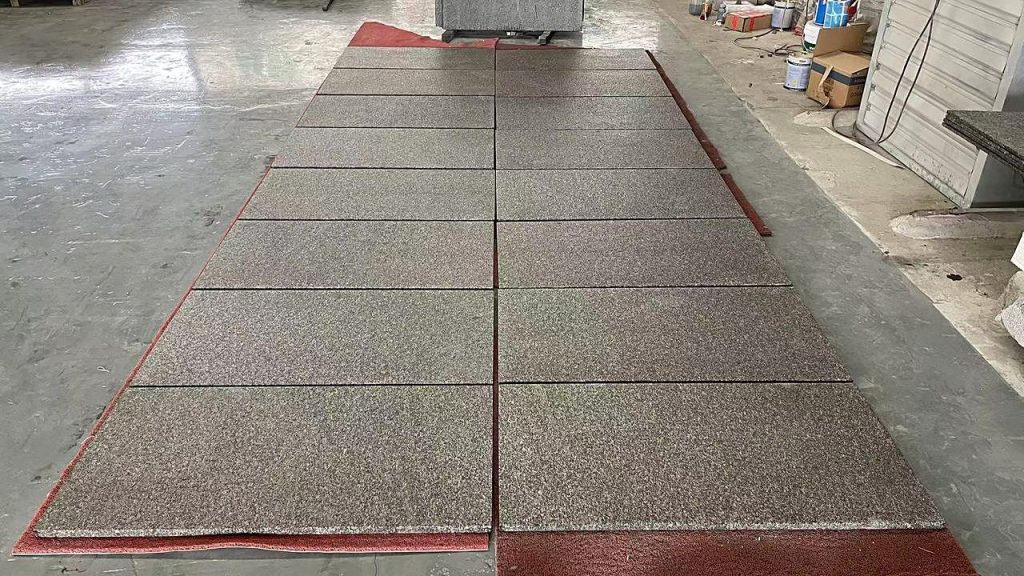
Before cutting, a serious order is set out across the floor and judged together rather than piece by piece. That dry-lay is where a wrong piece is caught — a drift in tone where the stone should be steady, a vein turning against the pieces beside it, a dull passage sitting in the middle of a clean field. Catching it there costs a piece. Catching it after fixing costs a wall.
The hours live in the finish and the edge
Two quotes for the same stone and the same sizes can differ purely on how the surface and the edges are worked, because that is where hours are spent and machines are not.
The seven faces we work are set out in the note on finishes, and they run in a rough order of cost. A sawn face is the least touched and the cheapest. A honed face has been through a machine pass that flattens the surface without bringing up a shine. A polished face has been through more passes, with progressively finer abrasives, and the last ones are slow. Beyond that, the hand-worked finishes — brushed, bush-hammered, an antique treatment, a chiselled face — stop being a machine operation at all. Somebody stands at the piece with a tool and works it, and the cost is that person’s day rather than a machine’s hour.
The edges follow the same logic. A simple arris on a front edge is a pass on a machine. A profiled edge all round, on a piece with an internal corner, on a run where the profile has to be continuous across a joint, is slower work and easier to get wrong. A mitred return — where the edge of the top turns down to meet the face of the same material — is a joint that has to be perfect, because its purpose is a joint you are not supposed to find. It is a fine detail and it is priced like one.
So when one quote is lower on identical sizes, the question to ask is not “how” but “which finish, and worked how”. A honed face quoted as polished, or an arris quoted as a bullnose, will explain a gap without anybody having done anything wrong.
The parts nobody prices until they are missing
There is a set of things that belong in a stone order and do not appear on a drawing. A spare or two of the pieces most likely to be damaged, which is the cheapest thing in the order to include and the most expensive to add later, as the case for a spare sets out. An approval panel, if the project requires one. The dry-lay, which is labour and floor space. The crate, the bearers, the corner protection, the film, the strapping. The numbered packing list that tells the site which piece goes where — a document that costs a shift at the works and saves a week on site, described in the note on numbering. The record of which block the order came from, so that a later addition has something to be matched against.
None of these is optional in any meaningful sense. All of them can be left out of a quote, and when they are, the quote is cheaper by exactly their cost. That is not a trick; it is arithmetic. The problem is that the buyer discovers the omission at the far end, when a crate arrives without corner protection and the first thing they need is a piece that was never ordered.
This is the single most useful line to check when three quotes are side by side. Not the total — the presence of the things that are not stone.
What is excluded, and who pays for it later
The last block of difference is the boundary of the price. One quote stops at the factory gate. One stops at the port. One stops at the customer’s door, and sometimes at the kerb outside it.
“Delivered” is one of the most expensive words in a quotation, because it means different things to different people. Delivered to a port is not delivered to a site. Delivered to a site is not unloaded, and a crate of stone is not something two people move by hand. Who pays the crane, who accepts the risk while the container is on the water, who deals with the paperwork at the far end — the arrangements themselves are covered on the page about how a stone order ships — each of these sits inside one quote and outside another, and the difference in total is often nothing more than where somebody drew the line.
It is worth asking directly, and in writing: at which address does this price stop, and what happens after that. The answer tells you more about the two quotes than the totals do.
One exclusion deserves its own line because it is so often discovered late: the split delivery. An order that ships as one consignment shares a container, a set of documents and a single loading operation. The same order shipped in two parts pays for those things twice, and pays again in risk, because the second consignment is cut from material chosen later and will be compared with the first on site. Where a project genuinely needs staged deliveries, it is cheaper to plan the split at the beginning and cut both parts from the same block, than to divide a finished order afterwards.
Cheap is usually a different product
Put those together and the conclusion is uncomfortable but simple. A quote that is materially below the others for the same drawing is almost never the same product at a better price. It is a thinner piece, or a block chosen for price rather than for the job, or a finish that is quicker, or an edge that is simpler than the one drawn, or a crate with less around it, or a set of spares that were never quoted, or a price that stops earlier in the journey.
Sometimes all of that is the right answer. A back-of-house wall, a plant room floor, a piece nobody will touch: cheaper is correct, and saying so is not a criticism of the supplier who quoted it. What is not correct is choosing on the total and then expecting the product that the other two quotes described. That is how a project ends up with stone that is technically what was ordered and not what was wanted, and with an argument about a name instead of a block.
The three questions that resolve most of the gap
Most of the difference between three quotes can be closed with three questions, asked of each supplier in the same words.
Which block, and is it held for this order? If the answer is a name rather than a block, the price is for a promise, and the order will be matched to whatever comes up.
Has the layout been drawn, and will it be dry-laid before cutting? If yes, the yield has been studied and the pieces have been looked at together. If no, the price includes a guess, and the guess is usually paid for later.
Where does the price stop, and what is in the crate besides the stone? This one question tends to reveal more than a page of specification, because it forces the invisible parts of the order — spares, packing, documents, freight — into the open where they can be compared.
What we will put in writing
When we quote, the answers go with the number: the block reference and whether it is held, the finish and which faces carry it, the edge and whether it runs all round, the intent for the joints, how the order will be laid out and packed, how many spares are included, and the address at which our price stops.
What we will not do is quote a name and let the rest be settled at the saw. On a project with an opening date, the difference between a quote that describes a block and a quote that describes a name is the difference between a date you can plan against and a date that has to be revised. The mechanism behind that is set out in how an order is quoted from your drawing, and the material side of it — what a slab actually is, and what a block will and will not give you — is in reading a granite slab.
If you want to compare properly, send the drawing and the quantities and ask all three suppliers the same three questions. The quotes will still differ, but they will differ for reasons you can see, and the choice stops being a bet on which supplier is honest. It becomes a decision about which set of answers fits the building. What we cut, and what each of those lines is finished to, is on the products page.
Every figure on this page comes from our own order sheets. Where something is a trade norm rather than a number we can hold, we say so — send a spec and we will confirm it against a real block before you commit.
More from the yard


Send the drawing. We do the rest.
Reply within one working day, in English or Chinese. Send a spec, a drawing or just a photo of the sample you are matching — we will tell you honestly whether we can hold it.
MOQ 1 × 20FT · FOB XIAMEN · SAMPLES IN 7 DAYS