Reading a granite slab: block, saw marks and thickness
A slab is one slice of one block: how the block decides what the slab can be, what the saw leaves behind, what thickness actually buys, and where buying slabs differs from buying cut pieces.
18 October 2026 · 12 min read · GranTerra Stone, Hui'an
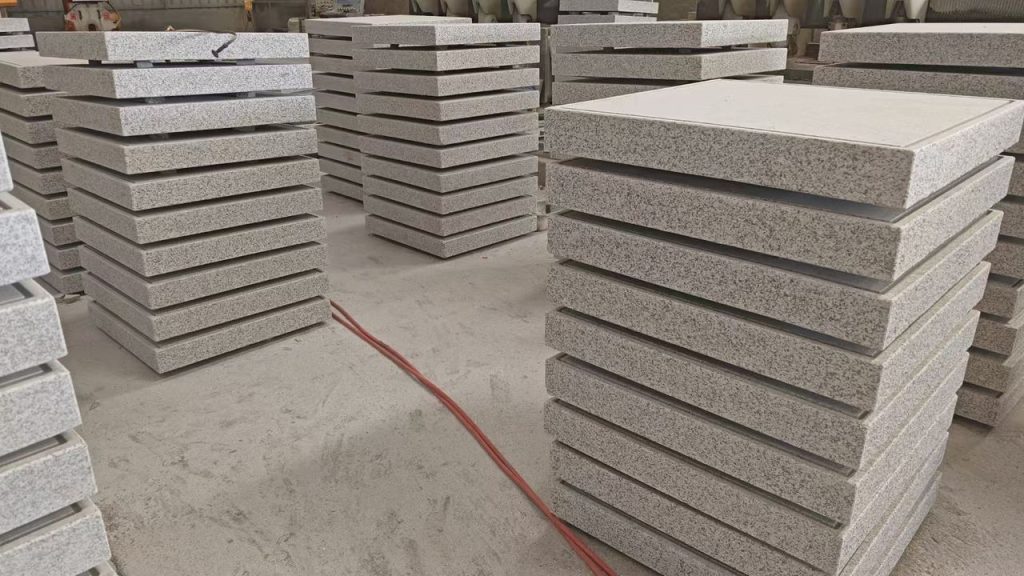
A slab is the most misunderstood object in the stone trade. To a designer it is a picture; to a fabricator it is a workpiece; to a quarry it is one slice out of a block that was sold before anyone saw it. All three are looking at the same piece of granite and pricing a different risk, which is why so many slab orders end with an argument about something that was decided months earlier, at the saw.
This article is about the material itself rather than the finished job: what a slab actually is commercially, how a block becomes one, what the saw leaves behind, why thickness is a decision and not a leftover, and where buying slabs differs from buying cut pieces. It is written for anyone specifying or importing granite who would rather understand the bundle than argue about it on site.
What a slab is, in commercial terms
A block leaves the quarry as a rough rectangular mass. It is then squared and sawn into a sequence of slabs, and the whole sequence is what the trade calls a bundle. Every slab in that bundle is a slice at a particular position, and position is not neutral: the top of a block has seen more weather, the middle is usually the soundest material, and the bottom often carries more of the darker minerals. Cut a bundle and you have cut a gradient, not a set of identical sheets.
That single fact explains most of the disappointment in slab buying. A buyer who asks for a certain number of slabs and receives a bundle has bought a slice of one block’s internal variation — not a colour, but a range within a colour. If the project needs the slabs to read as one surface, the answer is to choose the slabs and keep them together as a set, which is a different transaction from ordering a quantity of material.
Three products sit under this heading on our own list, and they are not interchangeable: rough granite slabs straight off the saw, polished big slabs with a finished face for viewing and selection, and thick granite slabs where the depth is part of the job rather than an allowance. Each is bought for a different reason, and each disappoints in a different way if it is bought for the wrong one.
The block decides before the saw does
By the time a block reaches the saw, most of what matters has already been fixed. Its size limits how large a slab can be. Its fissures decide how many slabs will come out sound. The way its minerals are distributed decides whether the bundle will read as calm or as busy, and whether a book-matched pair will look deliberate or accidental. None of this is adjustable downstream: you can polish a slab, calibrate it, fill it, back it, but you cannot put back the metre that a crack took out.
This is why two orders of the same named material can arrive looking like cousins rather than twins. The name on the invoice describes a stone type, not a specific block, and the difference between blocks of the same granite is routinely larger than the difference between two granites with different names. Our note on colour variation deals with that in detail; the short version is that variation is a property of the material rather than a defect in the order.
It is also why the material question deserves to be settled before the slab question. A granite, a basalt and a porphyry can look similar in a photograph and behave quite differently under a saw, a flame and a freeze — the distinctions are set out in granite, basalt or porphyry. Getting that wrong is more expensive than any finish decision made later.
Two ways a block becomes slabs, and what each leaves behind
Most granite is cut on a multi-blade frame, where a set of blades descends through a squared block and produces a whole bundle at once. The result is a consistent thickness across the bundle and a regular pattern of saw marks on both faces. It is slower per slab but far more efficient per block, and it is the reason a bundle can be sold as a set with predictable dimensions.
Harder material, thicker sections and blocks that need to be split without a frame go to a diamond wire instead. The wire cuts faster and handles awkward shapes, but the surface it leaves is different, and the thickness across a bundle is less uniform, because each pass is its own operation. For a project where the pieces will be calibrated or heavily finished, neither mark matters. For a project where the sawn face is the finished face — a rough paving slab, a dry-stone wall coping — the cutting method is visible in the result.
Both methods leave the same three things to deal with afterwards: a thickness that is nominal rather than exact, marks that have to be ground out if the face is to be polished, and edges that need to be squared or profiled. A slab is therefore not a finished product until somebody decides what happens to each of those, and that decision belongs on the order rather than in the workshop’s habits.
Thickness is a decision, not a leftover
Thickness is discussed as though it were a standard to be met, when in practice it is a budget being spent. Part of the sawn thickness disappears in calibrating and finishing, so the figure that matters to a fabricator is the finished thickness rather than the nominal one. A slab sold as a nominal thickness and delivered slightly under it is not a swindle; it is what happens when a sawn surface becomes a ground one.
Beyond the minimum, extra material buys specific things. It buys stiffness, which matters wherever a piece spans or cantilevers rather than sitting on a full bed. It buys an edge deep enough to carry a profile without the shape eating the whole side. It buys tolerance for a second grind if a face is damaged in handling. Outdoors, it buys thermal mass and resistance to a point load, which is why paving and kerb-scale work wants material that would be absurd on a wall.
What it does not buy is quality. A thick slab of badly chosen block is still badly chosen, and a thin slab of sound material is often the better purchase. The place to be strict is where thickness is doing structural work — a countertop with a long unsupported span, a step, a piece of street furniture — and those cases belong in the drawing rather than in a default. Our note on worktops for commercial kitchens goes through the same question in a room where the wrong answer shows up as a crack.
Saw marks, resin and the surface you actually buy
Between the saw and the finished face there is usually a stage that buyers never see and always pay for: filling and backing. Granite with fine fissures is commonly resin-treated, which stabilises the surface before polishing and lets a slab take a shine it would not otherwise hold. Fragile material gets a mesh or a scrim on the back so it survives being lifted. Neither is a trick; both are normal, and both should be stated on the order rather than discovered later.
The finish then decides how much of the slab’s own character survives. Polishing closes the surface and deepens colour, which flatters a figured stone and exposes any patchiness in the block. Honing leaves the colour flatter and the texture more honest, and it hides small variations that polishing exaggerates. A flamed or bush-hammered face removes the saw marks entirely and gives the grip that external work needs, at the cost of the polished look. The same slab can be any of these; the choice is the seventh decision on the order, not the first, and our summary of the seven granite finishes sets out where each one belongs.
Reading a slab for finish is a physical act rather than a photographic one. Look along the face at a low angle to see whether the polish is even, check the edge to see how much material was ground away, and look for a patch where the resin has taken differently. A photograph flattens all three, which is why selecting from an image and then complaining about the delivered slab is such a common sequence.
Reading a bundle: book-match, vein direction and the slab you get
Book-matching is the practice of opening consecutive slabs like the pages of a book so that their patterns mirror. It only works when the slabs are genuinely consecutive, which means the bundle has to be kept together and cut in sequence. Break the sequence, sell three slabs to one project and two to another, and the mirror is gone; the remaining pieces are still good stone, but they are no longer a pair.
Direction matters just as much as sequence. A slab has a grain, expressed in the way its minerals flow, and the same slab turned ninety degrees reads as a different material. That is why the drawing has to say which way the pattern runs relative to a doorway, a wall or a stair, and why a fabricator who is not told will make a perfectly sound decision that the client did not expect. The conventions for that live with the work: book-matched panels for a wall that is meant to be a picture, interior wall panels for the fixing side of the same question, and dry-hung cladding for what a facade can carry.
Not every granite rewards the treatment. A fine, even, salt-and-pepper material has little for a mirror to reflect, and book-matching it produces a wall that costs more and looks the same. The figured stones — the ones with movement, contrast and visible flow — are where the technique earns its price. Choosing to book-match a quiet granite is not wrong, it is simply paying for an effect that will not appear.
Slabs or cut-to-size: two different purchases
Buying slabs and buying cut pieces are different transactions with different risk. With slabs you buy material, and the yield is your problem: how the pieces nest into the slab, what is lost to a fissure, whether the last panel has to come from a second bundle with a slightly different tone. That trade is worth making when the fabricator is close to the project, knows the drawings and can adapt as the material reveals itself.
With cut-to-size you buy pieces, and the waste is priced in. Somebody has already decided how the panels nest, which slabs they come from and what happens at the edges, and the packing is built around the pieces rather than around a bundle. That is the better purchase when the stone has to travel — there is no point shipping a bundle across an ocean to lose a third of it in a workshop at the other end. How the order is quoted against a drawing is set out in cut to your drawing.
There is a third product that is neither: granite thin tiles, where the material is cut thin enough to be a facing rather than a structural slab, with the handling and fixing rules that follow from that. Thin is not a cheaper slab; it is a different product with its own backing, its own adhesive and its own tolerance for substrate movement. Treating it as a way to save material is how renovation projects end up with lippage.
Most sensible projects use both. Slabs where the appearance matters and the piece count is small — a feature wall, a bar front, a reception desk — and cut-to-size everywhere the geometry repeats. Deciding which is which at the drawing stage is the difference between a delivery that fits and one that has to be rethought in the car park.
What to ask before committing
The questions worth asking are all about provenance and sequence, and none of them are unusual if they are asked early.
- Which block, and is the bundle consecutive? Block and bundle references, so the slabs in a set can be traced to one another.
- Nominal or finished thickness? And whether the pieces will be calibrated before they leave.
- Resin, mesh or backing — stated or not? Anything stabilising the stone belongs on the order.
- Which way does the pattern run? On the drawing, relative to the room or the facade, not left to the workshop.
- Is the face sawn, honed, polished or flamed? And is the finish the same on the edges as on the face.
- Can the slabs be seen before they are cut? Photographs of the actual bundle, or an inspection if the volume justifies it.
- How will it be packed? Slabs travel on an A-frame, panels in crates, and the two arrangements suit different destinations — the reasoning is in how a stone order is loaded and packed.
Send those alongside the drawing and the answer comes back as a specific bundle rather than a category. The big slab and rough slab pages show the two starting points, the stone index covers colour and surface, and the works pages show where blocks are squared, sawn and finished. Slabs already selected for projects are photographed in the installation gallery, which is the closest thing to standing in the yard.
If the drawing is still moving, the useful next step is not a price but a conversation about which pieces should be bought as material and which as cut work — a split that changes the cost more than any finish choice. Send the layout and the quantities through the enquiry form and we will tell you where the yield risk sits and which parts of the order are better bought as slabs.
Every figure on this page comes from our own order sheets. Where something is a trade norm rather than a number we can hold, we say so — send a spec and we will confirm it against a real block before you commit.
More from the yard


Send the drawing. We do the rest.
Reply within one working day, in English or Chinese. Send a spec, a drawing or just a photo of the sample you are matching — we will tell you honestly whether we can hold it.
MOQ 1 × 20FT · FOB XIAMEN · SAMPLES IN 7 DAYS