A stone order stops being changeable in five places
Stone is cut, numbered and crated in a sequence that cannot be undone. Where in that sequence a change is still possible, and what each point on it costs.
8 November 2026 · 14 min read · GranTerra Stone, Hui'an
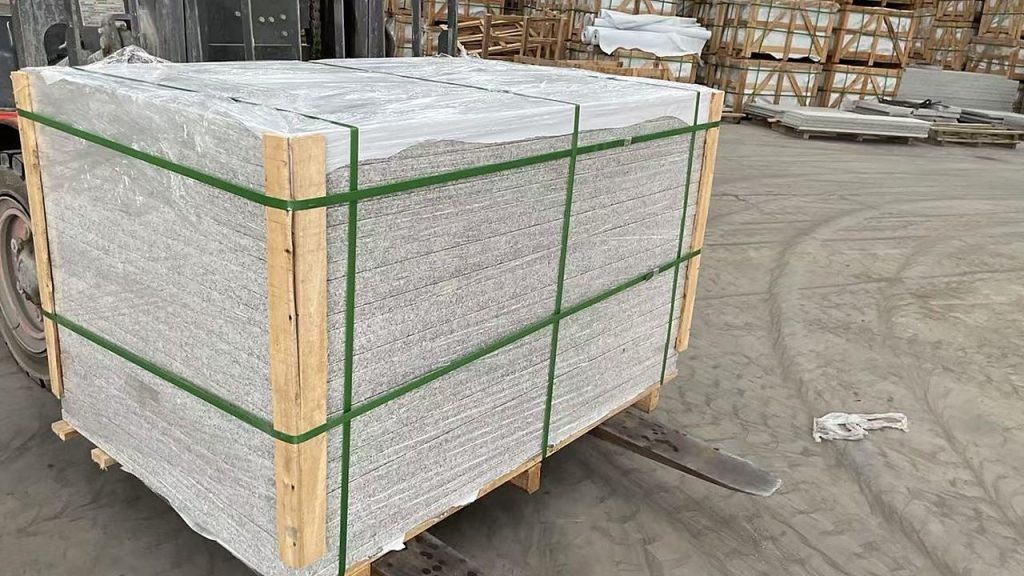
Somewhere in the middle of a project an email arrives asking for one more piece, or for a run of pieces to come out narrower. Sometimes the answer is yes and it costs almost nothing. Sometimes the answer is that this is now a new piece at a new price, and the buyer reads that as an obstacle placed in the way on purpose. It almost never is.
What decides the answer is not goodwill. It is where the order happens to be standing at the moment the email is opened. A stone order is not a document that waits; it is a sequence of physical states, and each state closes a door behind it. Knowing which door is still open is worth more than any discount negotiated at the start, because the cost of a change is decided by timing rather than by size.
Two requests hide inside the word change, and they behave nothing alike. Asking for more of something already specified is a question about capacity. Asking for something different is a question about material, and material that has already been worked cannot be talked back into a different shape. The first request is usually met generously. The second is usually a new order wearing the clothes of a small favour.
An order moves forward; it does not sit still
Most buyers carry a picture of an order as a sheet of paper in somebody’s in-tray, waiting to become goods. The picture is wrong in a way that causes trouble later. By the time a deposit clears, the order is a route: block selection, then the saw, then finishing, then numbering and dry-lay, then crating, then the container. It moves through those stations in that order and it does not go back.
Each station is cheap to pass and expensive to re-enter. That asymmetry is the whole subject. Asking whether something can be changed, without asking where it is now, produces an answer that is either pessimistic or false, and both damage trust.
The useful habit is to ask for the state of the order at the same time as the change. A supplier who can say that the crates were banded on Thursday is giving a much more useful reply than one who says they will try.
The programme is drawn for exactly this reason: not to explain why an answer is slow, but to make visible which station an order is standing in on any given day. A schedule that shows only the delivery date tells the buyer nothing about whether today is a good day to ask. The one set out in where the weeks in an order actually go is deliberately arranged by station rather than by date, so that a question about a change can be answered by pointing at a place on it.
The block is chosen once
Granite is bought in runs, and the run comes from a block. Once a block is chosen and cut, the pieces in the order carry that block’s particular arrangement of grain and tone. Swap in a different block halfway through and the delivery stops being one material and becomes two, which is a much larger problem than the one the change was meant to solve.
So the first door is the cheapest and the least free. Changing here does not usually cost material, because nothing has been cut. It costs time, because a new block has to be selected, and it resets the sequence: the reference sample changes, the dry-lay has to be made again, and the schedule restarts at the saw rather than at the email. The note on reading a granite slab explains what is being chosen at this point, and how much of it can still be influenced.
This is also the stage where a spare allowance belongs. Deciding later that a few extra pieces would have been wise is the most common version of a change that arrives one door too late, and the note on spare stone in the first order deals with how many to hold and why.
A block is not infinite either. A large order can exhaust the one it started on, and the last pieces then come from a block quarried beside it. That is ordinary practice and usually invisible in the finished work, but it means a late addition is not simply a matter of returning to the same pile. Somebody has to look at what is left, and the honest answer is sometimes that the only material still available reads slightly differently from what has already been cut.
After the saw, a dimension is a new piece
Cutting is subtraction. There is no operation that puts material back. So a request to make something narrower, shorter or slightly different in shape is not an adjustment to an existing item; it is a request for a different item, plus a decision about what happens to the one already cut.
Occasionally the answer is lucky. A piece asked to be smaller can sometimes be re-cut from the piece that exists, if enough is left and if the finish can be re-established on the new edge. That is a workshop judgement made with the piece in front of somebody, not a policy. More often the piece becomes a smaller piece nobody ordered, and the order needs a replacement cut from the same block, which by now is a block with a history.
Finishing adds a second complication. A freshly cut edge arrives raw and has to be brought back to the same surface as the face, by hand, on a piece whose neighbours were finished weeks earlier. Matching a polish to a batch that has already left the line is possible. It is also the kind of work that is noticed only when it has gone badly, which makes it expensive to get wrong and difficult to argue about.
The same logic runs through quantity. What has been cut cannot return to being uncut, which is why a reduction and an addition behave so differently even when they involve the same number of pieces. The piece count on a crate is a record of what has already happened rather than a forecast. How those counts are built up, and why an area measurement is not a quantity of stone, is set out in the note on how a stone quantity is counted.
Numbering is where the layout becomes irreversible
Numbering looks like labelling. It is not. When a set of pieces is numbered, each piece stops being interchangeable and becomes the only piece that fits its position. From that point the set is correct or incorrect as a whole, and a single substitution changes the meaning of every number around it.
This is why the dry-lay matters so much, and why it is the last moment at which a layout problem is cheap. Standing over the pieces laid out on the floor, somebody can still say that the vein should run the other way. After the numbers are marked, that sentence becomes a re-numbering exercise, and after crating it becomes a re-make.
The numbering is only as good as the drawing it was built from, and that relationship is covered in the number on the crate. What belongs here is the consequence: a change to the layout after numbering is not a change to one piece. It is a change to the system that told everyone where every piece goes.
There is a second cost hidden in that, and it is clerical. Every document downstream of the numbers carries them: the crate list, the site plan, the installer’s set-out drawing, sometimes a photograph taken at the dry-lay and pinned to a wall in the site office. Altering a number means altering all of them, and the one that gets forgotten is always the one the fitter happens to be holding.
The crate is a decision about grouping
Crating is usually imagined as the packing that happens at the end. It is better understood as a decision about which pieces travel together. A crate is built around a set: the timber frame is sized to it, the foam is cut for it, the bands are tensioned around it, and the packing list describes exactly that set and nothing else.
So adding one piece to a closed crate is not a matter of putting it on top. The crate has to be opened, the set re-arranged, the frame adjusted if the shape has changed, the bands re-tensioned, the list rewritten and the load re-checked. None of those steps is expensive on its own. Together they are a day of handling and a fresh opportunity to damage something that was already correct.
It is also the point where a mistake becomes durable. A crate that has been photographed, banded and marked is a record, and a record is harder to argue with than a memory. The packing and loading sequence, and what a banded crate is later supposed to prove, is set out separately in how a stone order ships.
The container is the last point where anything can be added
Loading is a plan about volume and weight before it is anything else. The crates are arranged so that the load is stable, so that nothing heavy sits on something fragile, and so that the whole thing fits within what the vehicle will legally carry. Every addition has to be absorbed by that plan.
Up to the moment the doors close, an addition is usually still possible and sometimes nearly free, because there is a gap in the stow and a little margin in hand. After the doors close and the seal goes on, the same addition becomes a second shipment, with its own freight, its own documentation and its own arrival date. That is the cliff. Nothing about the stone changed across it; only the number of journeys did.
This is why the answer to a request for a few extra pieces flips so sharply, and why it is worth asking while the container is still being loaded rather than a week after it has sailed.
The date that matters is not really ours. It belongs to the forwarder, who has a cut-off for documents that sits before the vessel loads, and to the port, which does not negotiate at all. An order finished in the yard on Monday can still miss a Friday sailing because a packing list was corrected on Thursday. The container is therefore not one deadline but a stack of them, each owned by somebody outside the conversation.
Adding is cheaper than everyone expects
The counter-intuitive half of this subject is that an addition is usually the cheap kind of change. A piece added while the block is still open rides the same selection, the same saw, the same finishing run and the same crate. The marginal cost is the piece. There is no second set-up, no second journey and no second set of documents.
That is worth saying plainly, because buyers often assume the opposite and hold back a request that would have been easy, then raise it later as something urgent. An addition declared early is a line on an order. The same addition declared late is an exception, and exceptions are handled by people rather than by process, which is where the cost lives.
The limit is that an addition still needs the same discipline as the original: a drawing, a position and a number. An extra piece described in a sentence is not an addition, it is a hope. How an order becomes a drawing that can be cut at all is the subject of cutting to your drawing.
Where inside the window the request lands matters less than people expect. A change arriving before the saw is close to free. The same change arriving two days after the saw is a conversation about waste. The distance between those two answers is not measured in weeks; it is measured by whether the piece is still part of a block or has become an object in its own right.
Taking away is dearer than anyone expects
Reducing a quantity feels as though it should behave like a discount. In a warehouse of interchangeable goods it would. In stone it usually does not, because the work has already been done on the pieces being removed. The material was chosen, cut, finished and packed for a job that is now not happening.
There is a second reason, and it is the one that causes the argument. Removing a piece can leave a set that no longer closes: a run that was continuous now has a gap where a numbered piece should be, or a layout that depended on a particular count no longer works. The buyer sees fewer goods and expects a smaller invoice. The factory sees the same labour and a set that has to be thought through again. Both are describing the truth from where they stand.
Partial cancellation is therefore worth handling explicitly rather than by inference. What is being removed, whether the remaining pieces still form a workable set, and what happens to the piece already made — those three questions asked in advance turn a dispute into a decision.
Who may approve, and on what
A change is not real because it was agreed. It is real when it appears on a drawing that carries a revision mark and comes back signed by somebody with the authority to commit the project. Everything else is a conversation, and conversations are where two versions of the same order begin to exist.
The failure mode is familiar. An instruction is given verbally to a fitter, passed to a project manager, mentioned on a call, and by the time it reaches the factory it has acquired details nobody agreed. The stone is then cut to a description that exists in three slightly different forms. When the pieces do not fit, the discussion is about who said what rather than about the material.
Two habits prevent it. Keep one revision number per drawing, because the file name is the only version control most projects actually have. And name the person who may approve, in writing, before the first change is needed — asking who is authorised in the middle of a dispute is too late to be useful. How a drawing becomes a comparable price is covered in three quotes, one drawing, and how the work divides between supplier and installer is covered in the half of the job that is not in the quote. Both matter here, because a change made on one side of that boundary frequently lands on the other.
When a change is refused, the refusal is more useful if it arrives with the alternatives. There are usually three: accept the order as it stands and live with the difference; hold the change for a second shipment and pay the freight; or take the piece from the spare crate, if a spare of that size happened to be made. A supplier who names those three has not said no. A supplier who says only that it is too late has told the buyer nothing they can act on.
What to agree while the order is still a drawing
None of this has to be negotiated in a hurry later. A short list of questions, asked once, removes most of the difficulty.
When does a change stop being free, and in which state of the order does that happen? A date is more useful than a policy, because a date can go into a programme.
Which pieces are cut from the same block, and can extras come from what is left of it? That decides whether a late addition is possible at all.
What spare allowance is being held, and who owns the spares afterwards? The honest answer is a number agreed in advance rather than a favour granted later.
Who signs a revision, by name and by role? One person, in writing, before anybody needs them.
If something has to be added after the container has gone, what does a second shipment cost? Knowing the figure in advance changes how carefully the first list is written.
With those five answered, the awkward email in the middle of a project becomes an administrative step rather than an argument. Send the drawing and the programme through the enquiry form, and the reply can name the last useful date for a change instead of leaving it to be discovered.
Every figure on this page comes from our own order sheets. Where something is a trade norm rather than a number we can hold, we say so — send a spec and we will confirm it against a real block before you commit.
More from the yard


Send the drawing. We do the rest.
Reply within one working day, in English or Chinese. Send a spec, a drawing or just a photo of the sample you are matching — we will tell you honestly whether we can hold it.
MOQ 1 × 20FT · FOB XIAMEN · SAMPLES IN 7 DAYS