When a spec says or equal, ask equal to what
A specification says or equal and nobody asks equal in what. Why the phrase works for manufactured parts, and what to write instead for natural stone.
14 November 2026 · 18 min read · GranTerra Stone, Hui'an
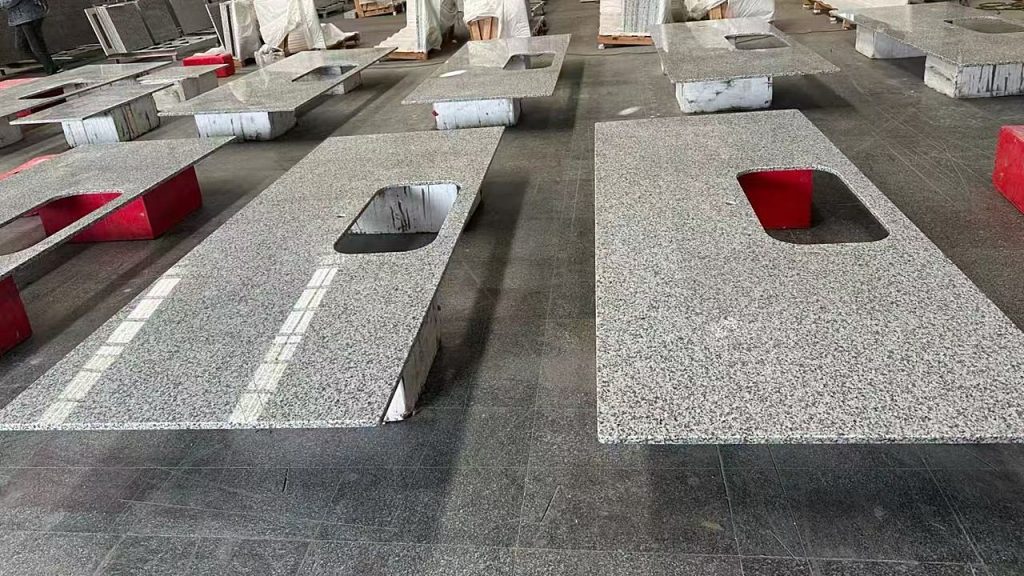
Somewhere in almost every tender document there is a line that reads like this: a granite, named by its trade colour, followed by two small words, or equal. It is one of the least examined lines in the whole specification. The person who copied it has written it a hundred times. The person pricing it has read it a hundred times. Nobody stops, because it looks like a routine piece of purchasing hygiene, the sort of phrase that keeps a specification from being tied to one supplier.
And for most of the things in that document, it works. Specify a pump, a door closer or a light fitting and add or equal, and several manufacturers can bid against the same written description. Swap the supplier and the drawings still work, the fixings still line up, the maintenance schedule still applies. The phrase was built for products that repeat.
Granite does not repeat. When the same two words are pasted into the stone section, they arrive with a word missing: equal in what. A stone that performs the same way underfoot and a stone that looks the same in a finished lobby are not necessarily the same stone, and on a natural material the two answers can point in opposite directions. Most of the arguments that follow are not arguments about price. They are arguments about which question the line was supposed to ask.
A clause written for things that repeat
The logic behind or equal is sound and worth keeping. Naming a single proprietary product in a public or commercial tender can lock out competition before anyone has priced anything. Adding an escape clause lets the buyer receive comparable bids, and it puts a little pressure on the named product’s price. In a document full of manufactured items, this is simply good practice, and the people who write specifications are right to use it.
What travels with the phrase is a set of assumptions so ordinary that nobody writes them down. The item can be described completely by its parameters. One unit is interchangeable with another. Replacing it does not change anything around it. A person checking the substitution can compare two data sheets and reach a defensible answer without seeing the building. All of that holds for a hinge. Almost none of it holds for a rock that was lifted from a particular face of a quarry.
The material behind a stone specification is not a product code. It is a finite group of blocks, chosen together because they read alike, cut in an order that keeps neighbouring pieces neighbouring. Its appearance is a property of that group rather than of the name on the drawing. Change the group and you have not changed the supplier; you have changed the visual reference the whole design was approved against. The drawing is untouched, the fixing detail is untouched, and the thing everyone will actually look at is different.
Nobody intends this. Stone sections are usually assembled from a template written for another package, and the phrase survives because it is harmless everywhere else in the file. By the time it reaches a fabricator, it reads as an open permission that no one has defined the limits of. That is the moment to ask a question that the document never answers.
The word equal has no object
Equal is not a complete idea. It is a comparison waiting for a property: equal in strength, equal in slip behaviour, equal in thickness, equal in the way it takes a finish, equal in the way it looks beside the next piece. Manufactured goods tend to satisfy most of those at once, because the same process produces the same result. A buyer can leave the property unnamed and still be understood, which is exactly why the phrase gets away with being vague for so long.
Stone splits the list in two. On one side are the things a workshop can describe and hold: the material family, the way the face is worked, the edge treatment, the dimensional approach, how the pieces are packed and in what order they arrive. These can be written down, checked and repeated. On the other side are colour depth, the direction and density of the movement in the stone, how the crystal catches light, and how one piece sits next to the piece beside it. Those have no parameters. They have only a physical example that somebody agrees to.
The two sides do not move together. Two granites can behave almost identically in service and look nothing alike when laid in the same field. Two that look close on a small sample can ask for different care in a wet area. A clause that does not say which side it is talking about therefore means whatever the person invoking it happens to care about that morning, and the person on the other end of the conversation is usually caring about the other one.
This is worth stating plainly because it changes the nature of the dispute. When a substitution is rejected, it is rarely a supplier being difficult about a cheaper alternative. More often, one party has approved the performance side and the other is objecting on the appearance side, and each of them is right about a different thing. The document gave them no shared word for which side they were on.
What can be matched, and what can only be chosen
It helps to sort the specification into two columns, even if nobody ever prints it that way. The first column contains everything that can be matched by another material without changing the building: the family of stone, the thickness and the tolerance approach that the fixings were designed around, the surface treatment, the edge profile, the way the pieces are numbered and grouped, the protection they travel in. A competent fabricator can put a different material into that column and still produce a set of pieces that fits the same detail. Where each surface treatment belongs is a useful starting point, because a finish is a process with consequences rather than a word on a schedule.
The second column contains everything that has to be chosen rather than matched. Colour depth. The scale and direction of the veining. How busy or quiet the field reads from a few steps back. Whether adjacent pieces sit quietly together or announce their joins. There is no datasheet for these, and no argument that will settle them. There is only a sample in someone’s hands, under a light someone has agreed on, and a decision. How to tell which rock a name actually describes can narrow the first column; it cannot decide the second.
The distinction between matching and choosing is the whole issue. Matching is a claim that can be checked by a third party. Choosing is one person’s acceptance of an object, given freely and on a particular day. Specifications routinely use the language of the first to authorise a change in the second. That is how a line intended to open up competition ends up producing an argument nobody can close, because there is no test that will tell two people which of them is right about a colour.
None of this means a substitution should be refused. It means the two columns need different treatment. The first can be opened to alternatives. The second needs a named physical reference and a named person who is allowed to accept a change to it.
The sample stops being evidence the moment the material changes
A sample panel or a set of approved blocks is not a picture of a colour. It is a piece of the actual material, cut and finished the way the job will be cut and finished, and its value comes entirely from that physical link. It says: this is what comes out of the group we have selected for your order. That is why it is worth insisting on, and why it is stronger than any photograph or printed chart.
Accept an alternative material and the link is broken. The sample is still a real object, still signed and dated and still sitting in somebody’s office, but it no longer describes the stone being made. It has quietly become a record of a decision about a different group of blocks. Most projects do not notice this at the moment of substitution, because the two materials share a name and the sample still looks plausible in isolation. The problem arrives at delivery, when the approved panel is produced as the reference for goods that were never cut from it.
At that point neither side has a common baseline. The buyer is holding evidence; the fabricator is holding an instruction to use something else; and the only honest answer is that the approval lapsed when the material changed. The four things a sample panel settles are all tied to the material in front of the person signing, not to the name typed beside it. If the material moves, the approval has to move with it.
There are two clean ways to handle this, and both are cheaper than an argument. Either a substitution triggers a fresh sample and a fresh sign-off, or the specification states explicitly that the approved panel illustrates a range and will not be used as an acceptance reference. The second is a legitimate choice, but it should be made consciously: it means giving up the appearance claim, not keeping it by another name. What does not work is keeping the old sample and quietly assuming it still applies. What a batch commits a supplier to is worth reading before that assumption is made.
Four people read the word differently
Ask four people on the same project what or equal means and you will get four reasonable answers. The designer means equal in appearance, judged in the light the finished space will have. The quantity surveyor or purchasing officer means equal enough for the bids to sit side by side, with a defensible reason for choosing one. The main contractor means equal in programme: the same fixing, the same sequence, the same delivery window, nothing that makes another trade come back. The client or the facilities team means equal in use: it will clean the same way, wear the same way, and be replaceable in five years without a visible patch.
Each of those readings is correct for the job that person does. The difficulty is that a substitution is normally approved by one of them, using their own measure, and the approval is then treated as if it settled the others. A change signed off on price and programme can still fail on appearance. A change the designer accepted under office lighting can still fail on cleaning. Nobody has been careless; the clause simply never said whose measure governed.
This is also why the phrase tends to survive until something goes wrong. Everyone has quietly substituted their own definition and assumed the others shared it. The document looks agreed. It is not agreed, it is unexamined. A single line naming who decides, and on what basis, does more for a stone package than another paragraph of description would.
Light deserves a particular mention, because it is the condition most often missing when two materials are declared to look alike. What the same surface does under two different lights is not a curiosity about interiors; it is a warning about where comparisons are made. Two samples that read as equal under a workshop lamp can separate completely under raking daylight across a large floor.
When the swap is suggested decides what it costs
The same substitution is a different event depending on the week it is proposed. At enquiry stage it costs almost nothing. A different material can be priced alongside the named one, the drawings have not been fixed, no blocks have been selected, and no dates have been reserved. This is the point at which or equal does exactly what its author intended: it produces comparable bids and leaves the choice open.
Once a sample has been approved, the change carries the cost of doing that work again. A new panel, a new physical reference, a new sign-off, and a fresh conversation about what the range of variation will be. It is still entirely manageable, and it is still worth doing if the alternative is better for the project, but it is no longer a line edited in a document. It is a decision with a visible consequence.
After the material has been selected and the run has been set out, a substitution is not a purchase change at all. The pieces have been laid out against the blocks that were chosen, numbered in the order they will be installed, and grouped into crates so that what is needed first is not at the back. Put a different stone into that sequence and every one of those decisions has to be taken again. The moment a set of pieces becomes irreversible is not marked by a form; it is marked by the saw, and it arrives earlier than most programmes allow for.
After delivery there is no longer a substitution to discuss. What remains is a repair, a replacement piece, or a decision to live with the difference, and all three are more expensive than the question would have been at the start. Why a spare has to be cut with the main batch is the same lesson told from the other end: the options are widest before anything is cut and narrow sharply afterwards.
Where the difference shows up first
An alternative material rarely fails on the first piece, looked at on its own. Single pieces are forgiving. Put one panel on a bench under even light, and two granites from different sources can both look entirely acceptable. The word equal feels reasonable in that moment, which is precisely why so many substitutions are approved under conditions that will never exist on the building.
The difference shows up in relationships. It appears where two pieces meet, where a run crosses a large floor and the eye can compare twenty panels at once, where the same stone turns a corner and the movement changes direction, where a wet area meets a dry one, and where a low light grazes across a polished face. None of those are properties of a sample. They are properties of a field, and a field is what gets installed.
This is why the most useful comparison is not one sample against one photograph. It is several pieces of each option placed side by side, in the orientation they will have, under the kind of light the space will have, with the joint spacing that the setting-out calls for. It takes a little longer to arrange and it settles the question in a way no datasheet can. What a joint between two materials has to absorb is relevant here too, because a change of stone can quietly change how the neighbouring detail reads, even when every dimension on the drawing stays where it was.
There is a practical consequence for anyone writing a specification. If the appearance is going to be judged as a field, the reference has to be a field. A single small sample can approve a material family; it cannot approve how a whole lobby will look. Saying so in the document is more honest than discovering it when the crates are open.
A better way to write the line
The answer is not to ban substitutions. Buyers should be able to receive competitive bids, and projects do change. The answer is to split the one line into three, so that each part can be changed only by the person who owns it.
The first line carries the material and the work: family, thickness and tolerance approach, surface treatment, edge profile, and the fixing or laying assumptions behind them. This is the line that can carry or equal, because the items on it can genuinely be compared. The second line carries the appearance reference: a specific physical sample or approved panel, identified well enough that nobody has to guess which one is meant, and a statement of whether it is an acceptance reference or simply an illustration of a range. The third line says who may accept a change to the second, and against what they will compare it.
Written that way, the clause still does its commercial job. Several suppliers can price the first line. But a change to the second line is no longer an invisible administrative edit; it is a decision with a named owner and a physical test. The fabricator receives something executable rather than an open permission, and the designer keeps the thing they actually cared about. The materials and colour page is a reasonable place to start when naming what has to be held, because it describes the range without pretending that a name fixes it.
This also makes the paperwork less dramatic. Nobody has to argue later about whether two stones are equal. They only have to ask whether the named reference was changed, and if so, whether the person allowed to change it did so. That is a question with an answer.
Three questions when the phrase comes back to you
When a message arrives saying that an equivalent has been found, three questions will settle it before any prices are discussed. Which of the two things has to be equal: the way it performs and is worked, or the way it looks in the finished space? Who is allowed to decide that, and under what conditions will they look? And what physical object will they compare against: which sample, which approved panel, which group of blocks, which revision of the drawing?
If all three have clear answers, the substitution can proceed and be documented in a few lines. If one of them is missing, the phrase should not stay in the specification, because the missing answer will simply be supplied later by whoever is most inconvenienced at the time. That is how a purchasing clause becomes a dispute about a colour, several months after anyone remembers writing it.
There is a simpler route when the three answers are hard to obtain: name the stone, attach the sample as a numbered reference, and say that changes to it require a new approval. It is less flexible, and on a project where the appearance genuinely matters it is usually cheaper. Flexibility is only valuable when someone knows what is being flexed.
Nor does any of this require a view on which material is better. An alternative may well be the right choice for the budget, the programme or the way the space will be used. It just needs to be made as a choice, with the property and the owner named, rather than as a quiet exercise of two small words.
Naming the stone is cheaper than approving a substitute
From this side, the position is straightforward. We can price the stone that is named, supply physical samples from the group we would actually cut, describe plainly how two options differ in working and in care, and write the appearance reference into the order so that it survives the months between approval and delivery. We can also price an alternative alongside it, at enquiry stage, while both are still just possibilities.
What we cannot usefully do is declare two natural stones equal on someone else’s behalf. One of those declarations is about a set of properties and can be checked. The other is about how a finished room will look to the person who has to live with it, and that judgment belongs to them. A supplier who answers it confidently is usually answering only the easy half of the question. A short note to us with the three lines described above is enough to start; there is no need for a rewritten specification.
The strange thing about or equal is that it was added to save time. Written loosely on a natural material, it tends to consume far more of it, later, in meetings where nobody can quite remember what was agreed. A named stone, a numbered sample and a named decision-maker take up one line of a document and remove the need for those meetings entirely.
Name the stone, name the sample, name who decides. That is the whole clause, and it fits on one line.
Every figure on this page comes from our own order sheets. Where something is a trade norm rather than a number we can hold, we say so — send a spec and we will confirm it against a real block before you commit.
More from the yard


Send the drawing. We do the rest.
Reply within one working day, in English or Chinese. Send a spec, a drawing or just a photo of the sample you are matching — we will tell you honestly whether we can hold it.
MOQ 1 × 20FT · FOB XIAMEN · SAMPLES IN 7 DAYS