Clinics wear stone out with wipes, not with shoes
Clinics clean far harder than they walk. What repeated wiping does to stone, why a matt surface ages better, and the details an inspection looks for.
17 November 2026 · 23 min read · GranTerra Stone, Hui'an
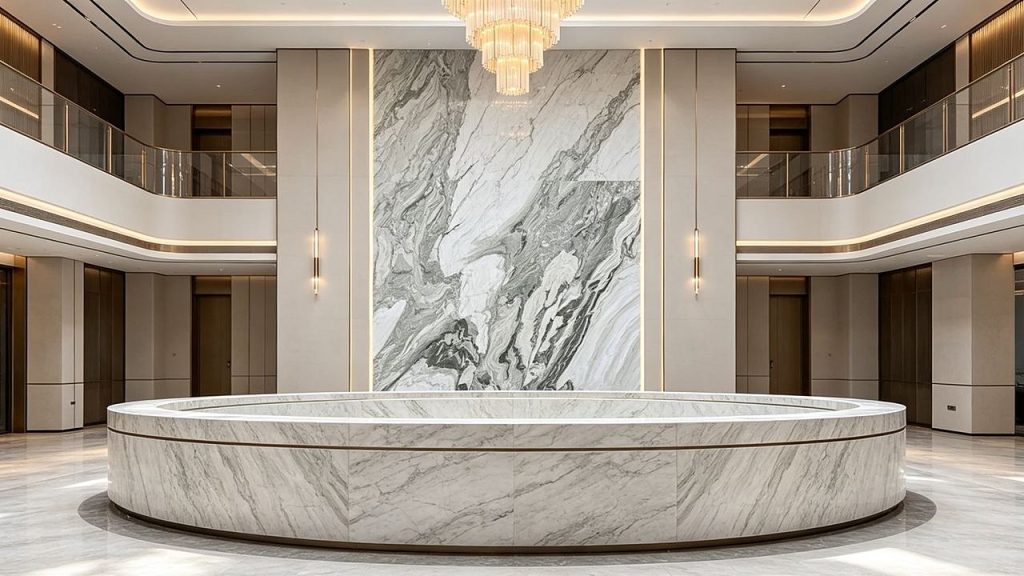
A clinic floor is judged in a way that no house floor ever is. Somebody walks the corridor with a clipboard, stops, and looks at the skirting line. Not at the stone. At the line where the stone meets the wall, because that is where a complaint starts. The surface they are inspecting may be perfectly sound, structurally intact, and carrying no more than it carried on the day it was laid. It will still be written up, because it has begun to look as though it is not clean.
That single fact reorganises everything about choosing stone for a medical building. The material is not being asked to be hygienic in a laboratory sense. It is being asked to keep looking hygienic under an inspection that happens every morning, in a building where the cleaning is done by a contractor on a schedule, with products chosen by somebody who has never seen a stone sample. Everything that follows sits inside that gap: between what the stone actually is and what a person with a clipboard can see from standing height.
The short version, and the one worth carrying into a specification meeting, is that a clinic does not wear stone out with feet. It wears it out with cloths. The traffic in a consulting room is nothing compared to the traffic in a shopping centre, and the stone in the shopping centre will still look newer at ten years. What the clinic has that the shopping centre does not is a cleaning regime with a written frequency, a named chemical, and an inspection that grades the result.
The surface is judged by eye, and the eye is not measuring microbes
It is worth being precise about what an inspection actually checks, because the answer is not what most suppliers assume. A cleaning audit in a healthcare building looks at visible soil, at the state of edges and corners, at whether surfaces are intact enough to be cleaned, and at whether the person doing the cleaning can reach everywhere they are supposed to reach. It is a visual and a procedural test. It is not a swab test, and the people running it know that a visibly spotless surface and a microbiologically clean one are two different claims.
This is good news for stone and bad news for stone, in the same sentence. Good, because granite and marble are as cleanable as any hard surface when the finish is right and the geometry allows a cloth to pass over them without leaving a line behind. Bad, because the same materials age in a way that reads, on a pale floor under bright light, as dirt. A polished surface that has lost its polish does not look worn. It looks unwashed. There is no visual language in a corridor for the difference between a surface that is soiled and a surface whose micro-texture has been opened up by five years of wiping, and a person with a clipboard has no reason to make that distinction on your behalf.
So the honest question at specification stage is not whether the stone can be kept clean. It is whether the stone can keep looking clean, for as long as the building is open, under a cleaning regime that will be written by somebody else.
Stone does not need to be antibacterial to belong in the room
This is the point where a supplier is tempted to say something it cannot support, and it is worth saying plainly what we will and will not put in writing. We do not claim that any stone we sell is antibacterial, antimicrobial, or infection-control rated, and we will not describe a surface as actively doing anything to organisms that land on it. Claims of that kind are regulated in most of the markets we ship to, they require test evidence against a defined method, and a stone yard in Fujian is not the party that should be issuing them. If a project needs that statement, it needs to come from a materials testing house, against the standard the client’s own authority recognises, and it will not come from a quotation.
What can be said without any of that machinery is more useful anyway. A polished or honed stone surface is non-porous enough to be wiped, hard enough not to be scored by a cloth, and flat enough that nothing sits in a texture. Those three properties are what a cleaning regime actually needs from a surface. Where organisms persist in a healthcare building, the evidence and the operational experience both point at the things around the surface rather than the surface itself: hands, equipment, the inside of a drain, a joint that has begun to open, the back of a fitting that nobody moves. A stone floor does not fail that list. A badly detailed one contributes to it, at the joint and at the corner, which is where the rest of this article spends its time.
If a client arrives with a specification that already carries an antimicrobial wording, the right move is not to argue about the science. It is to ask which element of the build-up the wording was written for. Nine times out of ten it was written for a vinyl or a resin floor, it was carried into the stone package by a copy and paste, and the client has never been told that the phrase has no defined meaning for a natural stone. Usually they would rather have the sentence removed than carry a claim they cannot defend at handover.
The cleaning schedule was written before anyone chose a stone
In a hospital or a clinic, cleaning is not a domestic habit scaled up. It is a procedure with an owner. Somebody in infection prevention writes down how often each area is cleaned, which product is used, at what dilution, and how long the product has to stay wet on the surface before it is allowed to dry. That last item is the one that matters most for stone and the one least understood outside the industry: a disinfectant is not effective the moment it touches. It has to remain in contact for a period, which means the liquid is deliberately left sitting on the stone rather than being wiped away immediately.
Put that beside a domestic kitchen, where a cleaner is sprayed on and taken off within seconds, and the difference in exposure is not a matter of degree. It is a different kind of event. The stone in a clinic is wet, with an active chemical, on a schedule, several times a day, for the life of the building. The chemical may change when the contract changes or when a supplier is swapped for cost, and nobody will think to mention it to the party who supplied the floor.
That is the structural problem, and it is not solved by choosing a better stone. It is solved by two things a supplier can actually do. The first is to ask for the cleaning products before the material is fixed, not after, and to say plainly what each one does to the candidate materials. The second is to accept that the regime will change and to choose a material that survives a change of regime rather than one that is optimal for today’s product. A dense granite tolerates a wider range of chemistry than a polished marble does, and the gap between them is much wider than the gap in price.
For the chemistry itself, what each family of cleaner does to which stone, there is a separate piece on what a cleaner does to a surface once the building is open, and it is the right place to start if the products are already known. What matters here is the timing of the question, and the answer is that it belongs in the enquiry, not in the operations manual.
What repeats does more than what is strong
A common mistake is to think about the strength of a cleaning product and not its frequency. A mild product applied twice a day for a decade is a larger force than a harsh one used twice a year, and clinics run on frequency. Three passes a day in a busy corridor is not unusual, and each pass includes a mechanical component as well as a chemical one.
The mechanical component deserves more respect than it gets. A flat mop with a microfibre pad is not a soft object. The fibres are designed to lift and trap particles, which means they are abrasive by design, and if grit is picked up and carried in the pad rather than rinsed out, the pad becomes a fine grinding sheet moving across the floor in a regular pattern. This is why clinic floors often show wear in long parallel bands rather than as an even dulling, and why the bands follow the route the cleaner walks rather than the route the patients walk. Nobody has done anything wrong. A cloth used several hundred times a year on the same surface is a wear process, and it will produce a visible result.
There is a second repeat that is easy to miss: the drying. Water left on a stone surface evaporates and leaves whatever was dissolved in it, and a disinfectant solution leaves more than water does. Over years, in the same places, that deposit builds into a haze. It is not etched into the stone and it can be removed, but it is the layer that makes an otherwise sound floor look tired, and it appears fastest where the floor is least disturbed.
The first thing to go is the shine, and the shine is what people read
A polished stone surface returns light because it is flat at a scale smaller than a wavelength of visible light. Polish is not a coating. Nothing has been applied that can wear off. The surface itself has been brought to a level of smoothness at which reflections are coherent, and the gloss you see is the room reflected back at you.
Repeated wiping raises the micro-roughness of that surface. Not visibly, not in a way you could measure with a fingernail, but enough that the reflection stops being coherent and starts being scattered. What happens next is a slow loss of depth rather than a change of colour. The stone is the same colour it was. It simply stops holding the room, and a floor that no longer reflects the windows above it reads as a floor that has gone grey.
This is the mechanism behind the most common complaint in healthcare fit-outs, and it explains why the complaint arrives at year three or four rather than year one. It also explains why the same stone in the same building can be praised in the entrance and criticised in a corridor: the corridor has the passes, the entrance has the matting and the polish. The visual effect of gloss, and why it changes with the light and the hour, is a subject in its own right and is covered elsewhere; here the point is narrower. Gloss is a measurable surface property that a cleaning programme removes, and once it is gone the material has lost the cue that made it read as new.
Pale floors turn grey and dark floors show every splash
The instinct in a clinic is to go pale, because pale reads as clean. That instinct is half right and it leads to the most common regret. A pale, uniform stone is the least forgiving surface in the catalogue. Every loss of gloss is visible against the brightness, every splash dries to a faint ring, and a single slightly darker slab in a run will be spotted from the far end of the corridor by a person who has walked that corridor every day for a year.
Dark stone solves the grey problem and creates a different one. Water marks show. Disinfectant droplets show. Dust shows within a day, and the mop that leaves a thin film shows as a pattern of streaks. Dark polished granite is spectacular on the day it is laid and demanding from the first week.
The variable that actually decides how a clinic floor ages is not the colour. It is the visual texture. A stone with a real pattern, with movement, with light and dark grains distributed through it, hides the small changes that a uniform surface amplifies. That is why a speckled granite in a mid tone outlasts a clean ivory marble in appearance, even though the marble is the more expensive specification and the one a designer will prefer on a sample board. The colours we hold are worth looking at in a photograph and then again in a corridor, because the second viewing is the one that matters.
The finish matters as much, and here there is an argument that is rarely made. A matt or brushed surface has no gloss to lose. Its appearance changes gradually and continuously because there was never a step change available to it. A polished floor is stable for a period and then appears to fall off a cliff, and the cliff arrives in the middle of an operating year. On a floor that will be judged every morning by eye, the surface that fails slowly is worth more than the surface that starts higher.
A joint is where a cleanable floor stops being cleanable
Ask a facilities manager what they dislike about a stone floor and the answer is rarely the stone. It is the joints. In a clinic, a dark line running along a joint is not read as a design feature. It is read as the floor going. And it does not matter that the line is the joint material rather than the stone, because from standing height nobody can tell the difference.
The mechanism is not mysterious. A cementitious joint is a porous material sitting between two non-porous ones, and it is the one part of the floor that absorbs. Repeated wet cleaning pushes solution into it, the binder in it ages faster under chlorine than the stone does, and the pigment, if there is pigment, is the first thing to go. The result is a joint that goes pale and then goes dark, in that order, and no amount of scrubbing brings it back because it is not soil on the surface. It is the joint material itself, changed.
The alternative is a joint that is as tight as the geometry allows and filled with something that behaves more like the stone. That is a decision with consequences elsewhere, because a floor needs somewhere to move, and a joint detailed to be invisible has to have its movement designed into it in some other way. Where two materials meet, and where a floor meets a wall, the movement and the sealant have to be thought through together or the tight joint will simply crack. This is the subject of a longer piece on where two materials are asked to end against each other, and the reason it matters here is that the clinic wants two things that pull in opposite directions: no visible line, and a floor that does not crack. The resolution is never to close the joint. It is to put the line somewhere the eye is not drawn, or to make it dark and continuous so it reads as a deliberate edge.
What we would not do is fill a clinic floor with a wide light-coloured joint and then describe it as easy to maintain. It is easy to lay. It is not easy to keep.
The corner nobody wipes twice
Cleaning is a path, not a force. A person with a flat mop moves along a wall in one direction and does not come back for a second pass unless something catches their eye. Any geometry that requires a return visit accumulates, and the accumulated thing is always in the same place, which is exactly where the inspection looks.
The specific detail is the base of the wall. A skirting that stands proud of the wall creates a shadow line behind it that a mop cannot enter and a vacuum cannot reach without a tool change. A wall panel that lands directly on the floor gives a corner that a cloth can be pushed into in one movement. A coved or gently curved transition removes the corner altogether, and it is not an aesthetic preference in a clinic. It is the difference between a surface that gets cleaned on every pass and one that gets cleaned when somebody is being audited.
The same logic applies at every internal angle in the room: the upstand behind a bench, the return at a door reveal, the recess where a bin stands. Each of these is a place where a straight pass leaves something behind, and each will be read as a failure of the floor rather than a failure of the detail. A stone detail that keeps every surface reachable in a single stroke is worth more in a medical building than a detail that looks more refined on a drawing and needs a second visit with a brush.
A clinical basin is a plumbing argument with a stone apron
Hand-wash basins in clinical rooms are specified by the plumbing and infection-control side, and the stone arrives afterwards to make them look like part of the room. That order of events is where the trouble starts, because two of the decisions taken before the stone was involved are the two the stone has to live with. Under all of it sits the layer that nobody in the room will ever see, and which layer takes the water is decided lower down than the surface.
The first is the overflow. Some clinical basins are specified without one, on the reasoning that an overflow channel is a wetted path that is difficult to clean and impossible to inspect. Whether that is the right call is for the project’s own authority to decide, and we do not argue it. But it changes the stone, because a basin without an overflow has to be set so that the water cannot run back over the rim under normal use, and a stone surround that is level with the rim will show every splash. The apron, the upstand and the tap position have to give the water somewhere to go other than across the top.
The second is the joint between the basin and the stone. If the basin is set into a stone top, the line where the two meet is sealed, and that sealant is the part of the whole assembly that ages fastest in a building that cleans with chlorine. It goes from clear to grey to black, and it does it in a place that a patient can see from the door. The remedy is not a better sealant. It is a shallower rebate and a tighter gap, so there is less material to fail, and a bench detail that does not trap water against the joint. On a basin standing on the top rather than set into it, the same problem becomes visible as a ring at the base, and the answer is a rebate or a chamfer that sheds water off the bench before it reaches the joint. The thickness question underneath all of this, and what the extra depth of a top actually buys at a cut-out, is set out in the work on commercial tops and the way they fail.
Which type of basin survives a room like this is a decision covered in detail in the piece on the three ways to set a stone bowl into a room, and it comes down to the same question as everything here: which version of the detail leaves the fewest places where water can stand. Where the room is wet enough to be a wet room rather than a basin, the drainage side of the same argument applies, and it is worth reading before the floor falls are set.
Trolleys do not break the floor, they draw on it
There is a wear pattern specific to medical buildings that almost never appears in a house or a hotel. A dressing trolley, a drug trolley, a linen cage: they run on small hard wheels, they run on the same route every day, and they turn in the same places. A polished floor under that traffic does not chip. It polishes. The wheels burnish the stone along their path, and the result is a band that is brighter than the floor around it, following a curve that traces every corner the trolley takes.
The band is faint at first and then unmistakable, because the contrast is between two polished surfaces rather than between a polished one and a damaged one. Nothing is broken. The floor is, in the narrowest sense, better finished where the wheels have been. It still looks wrong, because a floor with a route written into it tells everyone who walks in that the building has been in use for a long time.
There is no finish that prevents this and no stone that is immune to it. There is only the choice between a surface where the band will be visible and one where it will not, and that choice is the same one as before: a pattern softens it, a uniform colour sharpens it, and a matt surface shows it as a change of sheen rather than as a bright line. Where the route is known in advance, and in a clinical building it almost always is, the honest thing is to say so at specification stage rather than to promise that it will not happen.
What a clinic order should carry that a house order does not
Most of the work of getting this right happens before anything is cut, and it happens in a handful of items that a residential order would never include.
The finish, written down, not the colour. A clinic’s problem is almost never the wrong colour. It is a polished floor where a matt one was intended, because the sample was approved from a photograph and the order was placed against a colour name. The finish is the decision that governs how the floor ages, and it belongs in the order as a word, in the same line as the material.
The cleaning products, at enquiry stage. If the regime is already written, send it. If it is not, say who owns it and what is likely to be on the list, and we will tell you which of the candidate stones will tolerate the range and which will not. The cost of this question is one email. The cost of discovering it at year three is a floor that has to be replaced in a building that cannot close.
The approval under the right light. A sample approved in a showroom with warm light and seen in a clinic with cold light and high output are two different stones. This is not a subtlety, it is a regular source of dispute, and the fix is to have the sample seen on site or under a lamp of the same type as the one that will be installed.
The spare, in the first shipment. Not because the stone is fragile, but because a clinic repairs in small patches and a patch needs material from the same production as the floor around it. Waiting two years and ordering a replacement is not a repair, it is a visible rectangle. Why the spare has to travel with the first order rather than after it is an argument we have made at length elsewhere, and it is stronger in a medical building than anywhere else.
A cleaning note for the contractor, not the client. At handover, most projects leave the care information with the building owner. In a clinic the person who decides what goes on the floor is the cleaning supervisor, and the supervisor changes more often than the floor does. One page, listing what the surface tolerates and what it does not, handed to the cleaning contractor as well as the client, is worth more than a binder in an office.
One more thing belongs in this list and it is not a specification item at all. A working clinic is usually refurbished in phases, with the building open throughout. That means stone arriving into a site that is being cleaned daily, with protection that has to be moved, and with a finished floor being walked on before the building is finished. What a site does to a new stone surface, and why the last trades in are the ones that mark it, is worth reading as the list of what usually happens to a finished floor before handover, before the programme is fixed rather than after.
Our name goes on the crate, not on the corridor
We cut stone to a drawing, finish it to a named surface, and pack it so it arrives as it left. That is the whole of what we do. We do not provide infection-control certification, we do not design the cleaning regime, we do not install, and we are not the party who signs off the corridor at handover. Finished, accepted and handed over are three separate events, and only the first one is ours.
What we can do is answer the questions that decide whether the stone will still look right in five years: what the finish will do under the products the building actually uses, what the geometry at the wall and the basin will look like with a cloth in it, where the joints will be and how they will age, and which of the stones on our list will tolerate being cleaned several times a day without losing the surface that made it worth choosing.
Those questions have answers, and they are all decided before the first cut. A medical building is the one place where the client is buying an appearance that has to hold under an inspection, year after year, in a room where the cleaner is not the person who chose the stone. Get the finish, the geometry and the joints right and the floor will still pass the clipboard in a decade. Get them wrong and the stone will be blameless, sound, and replaced. The surfaces we cut are listed with what each one looks like after years of cleaning, not only on the day it is new, and a note to the sales desk with the room schedule is enough to start the conversation.
Every figure on this page comes from our own order sheets. Where something is a trade norm rather than a number we can hold, we say so — send a spec and we will confirm it against a real block before you commit.
More from the yard
Send the drawing. We do the rest.
Reply within one working day, in English or Chinese. Send a spec, a drawing or just a photo of the sample you are matching — we will tell you honestly whether we can hold it.
MOQ 1 × 20FT · FOB XIAMEN · SAMPLES IN 7 DAYS